Immunology Program, Memorial Sloan-Kettering Cancer Center, New York, NY 10065, USA; Louis V. Gerstner Jr. Graduate School of Biomedical Sciences, Memorial Sloan-Kettering Cancer Center, New York, NY 10065, USA.
Trends Immunol. 2013 Nov;34(11):531-9. doi: 10.1016/j.it.2013.08.003. Epub 2013 Sep 6.
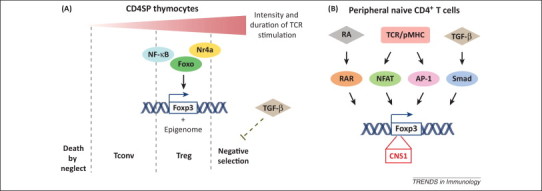
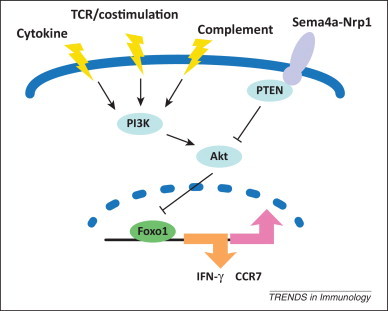
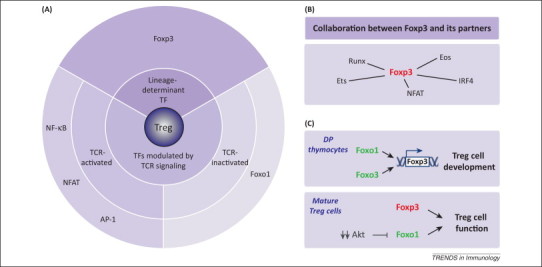
Regulatory T (Treg) cells differentiate from thymocytes or peripheral T cells in response to host and environmental cues, culminating in induction of the transcription factor forkhead box P3 (Foxp3) and the Treg cell-specific epigenome. An intermediate amount of antigen stimulation is required to induce Foxp3 expression by engaging T cell receptor (TCR)-activated [e.g., nuclear factor (NF)-κB] and TCR-inhibited (e.g., Foxo) transcription factors. Furthermore, Treg cell differentiation is associated with attenuated Akt signaling, resulting in enhanced nuclear retention of Foxo1, which is indispensable for Treg cell function. These findings reveal that Treg cell lineage commitment is not only controlled by genetic and epigenetic imprinting, but also modulated by transcriptional programs responding to extracellular signals.
调节性 T(Treg)细胞在宿主和环境线索的作用下从胸腺细胞或外周 T 细胞分化而来,最终诱导转录因子叉头框 P3(Foxp3)和 Treg 细胞特异性表观基因组的形成。需要中等量的抗原刺激来通过激活 T 细胞受体(TCR)-激活(例如,核因子(NF)-κB)和 TCR 抑制(例如,Foxo)转录因子来诱导 Foxp3 表达。此外,Treg 细胞分化与 Akt 信号的减弱有关,导致 Foxo1 的核保留增强,这对于 Treg 细胞功能是必不可少的。这些发现表明,Treg 细胞谱系的决定不仅受到遗传和表观遗传印记的控制,而且还受到对外界信号做出反应的转录程序的调节。