Medical Sciences Research Center, Renji hospital, School of Medicine, Shanghai Jiaotong University, Shanghai, China.
Cell Biosci. 2013 Sep 9;3(1):35. doi: 10.1186/2045-3701-3-35.
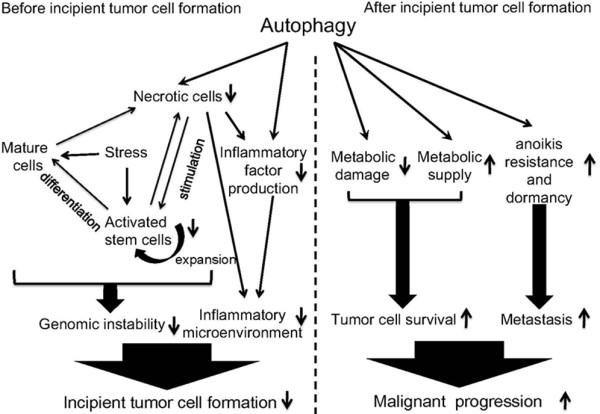
Autophagy serves as a dynamic degradation and recycling system that provides biological materials and energy in response to stress. The role of autophagy in tumor development is complex. Various studies suggest that autophagy mainly contributes to tumor suppression during the early stage of tumorigenesis and tumor promotion during the late stage of tumorigenesis. During the tumorization of normal cells, autophagy protects genomic stability by retarding stem cells-involved damage/repair cycle, and inhibits the formation of chronic inflammatory microenvironment, thus protecting normal cell homeostasis and preventing tumor generation. On the other hand, autophagy also protects tumor cells survival during malignant progression by supporting cellular metabolic demands, decreasing metabolic damage and supporting anoikis resistance and dormancy. Taken together, autophagy appears to play a role as a protector for either normal or tumor cells during the early or late stage of tumorigenesis, respectively. The process of tumorigenesis perhaps needs to undergo twice autophagy-associated screening. The normal cells that have lower autophagy capacity are prone to tumorization, and the incipient tumor cells that have higher autophagy capacity possibly are easier to survival in the hash microenvironment and accumulate more mutations to promote malignant progression.
自噬作为一种动态的降解和回收系统,可在应激时提供生物材料和能量。自噬在肿瘤发展中的作用是复杂的。各种研究表明,自噬主要在肿瘤发生的早期有助于肿瘤抑制,而在肿瘤发生的晚期则促进肿瘤。在正常细胞的癌变过程中,自噬通过延迟涉及干细胞的损伤/修复周期来保护基因组稳定性,并抑制慢性炎症微环境的形成,从而保护正常细胞的动态平衡,防止肿瘤发生。另一方面,自噬通过支持细胞代谢需求、减少代谢损伤以及支持失巢凋亡抗性和休眠,来保护肿瘤细胞在恶性进展期间的存活。总之,自噬在肿瘤发生的早期或晚期分别对正常或肿瘤细胞起着保护作用。肿瘤发生的过程可能需要经历两次与自噬相关的筛选。自噬能力较低的正常细胞更容易癌变,而自噬能力较高的早期肿瘤细胞可能更容易在恶劣的微环境中存活,并积累更多的突变以促进恶性进展。