Department of Migration and Immuno-Ecology, Max Planck Institute for Ornithology,Radolfzell, Germany ; Department of Biology, University of Konstanz, Konstanz, Germany.
PLoS One. 2013 Aug 30;8(8):e72629. doi: 10.1371/journal.pone.0072629. eCollection 2013.
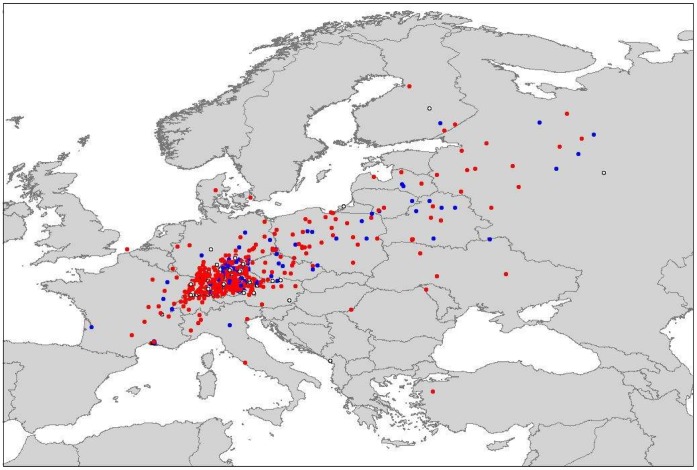
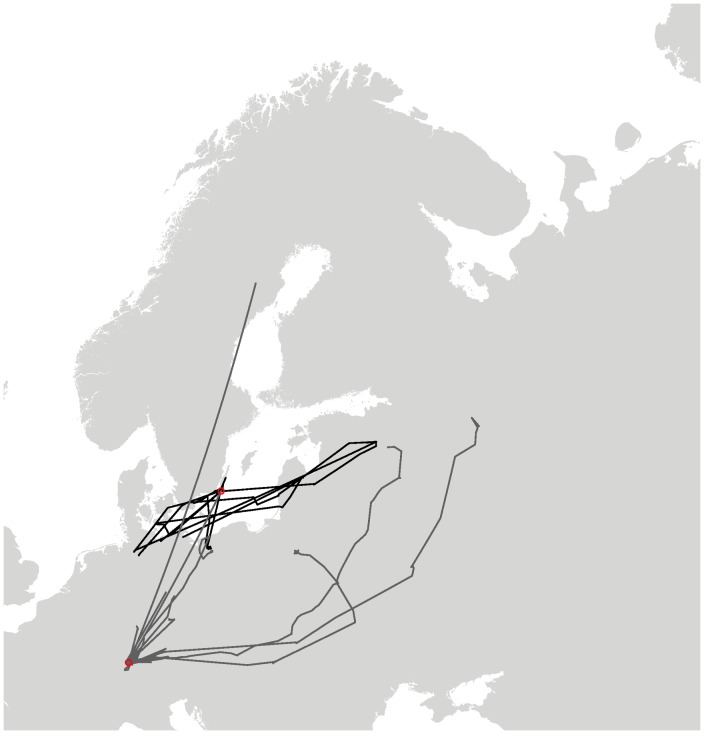
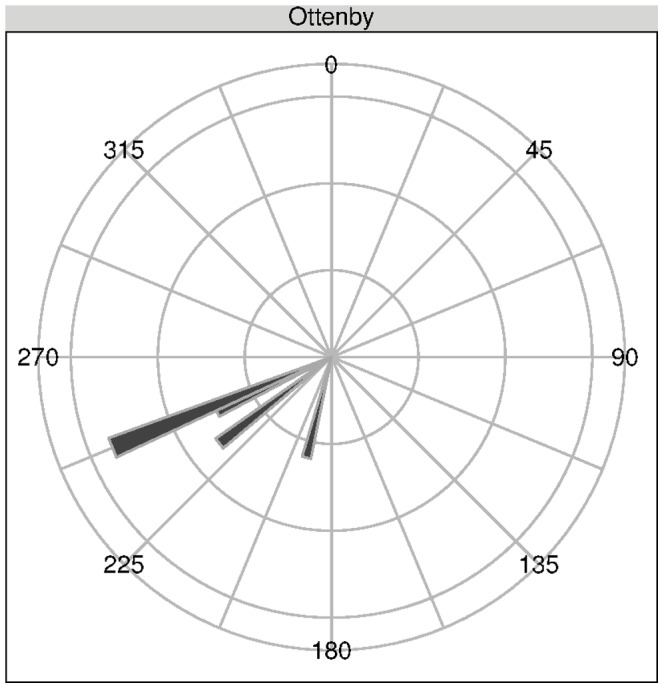
The ontogeny of continent-wide navigation mechanisms of the individual organism, despite being crucial for the understanding of animal movement and migration, is still poorly understood. Several previous studies, mainly conducted on passerines, indicate that inexperienced, juvenile birds may not generally correct for displacement during fall migration. Waterbirds such as the mallard (Anas platyrhynchos, Linnaeus 1758) are more flexible in their migration behavior than most migratory songbirds, but previous experiments with waterbirds have not yet allowed clear conclusions about their navigation abilities. Here we tested whether immature mallard ducks correct for latitudinal displacement during fall migration within Europe. During two consecutive fall migration periods, we caught immature females on a stopover site in southeast Sweden, and translocated a group of them ca. 1,000 km to southern Germany. We followed the movements of the ducks via satellite GPS-tracking and observed their migration decisions during the fall and consecutive spring migration. The control animals released in Ottenby behaved as expected from banding recoveries: they continued migration during the winter and in spring returned to the population's breeding grounds in the Baltics and Northwest Russia. Contrary to the control animals, the translocated mallards did not continue migration and stayed at Lake Constance. In spring, three types of movement tactics could be observed: 61.5% of the ducks (16 of 26) stayed around Lake Constance, 27% (7 of 26) migrated in a northerly direction towards Sweden and 11.5% of the individuals (3 of 26) headed east for ca. 1,000 km and then north. We suggest that young female mallards flexibly adjust their migration tactics and develop a navigational map that allows them to return to their natal breeding area.
尽管个体生物大陆范围导航机制的个体发生对于理解动物运动和迁徙至关重要,但仍知之甚少。几项先前的研究主要针对雀形目鸟类,表明没有经验的幼鸟在秋季迁徙期间通常不会纠正位移。像绿头鸭(Anas platyrhynchos,Linnaeus 1758)这样的水鸟比大多数迁徙鸣禽在迁徙行为上更灵活,但以前对水鸟的实验尚未能够对其导航能力得出明确结论。在这里,我们测试了未成熟的绿头鸭是否在欧洲秋季迁徙期间纠正纬度位移。在两个连续的秋季迁徙期间,我们在瑞典东南部的一个中途停留地点捕获了未成熟的雌性绿头鸭,并将它们中的一组约 1000 公里迁至德国南部。我们通过卫星 GPS 跟踪来跟踪鸭子的运动,并观察它们在秋季和随后的春季迁徙中的迁徙决策。在奥滕比释放的对照动物的行为符合从带环回收中获得的预期:它们在冬季继续迁徙,春季返回波罗的海和西北俄罗斯的繁殖地。与对照动物相反,被转移的绿头鸭没有继续迁徙,而是留在康斯坦茨湖。在春季,可以观察到三种类型的运动策略:61.5%的鸭子(26 只中的 16 只)留在康斯坦茨湖附近,27%(26 只中的 7 只)向瑞典北部方向迁徙,11.5%的个体(26 只中的 3 只)向东迁徙约 1000 公里,然后向北。我们认为,年轻的雌性绿头鸭灵活地调整其迁徙策略,并开发出一种导航图,使它们能够返回其出生地繁殖区。