Department of Biological Sciences, Virginia Tech, Blacksburg, Virginia, United States of America.
PLoS One. 2013 Aug 30;8(8):e73112. doi: 10.1371/journal.pone.0073112. eCollection 2013.
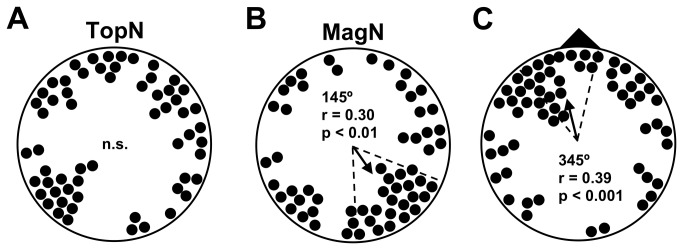
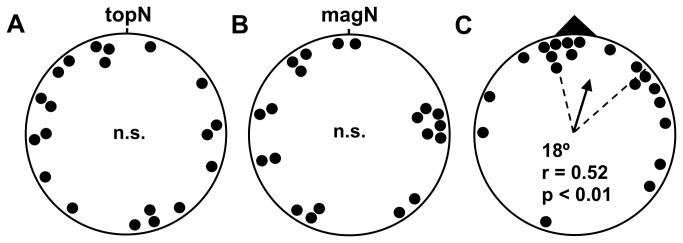
Magnetoreception has been demonstrated in all five vertebrate classes. In rodents, nest building experiments have shown the use of magnetic cues by two families of molerats, Siberian hamsters and C57BL/6 mice. However, assays widely used to study rodent spatial cognition (e.g. water maze, radial arm maze) have failed to provide evidence for the use of magnetic cues. Here we show that C57BL/6 mice can learn the magnetic direction of a submerged platform in a 4-armed (plus) water maze. Naïve mice were given two brief training trials. In each trial, a mouse was confined to one arm of the maze with the submerged platform at the outer end in a predetermined alignment relative to magnetic north. Between trials, the training arm and magnetic field were rotated by 180(°) so that the mouse had to swim in the same magnetic direction to reach the submerged platform. The directional preference of each mouse was tested once in one of four magnetic field alignments by releasing it at the center of the maze with access to all four arms. Equal numbers of responses were obtained from mice tested in the four symmetrical magnetic field alignments. Findings show that two training trials are sufficient for mice to learn the magnetic direction of the submerged platform in a plus water maze. The success of these experiments may be explained by: (1) absence of alternative directional cues (2), rotation of magnetic field alignment, and (3) electromagnetic shielding to minimize radio frequency interference that has been shown to interfere with magnetic compass orientation of birds. These findings confirm that mice have a well-developed magnetic compass, and give further impetus to the question of whether epigeic rodents (e.g., mice and rats) have a photoreceptor-based magnetic compass similar to that found in amphibians and migratory birds.
磁感觉在所有五个脊椎动物类群中都有被证实。在啮齿类动物中,筑巢实验表明两种鼹形鼠科(非洲冕豪猪和 C57BL/6 小鼠)以及仓鼠使用了磁线索。然而,用于研究啮齿类动物空间认知的广泛应用的实验(例如水迷宫、放射臂迷宫)未能提供使用磁线索的证据。在这里,我们展示了 C57BL/6 小鼠可以在 4 臂(加)水迷宫中学习淹没平台的磁方向。未训练的小鼠进行了两次简短的训练试验。在每次试验中,将一只小鼠限制在迷宫的一个臂中,将淹没平台放置在相对于磁北的预定对齐位置的外端。在试验之间,训练臂和磁场以 180(°)旋转,以便小鼠必须在相同的磁场方向游泳才能到达淹没平台。通过将其释放到迷宫中心并访问所有四个臂,在四个磁场对齐中的一个中对每个小鼠的方向偏好进行了一次测试。在四个对称的磁场对齐中测试的小鼠获得了相等数量的反应。结果表明,两次训练试验足以使小鼠在加水上迷宫中学习淹没平台的磁方向。这些实验的成功可能是由以下原因解释的:(1)缺乏替代的方向线索,(2)磁场方向的旋转,以及(3)电磁屏蔽以最大程度地减少射频干扰,射频干扰已被证明会干扰鸟类的磁罗盘定向。这些发现证实了小鼠具有发达的磁罗盘,并进一步推动了一个问题,即穴居啮齿动物(例如老鼠和大鼠)是否具有类似于在两栖动物和候鸟中发现的基于光感受器的磁罗盘。