Psychiatric/Psychological Service, Department of Justice, Zürich, Switzerland ; Faculty of Health Sciences, Molde University College, Molde, Norway.
PLoS One. 2013 Sep 2;8(9):e72484. doi: 10.1371/journal.pone.0072484. eCollection 2013.
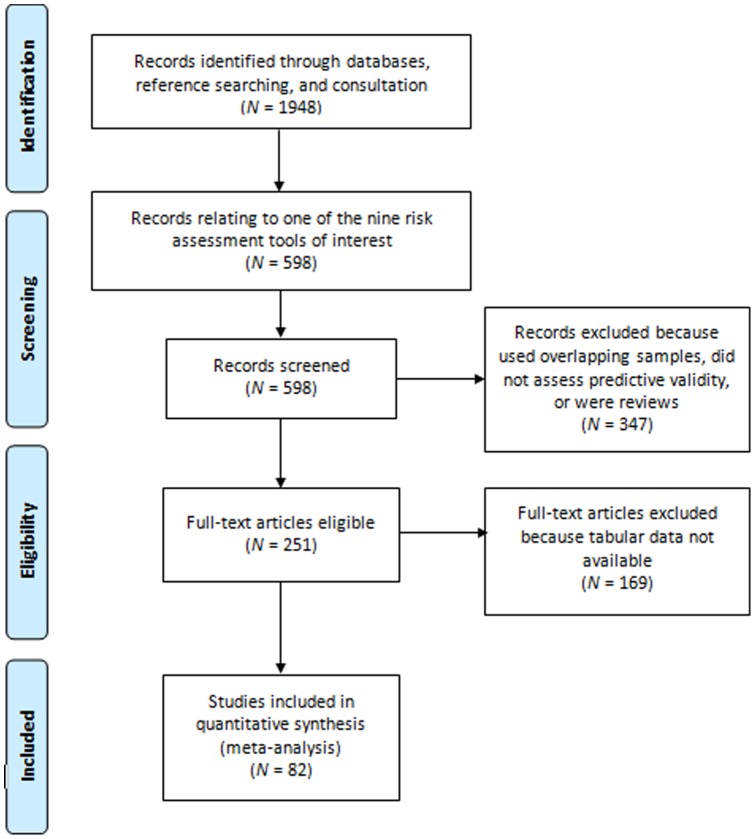
Various financial and non-financial conflicts of interests have been shown to influence the reporting of research findings, particularly in clinical medicine. In this study, we examine whether this extends to prognostic instruments designed to assess violence risk. Such instruments have increasingly become a routine part of clinical practice in mental health and criminal justice settings. The present meta-analysis investigated whether an authorship effect exists in the violence risk assessment literature by comparing predictive accuracy outcomes in studies where the individuals who designed these instruments were study authors with independent investigations. A systematic search from 1966 to 2011 was conducted using PsycINFO, EMBASE, MEDLINE, and US National Criminal Justice Reference Service Abstracts to identify predictive validity studies for the nine most commonly used risk assessment tools. Tabular data from 83 studies comprising 104 samples was collected, information on two-thirds of which was received directly from study authors for the review. Random effects subgroup analysis and metaregression were used to explore evidence of an authorship effect. We found a substantial and statistically significant authorship effect. Overall, studies authored by tool designers reported predictive validity findings around two times higher those of investigations reported by independent authors (DOR=6.22 [95% CI=4.68-8.26] in designers' studies vs. DOR=3.08 [95% CI=2.45-3.88] in independent studies). As there was evidence of an authorship effect, we also examined disclosure rates. None of the 25 studies where tool designers or translators were also study authors published a conflict of interest statement to that effect, despite a number of journals requiring that potential conflicts be disclosed. The field of risk assessment would benefit from routine disclosure and registration of research studies. The extent to which similar conflict of interests exists in those developing risk assessment guidelines and providing expert testimony needs clarification.
各种财务和非财务利益冲突已被证明会影响研究结果的报告,尤其是在临床医学领域。在这项研究中,我们研究了这种情况是否会扩展到用于评估暴力风险的预后工具。此类工具在精神健康和刑事司法环境中的临床实践中越来越成为常规部分。本荟萃分析通过比较设计这些工具的个人作为研究作者与独立调查的研究中预测准确性结果,研究了在暴力风险评估文献中是否存在作者效应。使用 PsycINFO、EMBASE、MEDLINE 和美国国家刑事司法参考服务摘要从 1966 年至 2011 年进行了系统搜索,以确定用于最常用的九种风险评估工具的预测有效性研究。从 83 项研究中收集了包含 104 个样本的表格数据,其中三分之二的信息是从研究作者处直接收到的。使用随机效应亚组分析和元回归探索作者效应的证据。我们发现了一个实质性且具有统计学意义的作者效应。总体而言,由工具设计者撰写的研究报告的预测有效性结果比独立作者报告的结果高两倍左右(在设计者的研究中,DOR=6.22[95%CI=4.68-8.26],而在独立研究中,DOR=3.08[95%CI=2.45-3.88])。由于存在作者效应的证据,我们还检查了披露率。在 25 项研究中,尽管许多期刊都要求披露潜在冲突,但没有一项研究的工具设计者或翻译者也是研究作者,发表了这样的利益冲突声明。风险评估领域将受益于研究工作的常规披露和注册。需要澄清在制定风险评估准则和提供专家证词的人中存在类似利益冲突的程度。