Faculty of Health Sciences, Simon Fraser University, Burnaby, British Columbia, Canada.
PLoS One. 2013 Sep 4;8(9):e72946. doi: 10.1371/journal.pone.0072946. eCollection 2013.
Homelessness and mental illness have a strong association with public disorder and criminality. Experimental evidence indicates that Housing First (HF) increases housing stability and perceived choice among those experiencing chronic homelessness and mental disorders. HF is also associated with lower residential costs than common alternative approaches. Few studies have examined the effect of HF on criminal behavior.
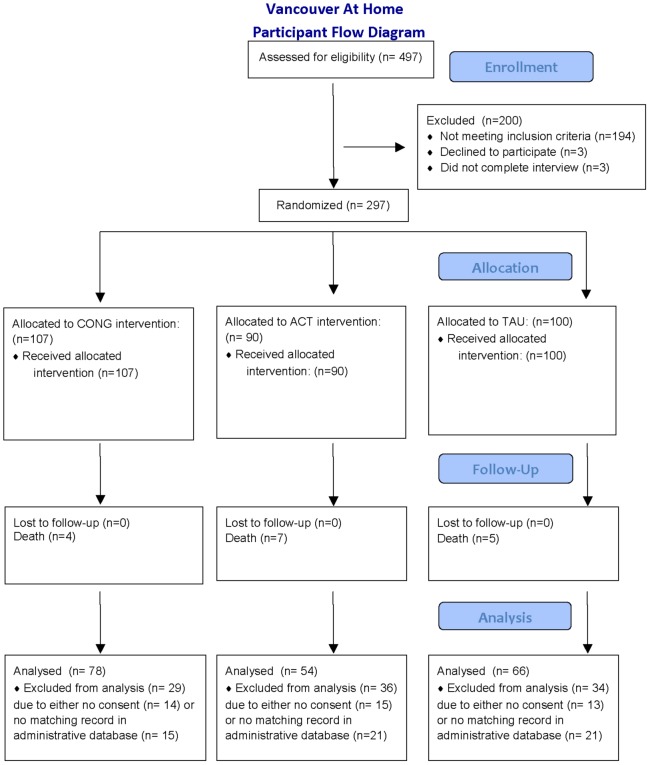
Individuals meeting criteria for homelessness and a current mental disorder were randomized to one of three conditions treatment as usual (reference); scattered site HF; and congregate HF. Administrative data concerning justice system events were linked in order to study prior histories of offending and to test the relationship between housing status and offending following randomization for up to two years.
The majority of the sample (67%) was involved with the justice system, with a mean of 8.07 convictions per person in the ten years prior to recruitment. The most common category of crime was "property offences" (mean=4.09). Following randomization, the scattered site HF condition was associated with significantly lower numbers of sentences than treatment as usual (Adjusted IRR=0.29; 95% CI 0.12-0.72). Congregate HF was associated with a marginally significant reduction in sentences compared to treatment as usual (Adjusted IRR=0.55; 95% CI: 0.26-1.14).
This study is the first randomized controlled trial to demonstrate benefits of HF among a homeless sample with mental illness in the domain of public safety and crime. Our sample was frequently involved with the justice system, with great personal and societal costs. Further implementation of HF is strongly indicated, particularly in the scattered site format. Research examining interdependencies between housing, health, and the justice system is indicated.
ISRCTN57595077.
无家可归和精神疾病与公共秩序和犯罪有很强的关联。实验证据表明,“优先安置住房”(HF)增加了那些长期无家可归和患有精神障碍者的住房稳定性和感知选择。HF 还与比常见替代方法更低的住房成本相关。很少有研究检查 HF 对犯罪行为的影响。
符合无家可归和当前精神障碍标准的个体被随机分配到三种条件之一:常规治疗(参考);分散安置 HF;集中安置 HF。为了研究犯罪前科,并检验随机分组后住房状况与犯罪之间的关系,在长达两年的时间内,将与司法系统事件相关的行政数据联系起来。
该样本的大多数(67%)人都与司法系统有关,在招募前的十年中,平均每人有 8.07 项定罪。最常见的犯罪类别是“财产犯罪”(平均=4.09)。随机分组后,与常规治疗相比,分散安置 HF 条件的判刑人数显著减少(调整后的 IRR=0.29;95%CI 0.12-0.72)。与常规治疗相比,集中安置 HF 与判刑人数略有减少相关(调整后的 IRR=0.55;95%CI:0.26-1.14)。
这项研究是第一项在患有精神疾病的无家可归者中,在公共安全和犯罪领域证明 HF 益处的随机对照试验。我们的样本经常与司法系统有关,个人和社会成本巨大。进一步实施 HF 是非常必要的,特别是在分散安置的形式。需要进一步研究住房、健康和司法系统之间的相互依存关系。
ISRCTN57595077。