Zhou Jiawei, Thompson Benjamin, Hess Robert F
McGill Vision Research, Dept. Ophthalmology, McGill University, Montreal, PQ, Canada, H3A 1A1.
Sci Rep. 2013;3:2638. doi: 10.1038/srep02638.
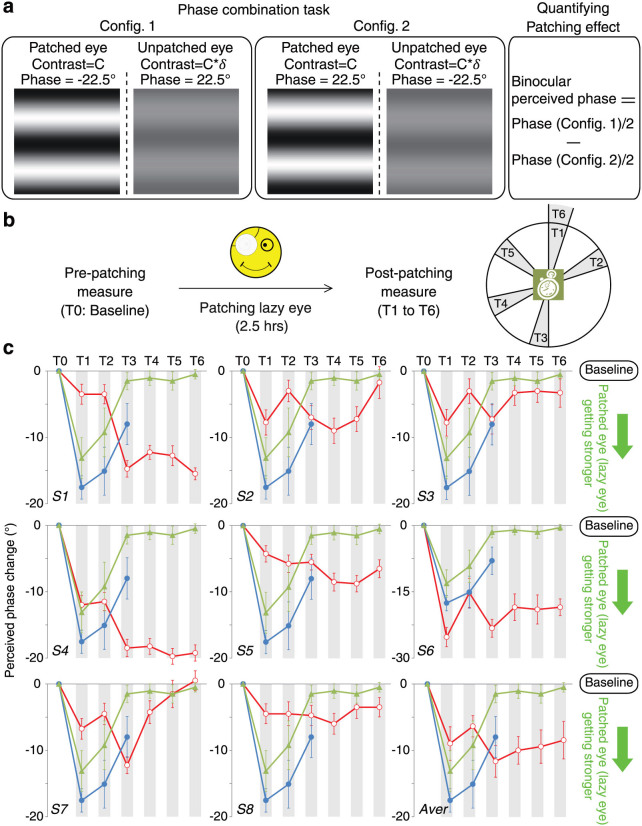
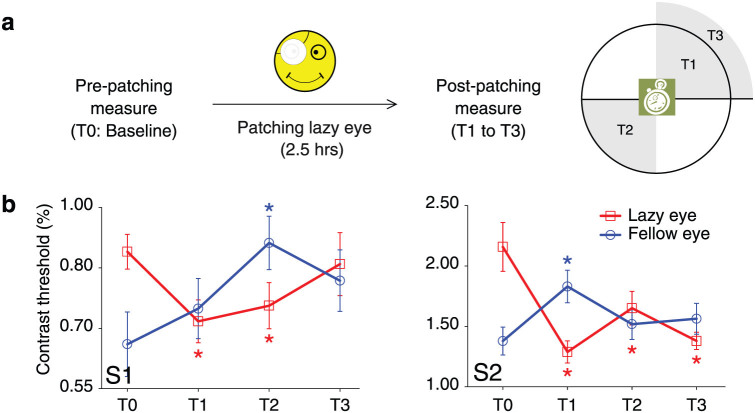
Amblyopia is a neurological disorder of binocular vision affecting up to 3% of the population resulting from a disrupted period of early visual development. Recently, it has been shown that vision can be partially restored by intensive monocular or dichoptic training (4-6 weeks). This can occur even in adults owing to a residual degree of brain plasticity initiated by repetitive and successive sensory stimulation. Here we show that the binocular imbalance that characterizes amblyopia can be reduced by occluding the amblyopic eye with a translucent patch for as little as 2.5 hours, suggesting a degree of rapid binocular plasticity in adults resulting from a lack of sensory stimulation. The integrated binocular benefit is larger in our amblyopic group than in our normal control group. We propose that this rapid improvement in function, as a result of reduced sensory stimulation, represents a new form of plasticity operating at a binocular site.
弱视是一种双眼视觉的神经紊乱疾病,影响着高达3%的人群,其成因是早期视觉发育阶段受到干扰。最近研究表明,通过强化单眼或双眼分别训练(4 - 6周),视力能够得到部分恢复。即使是成年人,由于重复且连续的感官刺激引发了一定程度的大脑可塑性,视力也能得到恢复。在此我们表明,弱视所特有的双眼不平衡能够通过用半透明贴片遮挡弱视眼仅2.5小时得以减轻,这表明由于缺乏感官刺激,成年人存在一定程度的快速双眼可塑性。弱视组的双眼综合受益大于正常对照组。我们认为,由于感官刺激减少而导致的这种功能快速改善,代表了一种在双眼部位起作用的新型可塑性。