Environmental Engineering Division, Civil Engineering Department, Jadavpur University, Kolkata 32, India.
Biomed Res Int. 2013;2013:134872. doi: 10.1155/2013/134872. Epub 2013 Aug 20.
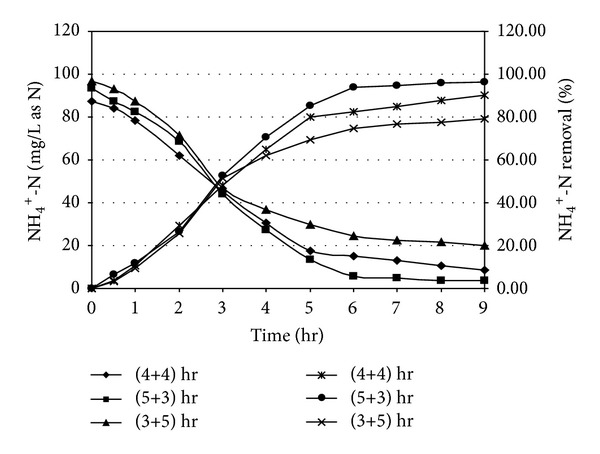
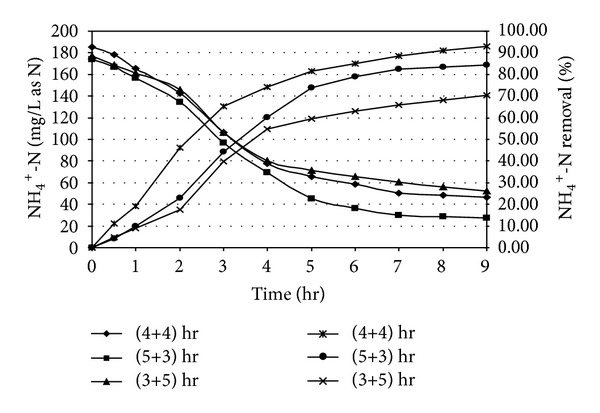
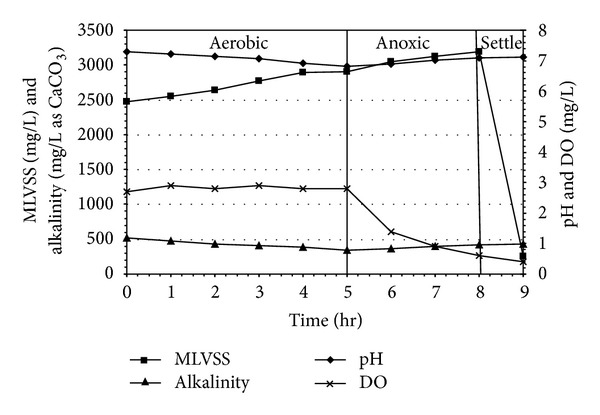
Slaughterhouse wastewater contains diluted blood, protein, fat, and suspended solids, as a result the organic and nutrient concentration in this wastewater is vary high and the residues are partially solubilized, leading to a highly contaminating effect in riverbeds and other water bodies if the same is let off untreated. The performance of a laboratory-scale Sequencing Batch Reactor (SBR) has been investigated in aerobic-anoxic sequential mode for simultaneous removal of organic carbon and nitrogen from slaughterhouse wastewater. The reactor was operated under three different variations of aerobic-anoxic sequence, namely, (4+4), (5+3), and (3+5) hr. of total react period with two different sets of influent soluble COD (SCOD) and ammonia nitrogen (NH4(+)-N) level 1000 ± 50 mg/L, and 90 ± 10 mg/L, 1000 ± 50 mg/L and 180 ± 10 mg/L, respectively. It was observed that from 86 to 95% of SCOD removal is accomplished at the end of 8.0 hr of total react period. In case of (4+4) aerobic-anoxic operating cycle, a reasonable degree of nitrification 90.12 and 74.75% corresponding to initial NH4(+)-N value of 96.58 and 176.85 mg/L, respectively, were achieved. The biokinetic coefficients (k, K(s), Y, k(d)) were also determined for performance evaluation of SBR for scaling full-scale reactor in future operation.
屠宰废水含有稀释的血液、蛋白质、脂肪和悬浮固体,因此这种废水中的有机物质和营养物质浓度非常高,残留物部分溶解,导致在河床和其他水体中具有高度的污染作用,如果未经处理就排放的话。本研究采用序批式间歇反应器(SBR)在好氧-缺氧序批模式下对屠宰废水进行了研究,以实现同时去除有机碳和氮。该反应器在三种不同的好氧-缺氧序列变化下运行,即(4+4)、(5+3)和(3+5)小时。总反应时间和两组不同的进水可溶性 COD(SCOD)和氨氮(NH4(+)-N)水平,分别为 1000±50mg/L 和 90±10mg/L、1000±50mg/L 和 180±10mg/L。结果表明,在 8.0 小时的总反应时间结束时,SCOD 的去除率达到 86%至 95%。在(4+4)好氧-缺氧操作周期的情况下,实现了合理程度的硝化作用,对应于初始 NH4(+)-N 值为 96.58 和 176.85mg/L,硝化率分别为 90.12%和 74.75%。还确定了 SBR 的生物动力学系数(k、K(s)、Y、k(d)),以便在未来的运行中对全规模反应器进行规模放大。