Arq Bras Cardiol. 2013 Nov;101(5):434-41. doi: 10.5935/abc.20130185. Epub 2013 Sep 13.
Most reports regarding the obesity paradox have focused on body mass index (BMI) to classify obesity and the prognostic values of other indirect measurements of body composition remain poorly examined in heart failure (HF).
To evaluate the association between BMI and other indirect, but easily accessible, body composition measurements associated with the risk of all-cause mortality in HF.
Anthropometric parameters of body composition were assessed in 344 outpatients with a left ventricular ejection fraction (LVEF) of <50% from a prospective HF cohort that was followed-up for 30 ± 8.2 months. Survival was evaluated using the Kaplan-Meier method and Cox proportional hazard regression analysis.
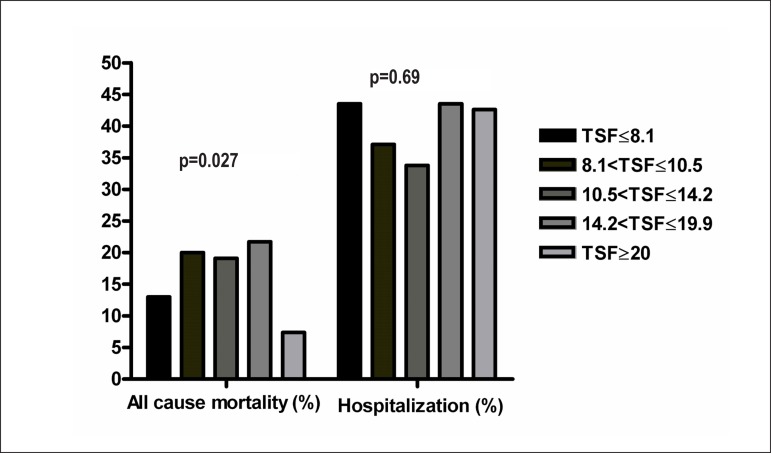
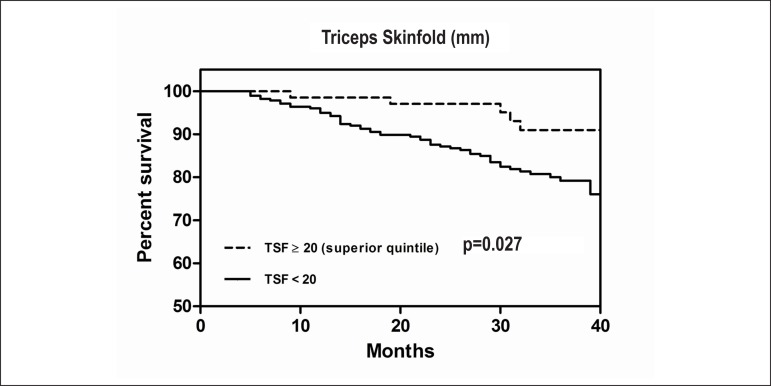
HF patients were predominantly male, of non-ischemic etiology, and had moderate to severe LV systolic dysfunction (mean LVEF = 32 ± 9%). Triceps skinfold (TSF) was the only anthropometric index that was associated with HF prognosis and had significantly lower values in patients who died (p = 0.047). A TSF > 20 mm was present in 9% of patients that died and 22% of those who survived (p = 0.027). Univariate analysis showed that serum creatinine level, LVEF, and NYHA class were associated with the risk of death, while Cox proportional hazard regression analysis showed that TSF > 20 was a strong independent predictor of all-cause mortality (hazard ratio = 0.36; 95% confidence interval = 0.13-0.97, p = 0.03).
Although BMI is the most widely used anthropometric parameter in clinical practice, our results suggested that TSF is a better predictive marker of mortality in HF outpatients.
大多数关于肥胖悖论的报告都集中在身体质量指数(BMI)上,以对肥胖进行分类,而心力衰竭(HF)中其他间接测量的身体成分的预后价值仍未得到充分研究。
评估 BMI 与其他间接但易于获得的身体成分测量指标与 HF 全因死亡率风险之间的关系。
对一个前瞻性 HF 队列中的 344 名左心室射血分数(LVEF)<50%的门诊患者进行了身体成分的人体测量参数评估,该队列的随访时间为 30±8.2 个月。使用 Kaplan-Meier 方法和 Cox 比例风险回归分析评估生存情况。
HF 患者主要为男性,非缺血性病因,且有中重度 LV 收缩功能障碍(平均 LVEF=32±9%)。三头肌皮褶厚度(TSF)是唯一与 HF 预后相关的人体测量指数,且在死亡患者中显著较低(p=0.047)。死亡患者中 TSF>20mm 的占 9%,存活患者中占 22%(p=0.027)。单因素分析显示血清肌酐水平、LVEF 和 NYHA 分级与死亡风险相关,而 Cox 比例风险回归分析显示 TSF>20 是全因死亡率的强独立预测因子(危险比=0.36;95%置信区间=0.13-0.97,p=0.03)。
虽然 BMI 是临床实践中最常用的人体测量参数,但我们的结果表明 TSF 是 HF 门诊患者死亡率的更好预测标志物。