Empresa Brasileira de Pesquisa Agropecuária - Soja , Londrina, PR , Brasil ; Universidade Estadual de Londrina Departamento Microbiologia , Londrina, PR , Brasil ; Conselho Nacional de Desenvolvimento Científico e Tecnológico , Brasília, DF , Brasil.
Braz J Microbiol. 2012 Apr;43(2):698-710. doi: 10.1590/S1517-83822012000200035. Epub 2012 Jun 1.
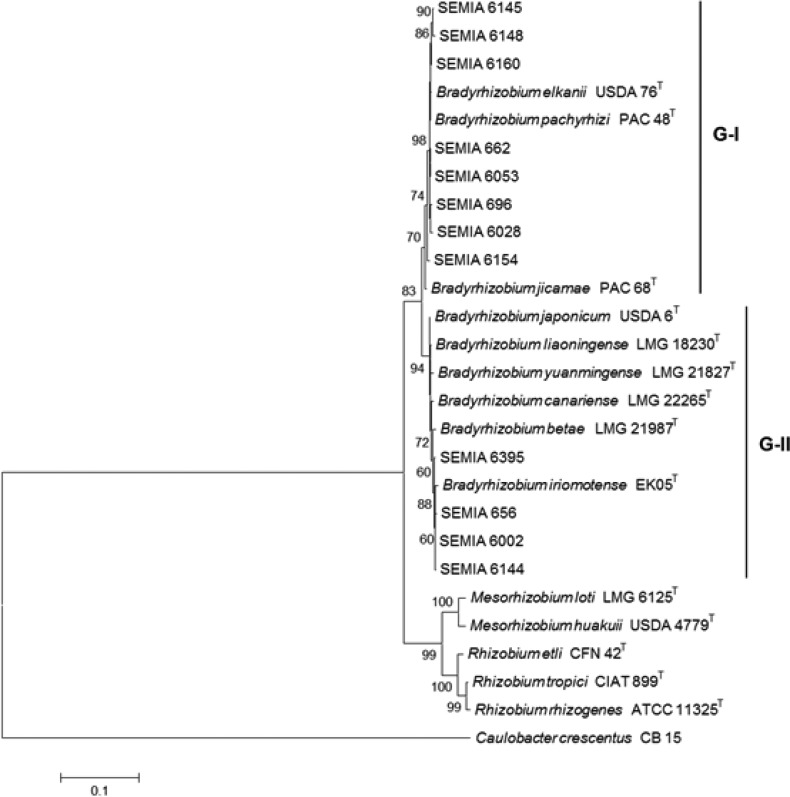
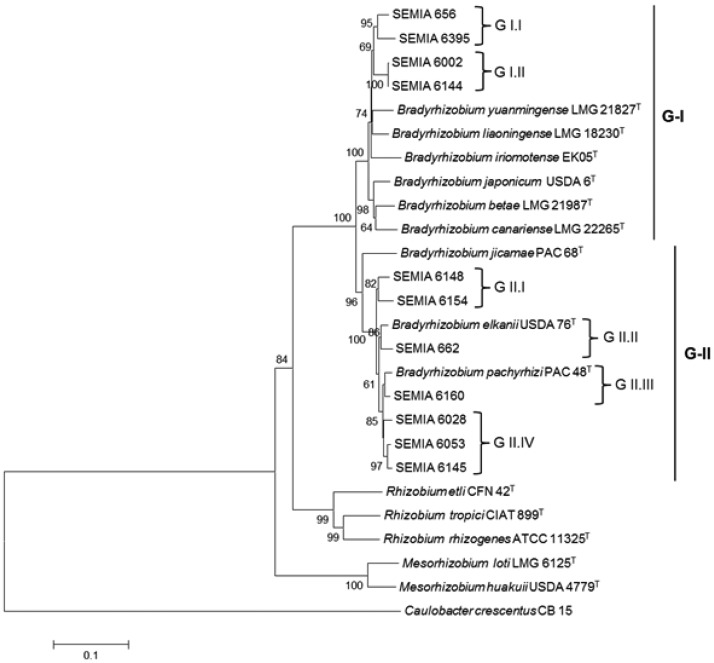
Symbiotic association of several genera of bacteria collectively called as rhizobia and plants belonging to the family Leguminosae (=Fabaceae) results in the process of biological nitrogen fixation, playing a key role in global N cycling, and also bringing relevant contributions to the agriculture. Bradyrhizobium is considered as the ancestral of all nitrogen-fixing rhizobial species, probably originated in the tropics. The genus encompasses a variety of diverse bacteria, but the diversity captured in the analysis of the 16S rRNA is often low. In this study, we analyzed twelve Bradyrhizobium strains selected from previous studies performed by our group for showing high genetic diversity in relation to the described species. In addition to the 16S rRNA, five housekeeping genes (recA, atpD, glnII, gyrB and rpoB) were analyzed in the MLSA (multilocus sequence analysis) approach. Analysis of each gene and of the concatenated housekeeping genes captured a considerably higher level of genetic diversity, with indication of putative new species. The results highlight the high genetic variability associated with Bradyrhizobium microsymbionts of a variety of legumes. In addition, the MLSA approach has proved to represent a rapid and reliable method to be employed in phylogenetic and taxonomic studies, speeding the identification of the still poorly known diversity of nitrogen-fixing rhizobia in the tropics.
几种被称为根瘤菌的细菌与豆科 (= 蝶形花科) 植物的共生关系导致了生物固氮过程,在全球氮循环中起着关键作用,也为农业带来了相关贡献。慢生根瘤菌被认为是所有固氮根瘤菌物种的祖先,可能起源于热带地区。该属包含多种不同的细菌,但在 16S rRNA 分析中捕捉到的多样性通常较低。在这项研究中,我们分析了从我们小组之前进行的显示与描述物种相比具有高遗传多样性的研究中选择的 12 株慢生根瘤菌菌株。除了 16S rRNA 外,还在 MLSA(多位点序列分析)方法中分析了五个看家基因(recA、atpD、glnII、gyrB 和 rpoB)。每个基因和串联看家基因的分析都捕捉到了更高水平的遗传多样性,并表明可能存在新的物种。结果突出了与各种豆科植物微共生菌相关的高遗传变异性。此外,MLSA 方法已被证明是一种快速可靠的方法,可用于系统发育和分类学研究,加速鉴定热带地区仍知之甚少的固氮根瘤菌多样性。