Institute of Entomology and Molecular Biology, College of Life Sciences, Chongqing Normal University, Chongqing, P,R, China.
Parasit Vectors. 2013 Sep 13;6(1):264. doi: 10.1186/1756-3305-6-264.
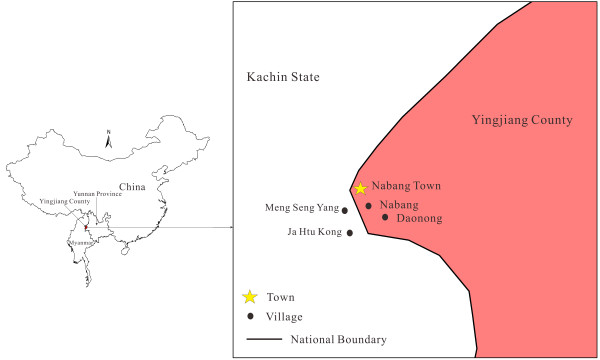
Malaria around the China-Myanmar border is a serious health problem in the countries of South-East Asia. An. minimus is a principle malaria vector with a wide geographic distribution in this area. Malaria is endemic along the boundary between Yunnan province in China and the Kachin State of Myanmar where the local Anopheles community (species composition) and the malaria transmission vectors have never been clarified.
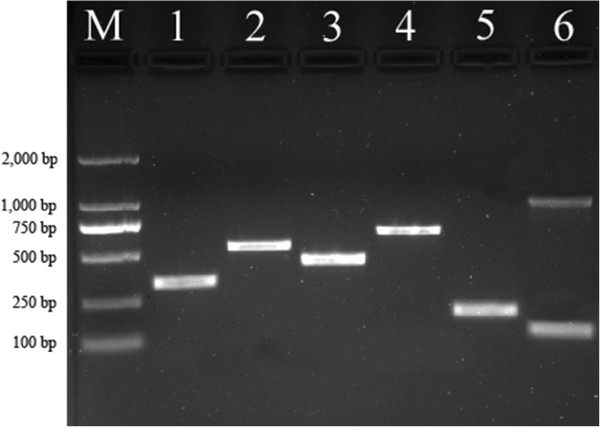
Adult Anopheles specimens were collected using CDC light traps in four villages along the border of China and Myanmar from May 2012 to April 2013. Morphological and molecular identification of mosquito adults confirmed the species of Anopheles. Blood-meal identification using the female abdomens was conducted using multiplex PCR. For sporozoite detection in An. minimus, sets of 10 female salivary glands were pooled and identified with SSU rDNA using nested PCR. Monthly abundance of An. minimus populations during the year was documented. The diversity of Anopheles and the role of An. minimus on malaria transmission in this border area were analyzed.
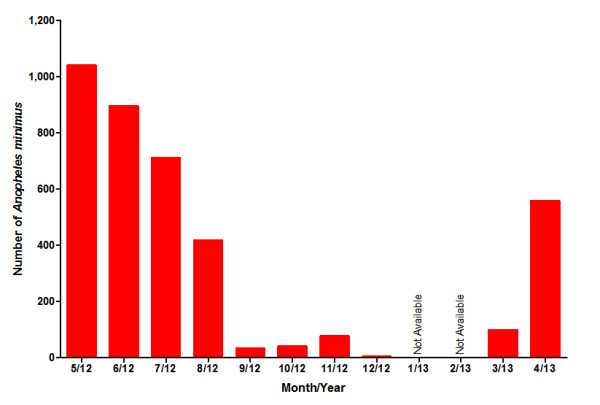
4,833 adult mosquitoes in the genus Anopheles were collected and morphologically identified to species or species complex. The Anopheles community is comprised of 13 species, and 78.83% of our total specimens belonged to An. minimus s.l., followed by An. maculatus (5.55%) and the An. culicifacies complex (4.03%). The quantity of trapped An. minimus in the rainy season of malaria transmission was greater than during the non-malarial dry season, and a peak was found in May 2012. An. minimus fed on the blood of four animals: humans (79.8%), cattle (10.6%), pigs (5.8%) and dogs (3.8%). 1,500 females of An. minimus were pooled into 150 samples and tested for sporozoites: only 1 pooled sample was found to have sporozoites of Plasmodium vivax.
Anopheles is abundant with An. minimus being the dominant species and having a high human blood index along the China-Myanmar border. The sporozoites in An. minimus were determined to be Plasmodium vivax with a 0.07-0.7% infection rate.
中缅边境地区疟疾是东南亚国家的一个严重的健康问题。微小按蚊是该地区广泛分布的主要疟疾传播媒介。在中国云南省和缅甸克钦邦边境地区,疟疾呈地方性流行,但当地按蚊群落(物种组成)和疟疾传播媒介从未得到明确。
2012 年 5 月至 2013 年 4 月,采用 CDC 诱蚊灯在中国和缅甸边境的四个村庄采集成蚊标本。成蚊的形态学和分子鉴定确认了按蚊的种类。采用多重 PCR 法对雌性腹部进行血餐鉴定。为了检测微小按蚊中的子孢子,将 10 只雌性唾液腺混合,并用 SSU rDNA 进行巢式 PCR 鉴定。记录了一年中微小按蚊种群的月丰度。分析了该边境地区按蚊的多样性和微小按蚊在疟疾传播中的作用。
共采集到 4833 只按蚊属成蚊,经形态学鉴定为种或种复合体。按蚊群落由 13 种组成,我们采集的标本中 78.83%属于微小按蚊复合体,其次是致倦库蚊(5.55%)和中华按蚊复合体(4.03%)。在疟疾传播的雨季,捕获的微小按蚊数量大于非疟疾的旱季,2012 年 5 月达到高峰。微小按蚊以 4 种动物的血液为食:人(79.8%)、牛(10.6%)、猪(5.8%)和狗(3.8%)。将 1500 只微小按蚊雌性混合成 150 个样本进行子孢子检测:只有 1 个混合样本检测到间日疟原虫的子孢子。
中缅边境地区按蚊丰富,微小按蚊为优势种,对人类血液的指数较高。在微小按蚊中检测到的子孢子为间日疟原虫,感染率为 0.07-0.7%。