Instituto de Genética Humana, Pontificia Universidad Javeriana, Bogotá, Colombia ; Department of Molecular Biosciences, The Wenner-Gren Institute, Stockholm University, Stockholm, Sweden.
PLoS One. 2013 Sep 6;8(9):e72098. doi: 10.1371/journal.pone.0072098. eCollection 2013.
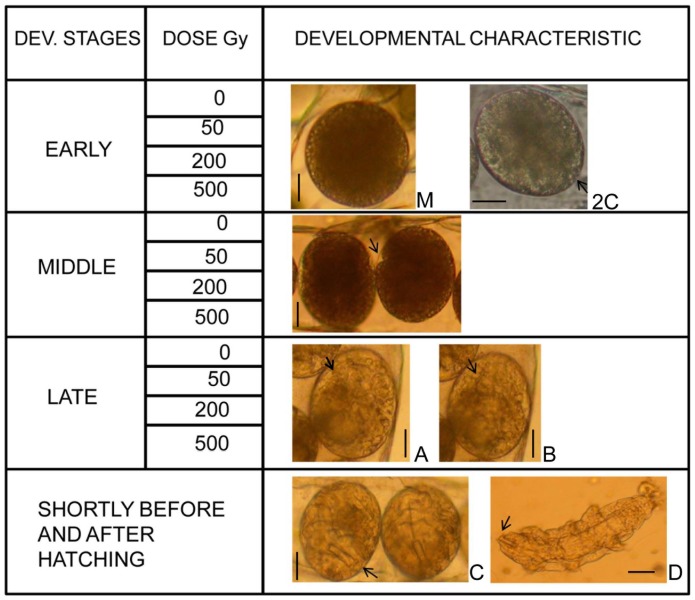
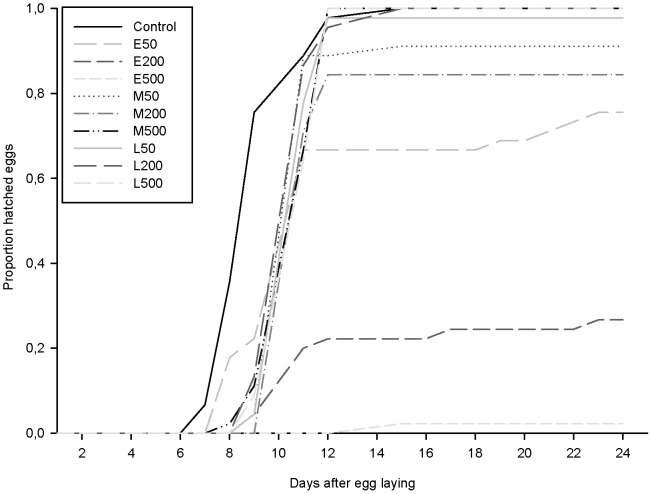
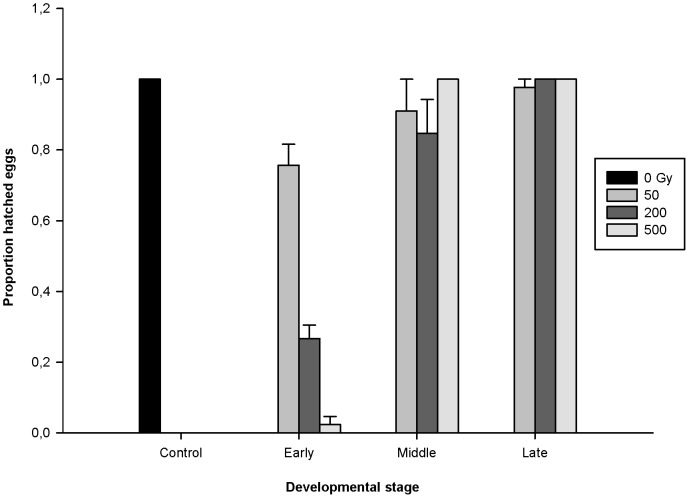
Tardigrades represent one of the most desiccation and radiation tolerant animals on Earth, and several studies have documented their tolerance in the adult stage. Studies on tolerance during embryological stages are rare, but differential effects of desiccation and freezing on different developmental stages have been reported, as well as dose-dependent effect of gamma irradiation on tardigrade embryos. Here, we report a study evaluating the tolerance of eggs from the eutardigrade Milnesium cf. tardigradum to three doses of gamma radiation (50, 200 and 500 Gy) at the early, middle, and late stage of development. We found that embryos of the middle and late developmental stages were tolerant to all doses, while eggs in the early developmental stage were tolerant only to a dose of 50 Gy, and showed a declining survival with higher dose. We also observed a delay in development of irradiated eggs, suggesting that periods of DNA repair might have taken place after irradiation induced damage. The delay was independent of dose for eggs irradiated in the middle and late stage, possibly indicating a fixed developmental schedule for repair after induced damage. These results show that the tolerance to radiation in tardigrade eggs changes in the course of their development. The mechanisms behind this pattern are unknown, but may relate to changes in mitotic activities over the embryogenesis and/or to activation of response mechanisms to damaged DNA in the course of development.
缓步动物是地球上最耐旱和耐辐射的动物之一,有几项研究记录了它们在成虫阶段的耐受性。胚胎发育阶段的耐受性研究很少,但已有研究报道了干燥和冷冻对不同发育阶段的不同影响,以及γ 辐射对缓步动物胚胎的剂量依赖性效应。在这里,我们报告了一项研究,评估了来自 eutardigrade Milnesium cf. tardigradum 的卵对三种剂量的γ辐射(50、200 和 500Gy)在早期、中期和晚期发育阶段的耐受性。我们发现,中期和晚期发育阶段的胚胎对所有剂量都有耐受性,而早期发育阶段的卵仅对 50Gy 的剂量有耐受性,并且随着剂量的增加,存活率下降。我们还观察到受照射卵的发育延迟,这表明在辐射诱导的损伤后可能发生了 DNA 修复期。这种延迟与在中期和晚期受照射的卵的剂量无关,可能表明在诱导损伤后修复有固定的发育时间表。这些结果表明,缓步动物卵对辐射的耐受性在其发育过程中发生了变化。这种模式背后的机制尚不清楚,但可能与胚胎发生过程中有丝分裂活动的变化有关,或者与受损 DNA 激活响应机制有关。