Schulz Daniela N, Candel Math Jjm, Kremers Stef Pj, Reinwand Dominique A, Jander Astrid, de Vries Hein
CAPHRI School for Public Health and Primary Care, Department of Health Promotion, Maastricht University, Maastricht, Netherlands.
J Med Internet Res. 2013 Sep 17;15(9):e206. doi: 10.2196/jmir.2568.
Web-based tailored interventions provide users with information that is adapted to their individual characteristics and needs. Randomized controlled trials assessing the effects of tailored alcohol self-help programs among adults are scarce. Furthermore, it is a challenge to develop programs that can hold respondents' attention in online interventions.
To assess whether a 3-session, Web-based tailored intervention is effective in reducing alcohol intake in high-risk adult drinkers and to compare 2 computer-tailoring feedback strategies (alternating vs summative) on behavioral change, dropout, and appreciation of the program.
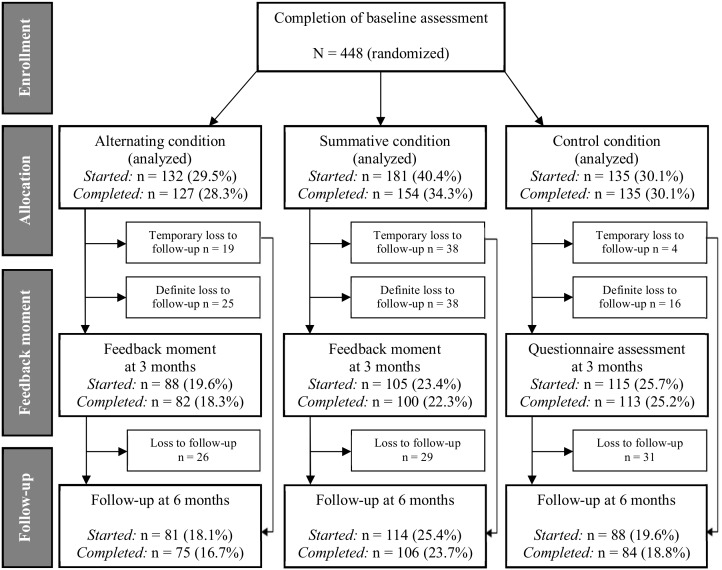
A single-blind randomized controlled trial was conducted with an experimental group and a control group (N=448) in Germany in 2010-2011. Follow-up took place after 6 months. Drinking behavior, health status, motivational determinants, and demographics were assessed among participants recruited via an online access panel. The experimental group was divided into 2 subgroups. In the alternating condition (n=132), the tailored feedback was split into a series of messages discussing individual topics offered while the respondent was filling out the program. Participants in the summative condition (n=181) received all advice at once after having answered all questions. The actual texts were identical for both conditions. The control group (n=135) only filled in 3 questionnaires. To identify intervention effects, logistic and linear regression analyses were conducted among complete cases (n=197) and after using multiple imputation.
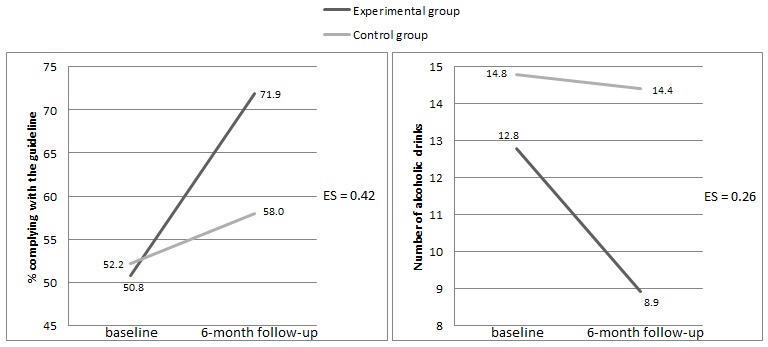
Among the complete cases (response rate: 197/448, 44.0%) who did not comply with the German national guideline for low-risk drinking at baseline, 21.1% of respondents in the experimental group complied after 6 months compared with 5.8% in the control group (effect size=0.42; OR 2.65, 95% CI 1.14-6.16, P=.02). The experimental group decreased by 3.9 drinks per week compared to 0.4 drinks per week in the control group, but this did not reach statistical significance (effect size=0.26; beta=-0.12, 95% CI -7.96 to 0.03, P=.05). Intention-to-treat analyses also indicated no statistically significant effect. Separate analyses of the 2 experimental subgroups showed no differences in intervention effects. The dropout rate during the first visit to the intervention website was significantly lower in the alternating condition than in the summative condition (OR 0.23, 95% CI 0.08-0.60, P=.003). Program appreciation was comparable for the 2 experimental groups.
Complete case analyses revealed that Web-based tailored feedback can be an effective way to reduce alcohol intake among adults. However, this effect was not confirmed when applying multiple imputations. There was no indication that one of the tailoring strategies was more effective in lowering alcohol intake. Nevertheless, the lower attrition rates we found during the first visit suggest that the version of the intervention with alternating questions and advice may be preferred.
International Standard Randomized Controlled Trial Number (ISRCTN): 91623132; http://www.controlled-trials.com/ISRCTN91623132 (Archived by WebCite at http://www.webcitation.org/6J4QdhXeG).
基于网络的个性化干预为用户提供适合其个人特征和需求的信息。评估成人个性化酒精自助计划效果的随机对照试验很少。此外,开发能够在在线干预中吸引受访者注意力的计划是一项挑战。
评估一个为期3节的基于网络的个性化干预对减少高危成年饮酒者酒精摄入量是否有效,并比较两种计算机定制反馈策略(交替式与总结式)对行为改变、退出率和对该计划的满意度的影响。
2010年至2011年在德国进行了一项单盲随机对照试验,分为实验组和对照组(N = 448)。6个月后进行随访。通过在线访问面板招募的参与者中评估了饮酒行为、健康状况、动机决定因素和人口统计学特征。实验组分为两个亚组。在交替条件组(n = 132)中,定制反馈被拆分为一系列在受访者填写计划时讨论各个主题的信息。总结条件组(n = 181)的参与者在回答所有问题后一次性收到所有建议。两种条件下的实际文本相同。对照组(n = 135)仅填写3份问卷。为了确定干预效果,在完整病例(n = 197)中以及使用多重填补后进行了逻辑回归和线性回归分析。
在基线时未遵守德国低风险饮酒国家指南的完整病例(应答率:197/448,44.0%)中,实验组21.1%的受访者在6个月后达到了标准,而对照组为5.8%(效应大小 = 0.42;OR 2.65,95% CI 1.14 - 6.16,P = 0.02)。实验组每周饮酒量减少3.9杯,而对照组每周减少0.4杯,但这未达到统计学显著性(效应大小 = 0.26;β = -0.12,95% CI -7.96至0.03,P = 0.05)。意向性分析也未显示出统计学显著效果。对两个实验组的单独分析显示干预效果无差异。在首次访问干预网站期间,交替条件组的退出率显著低于总结条件组(OR 0.23,95% CI 0.08 - 0.60,P = 0.003)。两个实验组对该计划的满意度相当。
完整病例分析表明,基于网络的定制反馈可能是减少成年人酒精摄入量的有效方法。然而,应用多重填补时未证实这种效果。没有迹象表明哪种定制策略在降低酒精摄入量方面更有效。尽管如此,我们在首次访问期间发现的较低流失率表明,交替提问和建议的干预版本可能更受青睐。
国际标准随机对照试验编号(ISRCTN):91623132;http://www.controlled-trials.com/ISRCTN91623132(由WebCite存档于http://www.webcitation.org/6J4QdhXeG)