Steppan Jochen, Nyhan Daniel, Berkowitz Dan E
Department of Anesthesiology and Critical Care Medicine, The Johns Hopkins Medical Institutions , Baltimore, MD , USA.
Front Immunol. 2013 Sep 17;4:278. doi: 10.3389/fimmu.2013.00278.
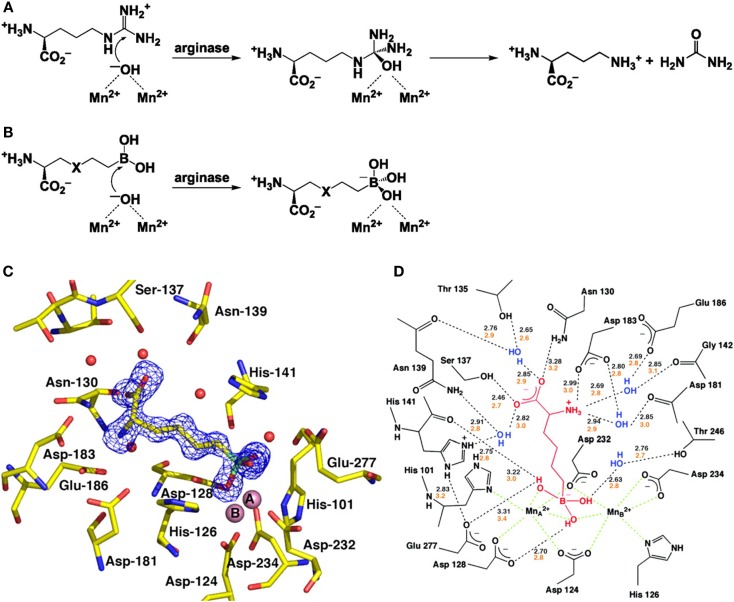
Endothelial dysfunction and resulting vascular pathology have been identified as an early hallmark of multiple diseases, including diabetes mellitus. One of the major contributors to endothelial dysfunction is a decrease in nitric oxide (NO) bioavailability, impaired NO signaling, and an increase in the amount of reactive oxygen species (ROS). In the endothelium NO is produced by endothelial nitric oxide synthase (eNOS), for which l-arginine is a substrate. Arginase, an enzyme critical in the urea cycle also metabolizes l-arginine, thereby directly competing with eNOS for their common substrate and constraining its bioavailability for eNOS, thereby compromising NO production. Arginase expression and activity is upregulated in many cardiovascular diseases including ischemia reperfusion injury, hypertension, atherosclerosis, and diabetes mellitus. More importantly, since the 1990s, specific arginase inhibitors such as N-hydroxy-guanidinium or N-hydroxy-nor-l-arginine, and boronic acid derivatives, such as, 2(S)-amino-6-boronohexanoic acid, and S-(2-boronoethyl)-l-cysteine, that can bridge the binuclear manganese cluster of arginase have been developed. These highly potent and specific inhibitors can now be used to probe arginase function and thereby modulate the redox milieu of the cell by changing the balance between NO and ROS. Inspired by this success, drug discovery programs have recently led to the identification of α-α-disubstituted amino acid based arginase inhibitors [such as (R)-2-amino-6-borono-2-(2-(piperidin-1-yl)ethyl)hexanoic acid], that are currently under early investigation as therapeutics. Finally, some investigators concentrate on identification of plant derived compounds with arginase inhibitory capability, such as piceatannol-3'-O-β-d-glucopyranoside (PG). All of these synthesized or naturally derived small molecules may represent novel therapeutics for vascular disease particularly that associated with diabetes.
内皮功能障碍及由此导致的血管病变已被确定为包括糖尿病在内的多种疾病的早期标志。内皮功能障碍的主要促成因素之一是一氧化氮(NO)生物利用度降低、NO信号传导受损以及活性氧(ROS)量增加。在内皮细胞中,NO由内皮型一氧化氮合酶(eNOS)产生,L-精氨酸是其底物。精氨酸酶是尿素循环中的一种关键酶,也代谢L-精氨酸,从而直接与eNOS竞争其共同底物,并限制其对eNOS的生物利用度,进而损害NO的产生。在许多心血管疾病中,包括缺血再灌注损伤、高血压、动脉粥样硬化和糖尿病,精氨酸酶的表达和活性都会上调。更重要的是,自20世纪90年代以来,已经开发出了特异性精氨酸酶抑制剂,如N-羟基胍或N-羟基-N-L-精氨酸,以及硼酸衍生物,如2(S)-氨基-6-硼代己酸和S-(2-硼代乙基)-L-半胱氨酸,它们可以桥接精氨酸酶的双核锰簇。这些高效且特异性的抑制剂现在可用于探究精氨酸酶的功能,从而通过改变NO和ROS之间的平衡来调节细胞的氧化还原环境。受此成功启发,药物研发项目最近已鉴定出基于α-α-二取代氨基酸的精氨酸酶抑制剂[如(R)-2-氨基-6-硼代-2-(2-(哌啶-1-基)乙基)己酸],目前正作为治疗药物进行早期研究。最后,一些研究人员专注于鉴定具有精氨酸酶抑制能力的植物衍生化合物,如白皮杉醇-3'-O-β-D-吡喃葡萄糖苷(PG)。所有这些合成的或天然衍生的小分子可能代表了治疗血管疾病,特别是与糖尿病相关的血管疾病的新型疗法。