
医学催眠疗法对患有慢性疼痛的服装业员工的影响。
The effects of a medical hypnotherapy on clothing industry employees suffering from chronic pain.
机构信息
Ergonomics Research Centre, University of Latvia, Riga, Latvia.
出版信息
J Occup Med Toxicol. 2013 Sep 25;8(1):25. doi: 10.1186/1745-6673-8-25.
BACKGROUND
Problems associated with pain in several body regions due to work-related musculoskeletal disorders (WRMDs), repetitive movement and negative stress at work are quite common in many manufacturing industries of Latvia, int.al. clothing industry. The aim of this study was to evaluate efficiency of the psychotherapeutic intervention using medical hypnotherapy (MH) program for mind-body relaxation with pain-blocking imagery, cognitive restructuring of unpleasant physical and emotional experience.
METHODS
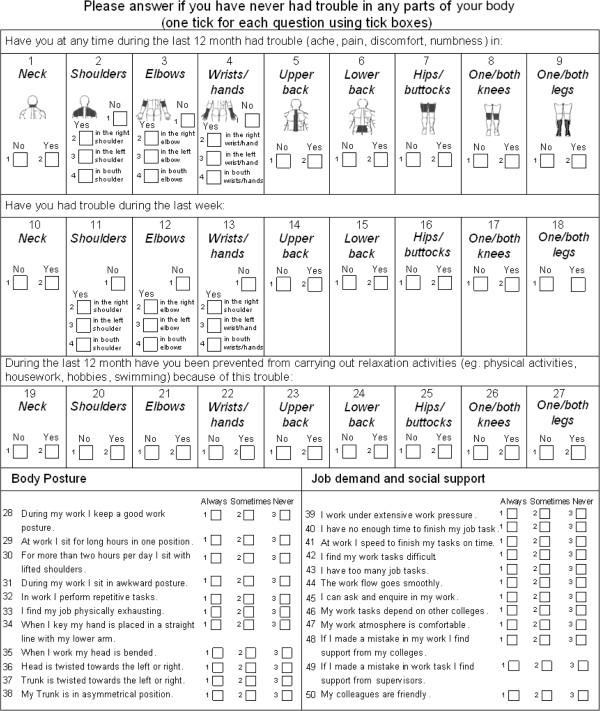
300 sewers and 50 cutters with chronic pain were involved in the study. Self-rated WRMDs symptoms, pain intensity and interference were assessed using the extended version of Nordic Musculoskeletal Questionnaire and Brief Pain Inventory Scale. Assessment of the functional state of muscles was carried out using myotonometric (MYO) measurements. Work heaviness degree was estimated via heart rate monitoring (HRM). The MH program was composed of cognitive hypnotherapy and self-hypnosis training. Sunnen Trance Scale was used to determine person's hypnotic susceptibility. Life quality assessment before and after MH program was carried out using Quality of Life Scale.
RESULTS
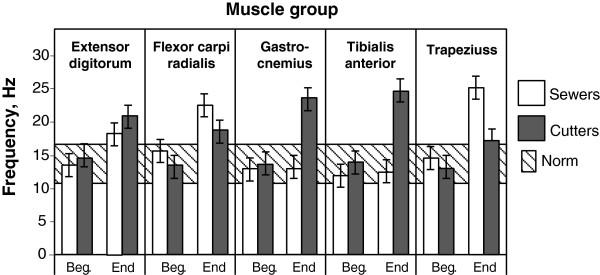
At the beginning of MH program sessions both sewers and cutters reported on pain interference with general activities, mood, sleep, normal work, etc., but after MH the interference of pain significantly decreased. HRM data confirmed that work heaviness degree of sewers and cutters can be referred to as light and moderate work (energy expenditure for their tasks varies from 3.4 till 4.7 kcal/min). Using MYO measurements it was stated that before MH 22% of workers involved in the study fell under III MYO category indices, consequently, their muscle tone was increased, which is associated with muscular fatigue. After MH muscle tone remained within the normal range meaning that they were able to adapt to the existing workload (II MYO category) or fully relax (I MYO category).
CONCLUSIONS
MH program including exercises-workouts, cognitive hypnotherapy and self-hypnosis training sessions is an effective method to decrease composite chronic pain intensity for sewers and cutters, as well as to decrease psychogenic tension and muscle fatigue (proved by objective measurements of muscles tone) and to increase the life quality.
背景
在拉脱维亚的许多制造业中,包括服装业,由于与工作相关的肌肉骨骼疾病(WRMD)、重复性运动和工作中的负面压力,导致身体多个部位疼痛的问题相当普遍。本研究的目的是评估使用医疗催眠疗法(MH)程序进行身心放松的心理治疗干预的效果,该程序包括疼痛阻断意象、对不愉快的身体和情绪体验进行认知重构。
方法
研究纳入了 300 名缝纫工和 50 名裁剪工,他们患有慢性疼痛。使用北欧肌肉骨骼问卷的扩展版本和简明疼痛量表(Brief Pain Inventory Scale)评估自我报告的 WRMD 症状、疼痛强度和干扰。使用肌电描记术(MYO)测量评估肌肉功能状态。通过心率监测(HRM)评估工作繁重程度。MH 方案由认知催眠和自我催眠训练组成。使用 Sunnen 恍惚量表确定人的催眠易感性。使用生活质量量表评估 MH 方案前后的生活质量。
结果
在 MH 方案开始时,缝纫工和裁剪工都报告说疼痛对一般活动、情绪、睡眠、正常工作等造成干扰,但在 MH 之后,疼痛的干扰显著减少。HRM 数据证实,缝纫工和裁剪工的工作繁重程度可归类为轻至中度工作(他们的任务的能量消耗在 3.4 至 4.7 千卡/分钟之间)。使用 MYO 测量发现,在 MH 之前,研究中 22%的工人属于 III MYO 类别指数,因此,他们的肌肉紧张度增加,这与肌肉疲劳有关。在 MH 之后,肌肉紧张度保持在正常范围内,这意味着他们能够适应现有的工作量(II MYO 类别)或完全放松(I MYO 类别)。
结论
MH 方案包括锻炼、认知催眠和自我催眠训练课程,是一种有效降低缝纫工和裁剪工综合慢性疼痛强度的方法,同时还可以降低心理紧张和肌肉疲劳(通过客观测量肌肉紧张度证明),提高生活质量。




 Zotero 插件