School of Medicine, University of Louisville, Louisville, Kentucky, United States of America.
PLoS Comput Biol. 2013;9(9):e1003231. doi: 10.1371/journal.pcbi.1003231. Epub 2013 Sep 19.
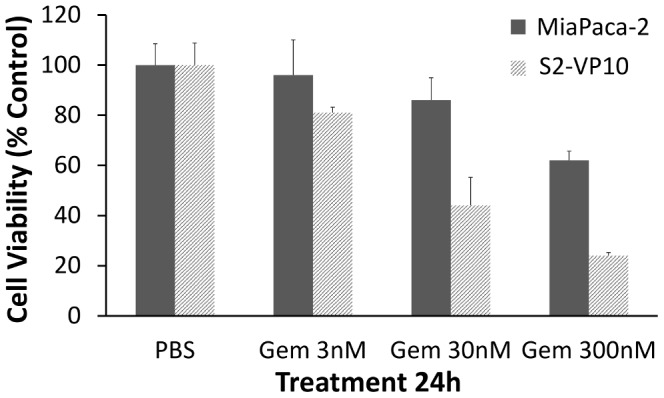
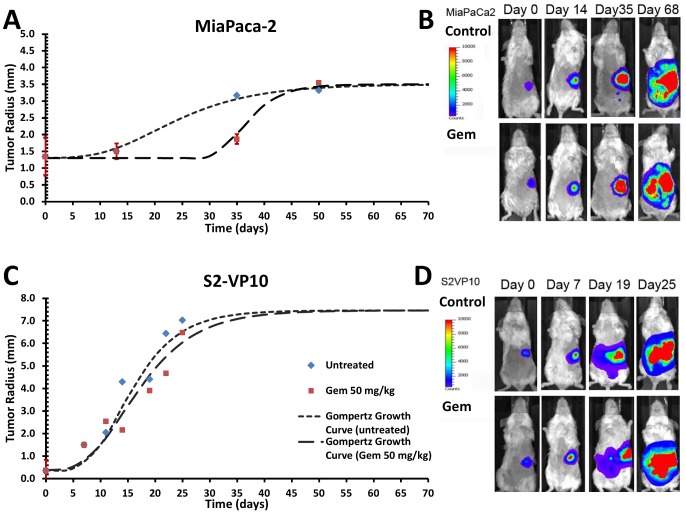
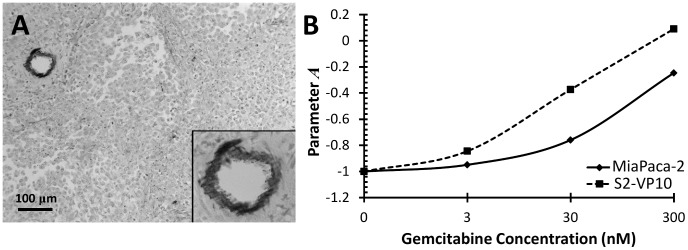
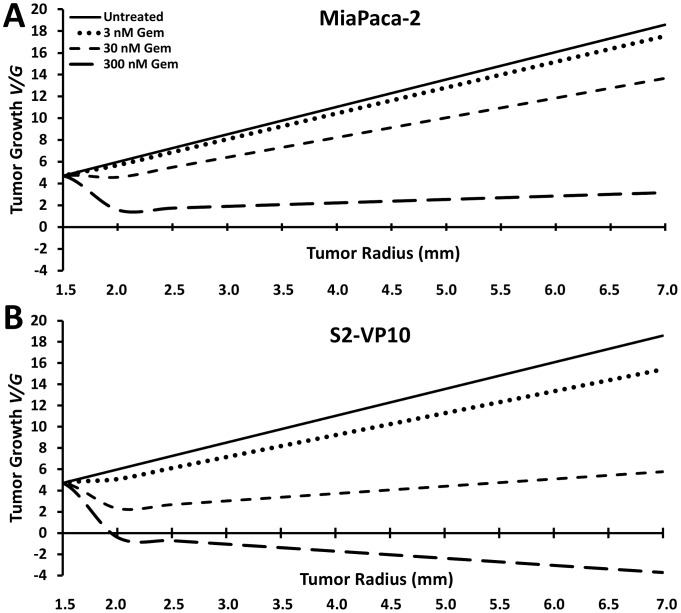
A clear contradiction exists between cytotoxic in-vitro studies demonstrating effectiveness of Gemcitabine to curtail pancreatic cancer and in-vivo studies failing to show Gemcitabine as an effective treatment. The outcome of chemotherapy in metastatic stages, where surgery is no longer viable, shows a 5-year survival <5%. It is apparent that in-vitro experiments, no matter how well designed, may fail to adequately represent the complex in-vivo microenvironmental and phenotypic characteristics of the cancer, including cell proliferation and apoptosis. We evaluate in-vitro cytotoxic data as an indicator of in-vivo treatment success using a mathematical model of tumor growth based on a dimensionless formulation describing tumor biology. Inputs to the model are obtained under optimal drug exposure conditions in-vitro. The model incorporates heterogeneous cell proliferation and death caused by spatial diffusion gradients of oxygen/nutrients due to inefficient vascularization and abundant stroma, and thus is able to simulate the effect of the microenvironment as a barrier to effective nutrient and drug delivery. Analysis of the mathematical model indicates the pancreatic tumors to be mostly resistant to Gemcitabine treatment in-vivo. The model results are confirmed with experiments in live mice, which indicate uninhibited tumor proliferation and metastasis with Gemcitabine treatment. By extracting mathematical model parameter values for proliferation and death from monolayer in-vitro cytotoxicity experiments with pancreatic cancer cells, and simulating the effects of spatial diffusion, we use the model to predict the drug response in-vivo, beyond what would have been expected from sole consideration of the cancer intrinsic resistance. We conclude that this integrated experimental/computational approach may enhance understanding of pancreatic cancer behavior and its response to various chemotherapies, and, further, that such an approach could predict resistance based on pharmacokinetic measurements with the goal to maximize effective treatment strategies.
体外细胞毒性研究表明吉西他滨能够有效抑制胰腺癌,而体内研究却未能证明吉西他滨是一种有效的治疗方法,这两者之间存在明显的矛盾。在转移性阶段(手术不再可行)进行化疗的结果显示,5 年生存率<5%。显然,无论设计多么完善,体外实验都可能无法充分代表癌症复杂的体内微环境和表型特征,包括细胞增殖和凋亡。我们使用基于描述肿瘤生物学的无维形式化的肿瘤生长数学模型,将体外细胞毒性数据评估为体内治疗成功的指标。模型的输入是在体外最佳药物暴露条件下获得的。该模型纳入了由于血管化效率低下和丰富的基质导致的氧气/营养物质的空间扩散梯度引起的异质细胞增殖和死亡,因此能够模拟微环境作为有效营养物质和药物输送的屏障的影响。数学模型的分析表明,胰腺肿瘤在体内对吉西他滨治疗大多具有抗性。通过在活小鼠中进行实验,验证了模型的结果,实验表明吉西他滨治疗会导致肿瘤不受抑制地增殖和转移。通过从胰腺癌细胞的单层体外细胞毒性实验中提取增殖和死亡的数学模型参数值,并模拟空间扩散的影响,我们使用该模型预测体内药物反应,这超出了仅考虑癌症内在抗性所预期的范围。我们得出结论,这种综合的实验/计算方法可以增强对胰腺癌行为及其对各种化疗药物反应的理解,并且,这种方法可以基于药代动力学测量来预测耐药性,以最大化有效的治疗策略。