Academic Department of Rheumatology, Centre for Molecular and Cellular Biology of Inflammation, King's College London, London, United Kingdom ; Department of Medical and Molecular Genetics, King's College London, London, United Kingdom.
PLoS Genet. 2013;9(9):e1003808. doi: 10.1371/journal.pgen.1003808. Epub 2013 Sep 19.
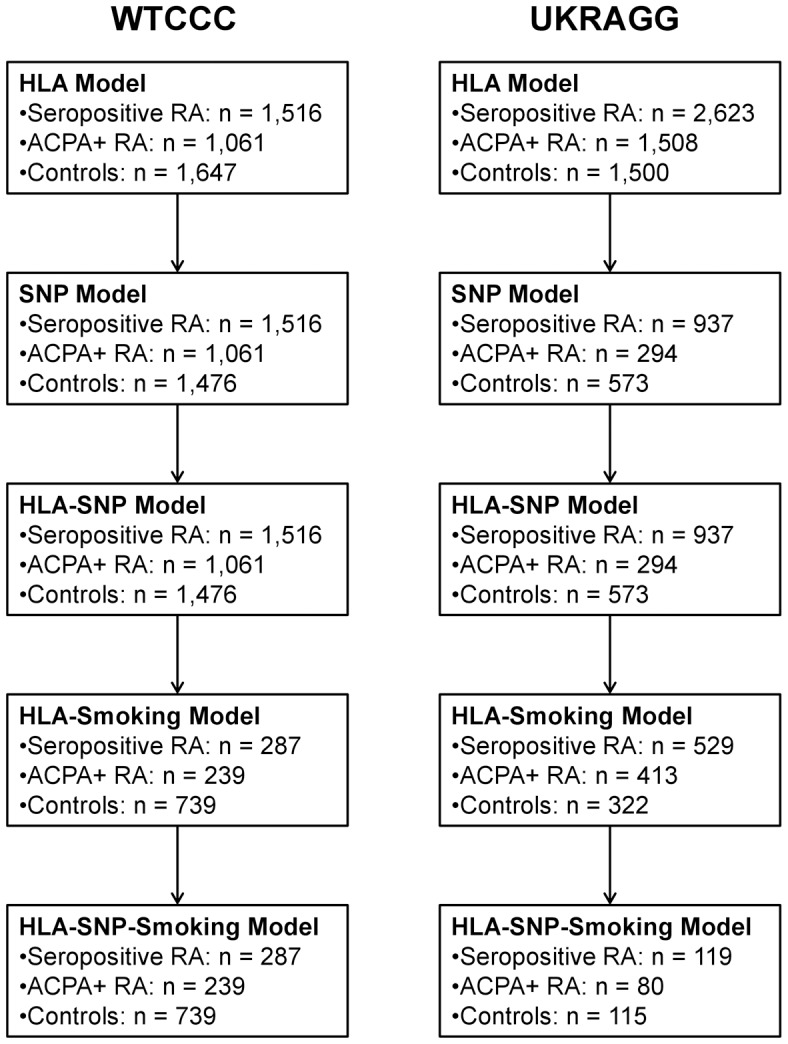
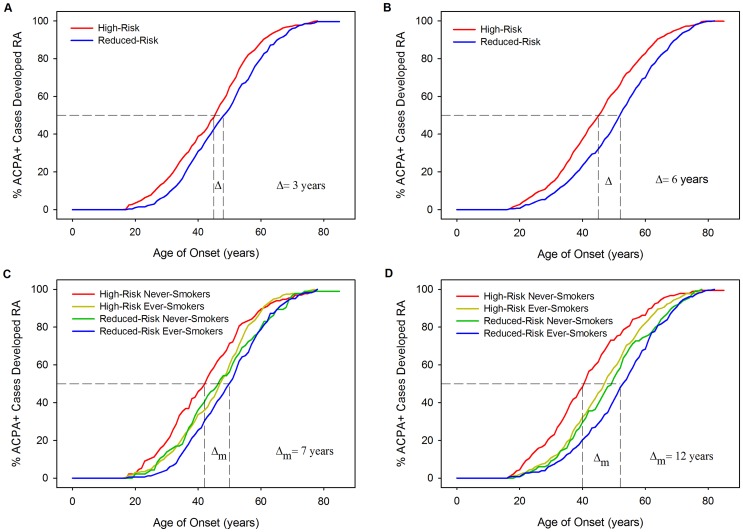
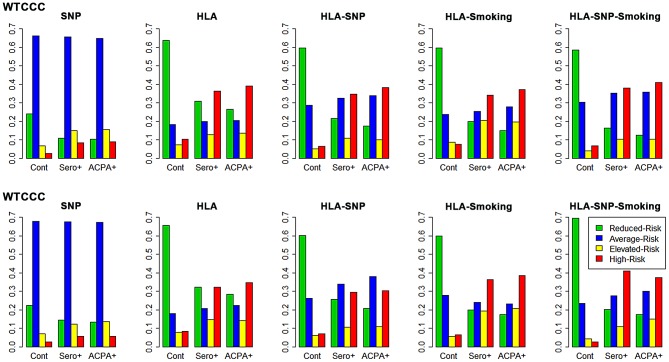
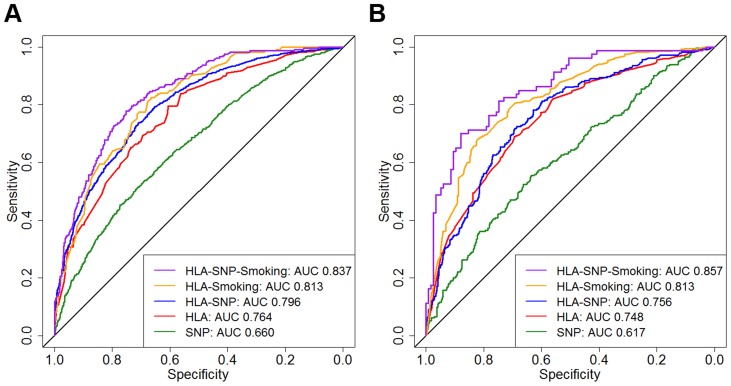
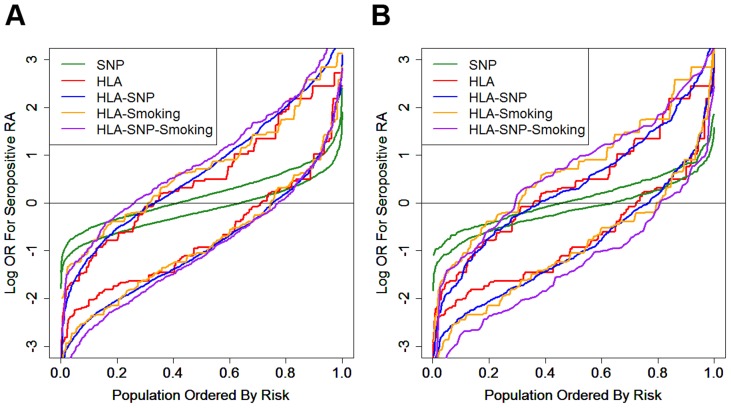
The improved characterisation of risk factors for rheumatoid arthritis (RA) suggests they could be combined to identify individuals at increased disease risks in whom preventive strategies may be evaluated. We aimed to develop an RA prediction model capable of generating clinically relevant predictive data and to determine if it better predicted younger onset RA (YORA). Our novel modelling approach combined odds ratios for 15 four-digit/10 two-digit HLA-DRB1 alleles, 31 single nucleotide polymorphisms (SNPs) and ever-smoking status in males to determine risk using computer simulation and confidence interval based risk categorisation. Only males were evaluated in our models incorporating smoking as ever-smoking is a significant risk factor for RA in men but not women. We developed multiple models to evaluate each risk factor's impact on prediction. Each model's ability to discriminate anti-citrullinated protein antibody (ACPA)-positive RA from controls was evaluated in two cohorts: Wellcome Trust Case Control Consortium (WTCCC: 1,516 cases; 1,647 controls); UK RA Genetics Group Consortium (UKRAGG: 2,623 cases; 1,500 controls). HLA and smoking provided strongest prediction with good discrimination evidenced by an HLA-smoking model area under the curve (AUC) value of 0.813 in both WTCCC and UKRAGG. SNPs provided minimal prediction (AUC 0.660 WTCCC/0.617 UKRAGG). Whilst high individual risks were identified, with some cases having estimated lifetime risks of 86%, only a minority overall had substantially increased odds for RA. High risks from the HLA model were associated with YORA (P<0.0001); ever-smoking associated with older onset disease. This latter finding suggests smoking's impact on RA risk manifests later in life. Our modelling demonstrates that combining risk factors provides clinically informative RA prediction; additionally HLA and smoking status can be used to predict the risk of younger and older onset RA, respectively.
类风湿关节炎(RA)风险因素的特征得到改善,这表明可以将它们结合起来,以识别疾病风险增加的个体,从而评估预防策略。我们旨在开发一种能够生成临床相关预测数据的 RA 预测模型,并确定其是否能更好地预测年轻发病的 RA(YORA)。我们的新型建模方法结合了 15 个四位数字/10 个两位数字 HLA-DRB1 等位基因、31 个单核苷酸多态性(SNP)和男性的吸烟状态的比值比,通过计算机模拟和基于置信区间的风险分类来确定风险。只有男性被纳入我们的模型进行评估,因为吸烟是男性而非女性患 RA 的重要危险因素。我们开发了多种模型来评估每个风险因素对预测的影响。我们在两个队列中评估了每个模型区分抗瓜氨酸蛋白抗体(ACPA)阳性 RA 与对照的能力:威康信托基金会病例对照研究(WTCCC:1516 例;1647 例对照);英国 RA 遗传组联盟(UKRAGG:2623 例;1500 例对照)。HLA 和吸烟提供了最强的预测,证据是 HLA-吸烟模型在 WTCCC 和 UKRAGG 的曲线下面积(AUC)值分别为 0.813。SNP 提供了最小的预测(AUC 值分别为 0.660 WTCCC/0.617 UKRAGG)。虽然确定了一些高个体风险,但有些病例的终身患病风险估计为 86%,但总体而言,只有少数病例的 RA 发病几率大大增加。HLA 模型的高风险与 YORA 相关(P<0.0001);吸烟与发病年龄较大有关。后一种发现表明,吸烟对 RA 风险的影响在生命后期才显现出来。我们的建模表明,将风险因素结合起来可以提供有临床意义的 RA 预测;此外,HLA 和吸烟状况可以分别用于预测年轻和年老发病的 RA 风险。