Shand Grayden, Fuller Daniel T, Lufkin Leon, Lovelett Carly, Pal Nabendu, Mondal Sumona, Sur Shantanu
David D. Reh School of Business, Clarkson University, Potsdam, NY, United States.
Department of Mathematics, Clarkson University, Potsdam, NY, United States.
Front Epidemiol. 2023 Dec 15;3:1216497. doi: 10.3389/fepid.2023.1216497. eCollection 2023.
Rheumatoid arthritis (RA) is an autoimmune disorder characterized by chronic and systemic inflammation. Recent research underscores the role of chronic inflammation in multiple common RA comorbidities such as depression, obesity, and cardiovascular diseases (CVDs), suggesting a potential overlap of the pathogenic mechanisms for RA. However, it is not well understood how the coexistence of these comorbid conditions impacts the risk of RA and whether any such association relates to body's inflammatory state.
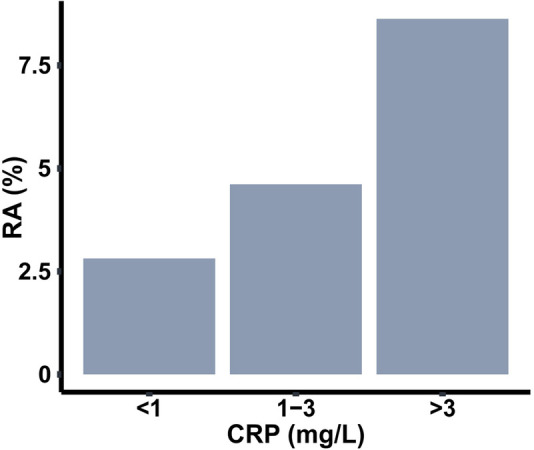
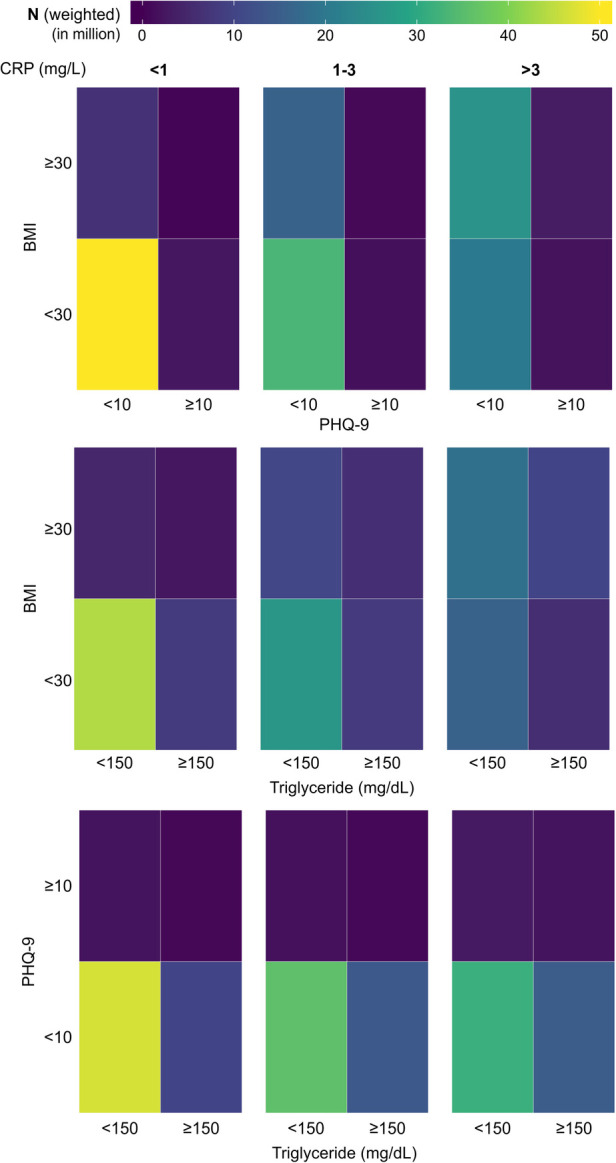
We used data from the 2007-2010 United States National Health and Nutrition Examination Survey (NHANES) database and compared RA prevalence between subsamples with the presence of any two conditions among depression, obesity, and hypertriglyceridemia (HTG). Each subsample was further divided into three categories based on the serum level of the inflammatory marker C-reactive protein (CRP) and analyzed for statistically significant differences using three-way tests of independence.
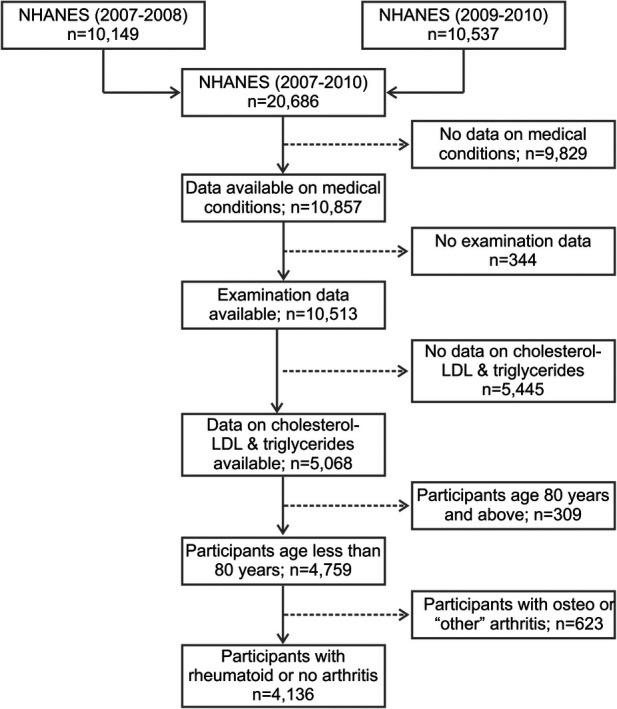
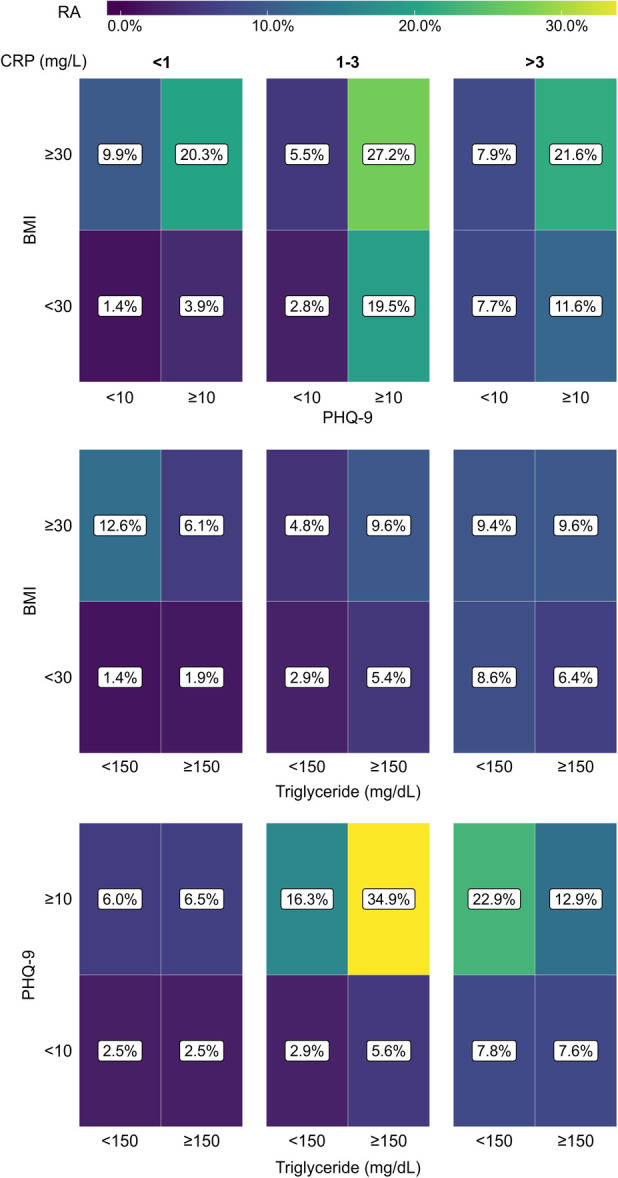
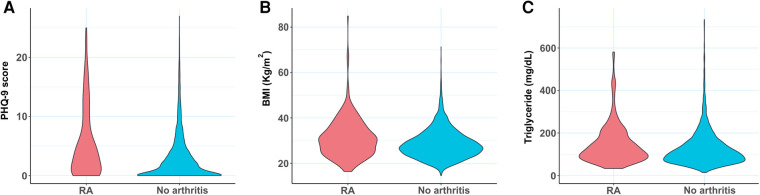
The study was conducted on 4,136 patients who fulfilled the inclusion criteria (representing 163,540,241 individuals after adjustment for sampling weights). Rates of depression, obesity, and HTG were found to be significantly higher ( < 0.001) among the subjects with RA compared with the control population with no arthritis. The presence of depression along with obesity or HTG showed a noticeably higher RA prevalence but such an association was not observed for the combination of obesity and HTG. The synergistic effect of HTG with depression was found to be most prominent at a medium CRP level (1-3 mg/L), while for obesity, the effect was observed across all CRP levels examined. These findings were further confirmed by the three-way test for independence.
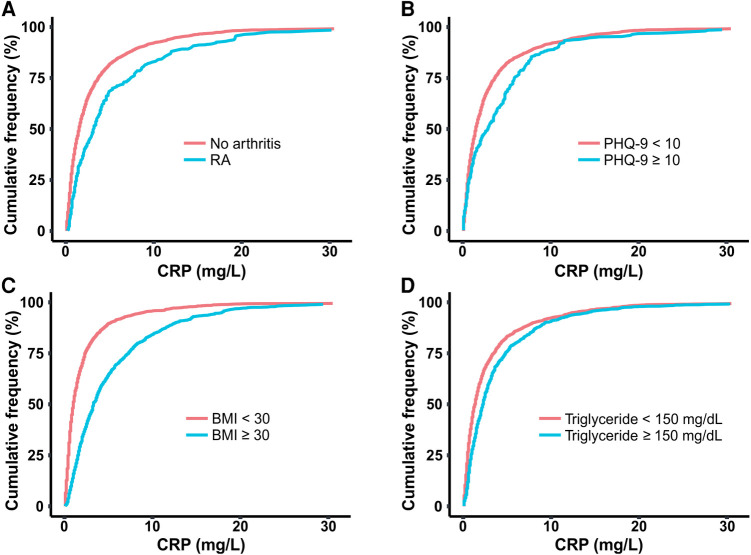
The presence of obesity or HTG in subjects suffering from depression might pose an increased risk of RA. Inflammatory mechanisms potentially play an important underlying role as suggested by the strong dependency of the association to CRP level. Identification of synergistic associations between RA risk conditions could provide useful information to predict the development and progress of RA.
类风湿关节炎(RA)是一种以慢性全身性炎症为特征的自身免疫性疾病。最近的研究强调了慢性炎症在多种常见的RA合并症中的作用,如抑郁症、肥胖症和心血管疾病(CVD),这表明RA的致病机制可能存在潜在重叠。然而,目前尚不清楚这些合并症的共存如何影响RA的风险,以及这种关联是否与身体的炎症状态有关。
我们使用了2007 - 2010年美国国家健康与营养检查调查(NHANES)数据库中的数据,比较了抑郁症、肥胖症和高甘油三酯血症(HTG)中任意两种疾病共存的亚样本之间的RA患病率。每个亚样本根据炎症标志物C反应蛋白(CRP)的血清水平进一步分为三类,并使用三向独立性检验分析统计学上的显著差异。
该研究对4136名符合纳入标准的患者进行(经抽样权重调整后代表163540241人)。与无关节炎的对照人群相比,RA患者中抑郁症、肥胖症和HTG的发生率显著更高(<0.001)。抑郁症与肥胖症或HTG共存时,RA患病率明显更高,但肥胖症和HTG的组合未观察到这种关联。发现HTG与抑郁症的协同效应在中等CRP水平(1 - 至3mg/L)时最为显著,而对于肥胖症,在所有检测的CRP水平上均观察到该效应。这些发现通过三向独立性检验得到进一步证实。
抑郁症患者中肥胖症或HTG的存在可能会增加患RA的风险。正如该关联对CRP水平的强烈依赖性所表明的那样,炎症机制可能起着重要的潜在作用。识别RA风险状况之间的协同关联可为预测RA的发展和进程提供有用信息。