Bennett Paul N, Daly Robin M, Fraser Steve F, Haines Terry, Barnard Robert, Ockerby Cherene, Kent Bridie
Centre for Nursing Research - Deakin University and Monash Health Partnership, Clayton, Victoria 3168, Australia.
BMC Nephrol. 2013 Sep 27;14:204. doi: 10.1186/1471-2369-14-204.
Exercise during hemodialysis treatments improves physical function, markers of cardiovascular disease and quality of life. However, exercise programs are not a part of standard therapy in the vast majority of hemodialysis clinics internationally. Hemodialysis unit-based accredited exercise physiologists may contribute to an increased intradialytic exercise uptake and improved physical function.
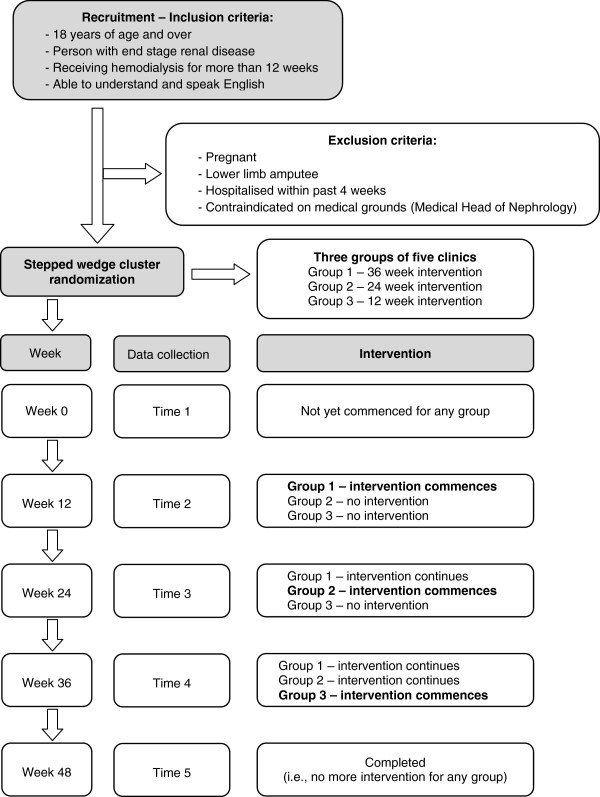
This is a stepped wedge cluster randomised controlled trial design. A total of 180 participants will be recruited from 15 community satellite hemodialysis clinics in a large metropolitan Australian city. Each clinic will represent a cluster unit. The stepped wedge design will consist of three groups each containing five randomly allocated cluster units, allocated to either 12, 24 or 36 weeks of the intervention. The intervention will consist of an accredited exercise physiologist-coordinated program consisting of six lower body resistance exercises using resistance elastic bands and tubing. The resistance exercises will include leg abduction, plantar flexion, dorsi flexion, straight-leg/bent-knee raise, knee extension and knee flexion. The resistance training will incorporate the principle of progressive overload and completed in a seated position during the first hour of hemodialysis treatment. The primary outcome measure is objective physical function measured by the 30-second sit to stand test. Secondary outcome measures include the 8-foot timed-up-and-go test, the four square step test, quality of life, cost-utility analysis, uptake and involvement in community activity, self-reported falls, fall's confidence, medication use, blood pressure and morbidity (hospital admissions).
The results of this study are expected to determine the efficacy of an accredited exercise physiologist supervised resistance training on the physical function of people receiving hemodialysis and the cost-utility of exercise physiologists in hemodialysis centres. This may contribute to intradialytic exercise as standard therapy using an exercise physiologist workforce model.
Current Controlled Trials ACTRN12612001223820.
血液透析治疗期间进行运动可改善身体功能、心血管疾病标志物及生活质量。然而,在国际上绝大多数血液透析诊所中,运动项目并非标准治疗的一部分。基于血液透析单元的认证运动生理学家可能有助于增加透析期间的运动参与度并改善身体功能。
这是一项阶梯式楔形整群随机对照试验设计。将从澳大利亚一个大城市的15个社区卫星血液透析诊所招募总共180名参与者。每个诊所将代表一个整群单元。阶梯式楔形设计将包括三组,每组包含五个随机分配的整群单元,分别分配到12周、24周或36周的干预。干预将包括一个由认证运动生理学家协调的项目,该项目包括使用阻力弹性带和管材进行的六项下肢阻力运动。阻力运动将包括腿部外展、跖屈、背屈、直腿/屈膝抬高、膝关节伸展和膝关节屈曲。阻力训练将纳入渐进性超负荷原则,并在血液透析治疗的第一个小时内以坐姿完成。主要结局指标是通过30秒坐立试验测量的客观身体功能。次要结局指标包括8英尺计时起立行走试验、四方步试验、生活质量、成本效用分析、社区活动的参与度和参与情况、自我报告的跌倒、跌倒信心、药物使用、血压和发病率(住院情况)。
本研究结果有望确定认证运动生理学家监督的阻力训练对接受血液透析者身体功能的疗效以及运动生理学家在血液透析中心的成本效用。这可能有助于将透析期间运动作为使用运动生理学家劳动力模式的标准治疗方法。
当前受控试验ACTRN12612001223820。