Auburn University , Department of Chemistry and Biochemistry, Auburn, Alabama 36849 United States.
Anal Chem. 2013 Nov 5;85(21):10556-64. doi: 10.1021/ac4026048. Epub 2013 Oct 23.
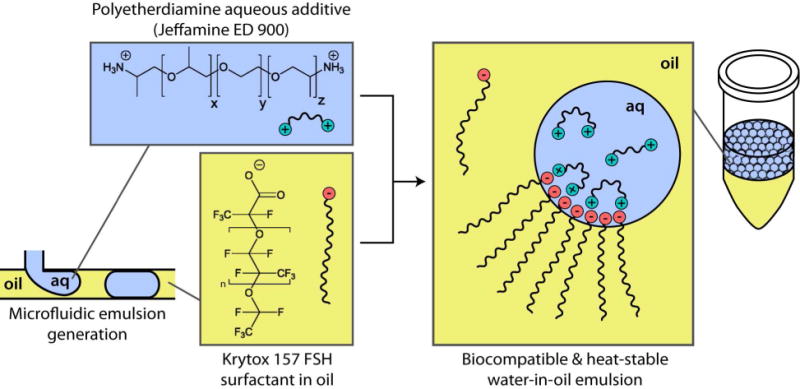
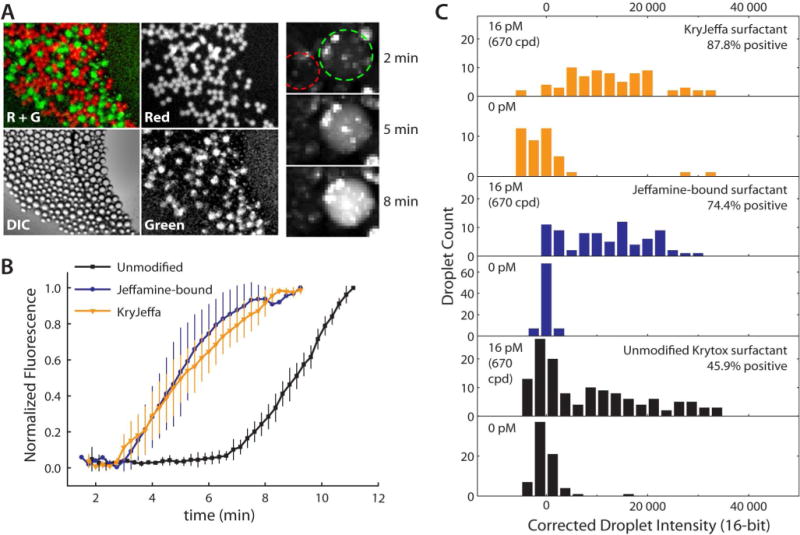
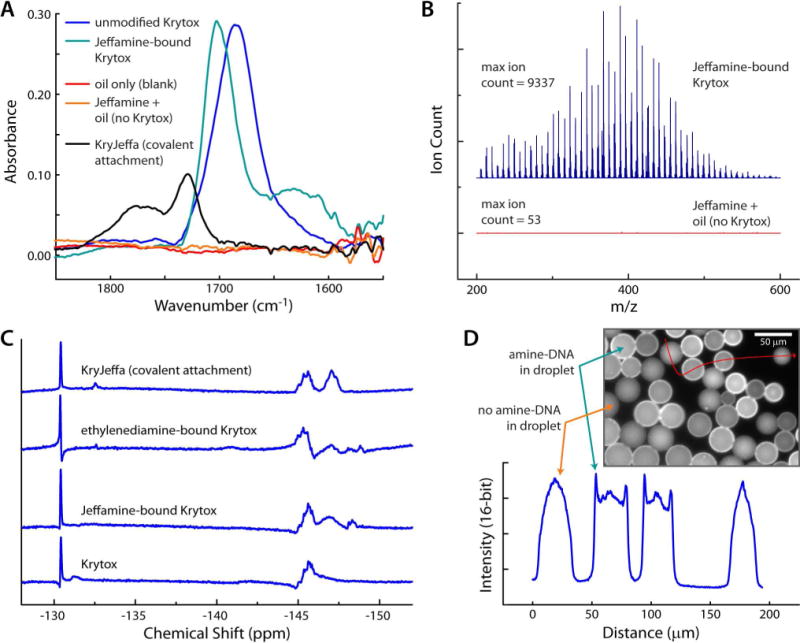
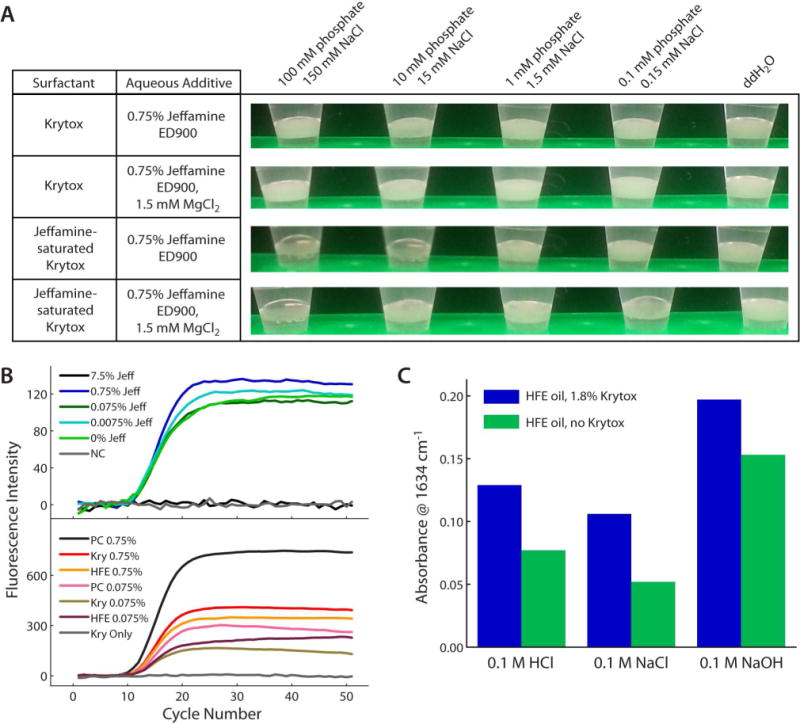
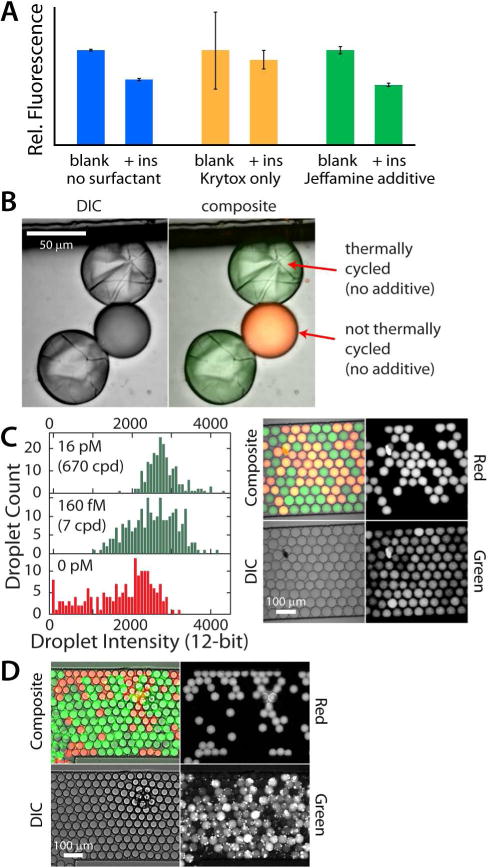
Currently, one of the most prominent methods used to impart biocompatibility to aqueous-in-oil droplets is to synthesize a triblock copolymer surfactant composed of perfluoropolyether and polyether blocks. The resulting surfactants (EA surfactant, KryJeffa, etc.) allow generation of highly biocompatible droplet surfaces while maintaining the heat stability of the starting material. However, production of these surfactants requires expertise in synthetic organic chemistry, creating a barrier to widespread adoption in the field. Herein, we describe a simple alternative to synthetic modification of surfactants to impart biocompatibility. We have observed that aqueous-in-oil droplet surfaces can be made biocompatible and heat stable by merely exploiting binding interactions between polyetherdiamine additives in the aqueous phase and carboxylated perfluorocarbon surfactants in the oil phase. Droplets formed under these conditions are shown to possess biocompatible surfaces capable of supporting picoliter-scale protein assays, droplet polymerase chain reaction (PCR), and droplet DNA amplification with isothermal recombinase polymerase amplification (RPA). Droplets formed with polyetherdiamine aqueous additives are stable enough to withstand temperature cycling during PCR (30-40 cycles at 60-94 °C) while maintaining biocompatibility, and the reaction efficiency of RPA is shown to be similar to that with a covalently modified surfactant (KryJeffa). The binding interaction was confirmed with various methods, including FT-IR spectroscopy, NMR spectroscopy, electrospray ionization mass spectrometry (ESI-MS), and fluorescence microscopy. Overall, our results suggest that, by simply introducing a commercially-available, polyetherdiamine additive (Jeffamine ED-900) to the aqueous phase, researchers can avoid synthetic methods in generating biocompatible droplet surfaces capable of supporting DNA and protein analysis at the subnanoliter scale.
目前,赋予水包油液滴生物相容性的最突出方法之一是合成由全氟聚醚和聚醚嵌段组成的三嵌段共聚物表面活性剂。所得表面活性剂(EA 表面活性剂、KryJeffa 等)允许生成高度生物相容的液滴表面,同时保持起始材料的热稳定性。然而,这些表面活性剂的生产需要合成有机化学方面的专业知识,这在一定程度上阻碍了它们在该领域的广泛应用。在此,我们描述了一种替代合成表面活性剂修饰以赋予生物相容性的简单方法。我们已经观察到,通过仅仅利用水相中的聚醚二胺添加剂与油相中的羧基全氟碳表面活性剂之间的结合相互作用,就可以使水包油液滴表面具有生物相容性和热稳定性。在这些条件下形成的液滴被证明具有生物相容性的表面,能够支持皮升级别的蛋白质分析、液滴聚合酶链反应 (PCR) 以及使用等温重组酶聚合酶扩增 (RPA) 的液滴 DNA 扩增。带有聚醚二胺水相添加剂的液滴足够稳定,可以在 PCR 过程中承受温度循环(60-94°C 下 30-40 个循环),同时保持生物相容性,并且 RPA 的反应效率与共价修饰的表面活性剂(KryJeffa)相似。通过各种方法,包括傅里叶变换红外光谱 (FT-IR) 光谱、核磁共振 (NMR) 光谱、电喷雾电离质谱 (ESI-MS) 和荧光显微镜,证实了这种结合相互作用。总体而言,我们的结果表明,通过简单地向水相引入市售的聚醚二胺添加剂(Jeffamine ED-900),研究人员可以避免使用合成方法生成能够在亚纳升级别支持 DNA 和蛋白质分析的生物相容液滴表面。