Max-Planck-Institut für Biophysik, Frankfurt, Germany ; Institut für Biophysik und Physikalische Biochemie, Universität Regensburg, Regensburg, Germany.
PLoS One. 2013 Sep 20;8(9):e74707. doi: 10.1371/journal.pone.0074707. eCollection 2013.
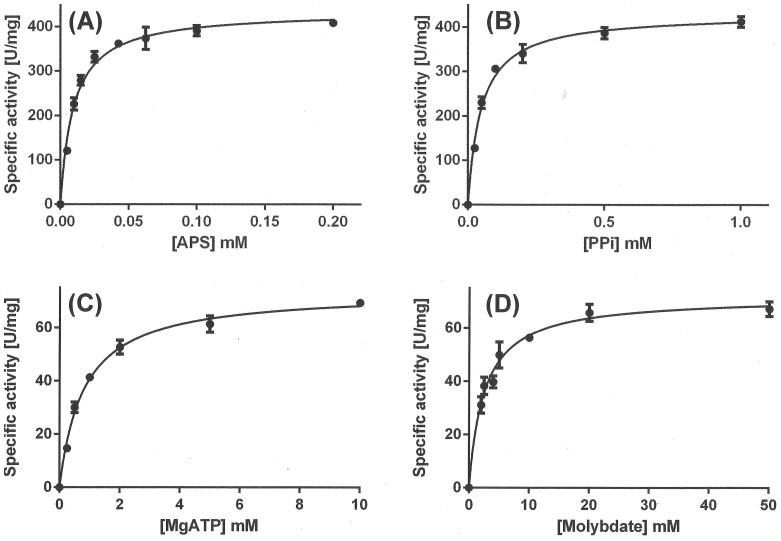
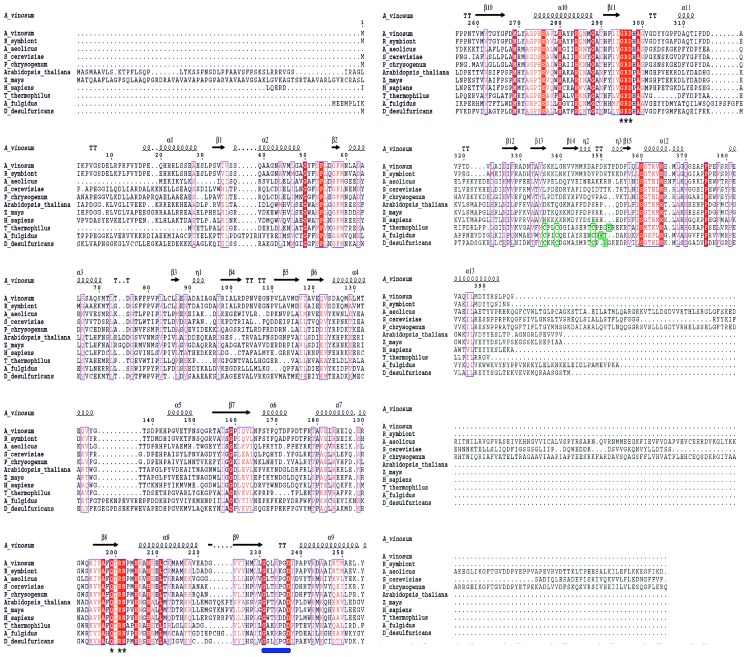
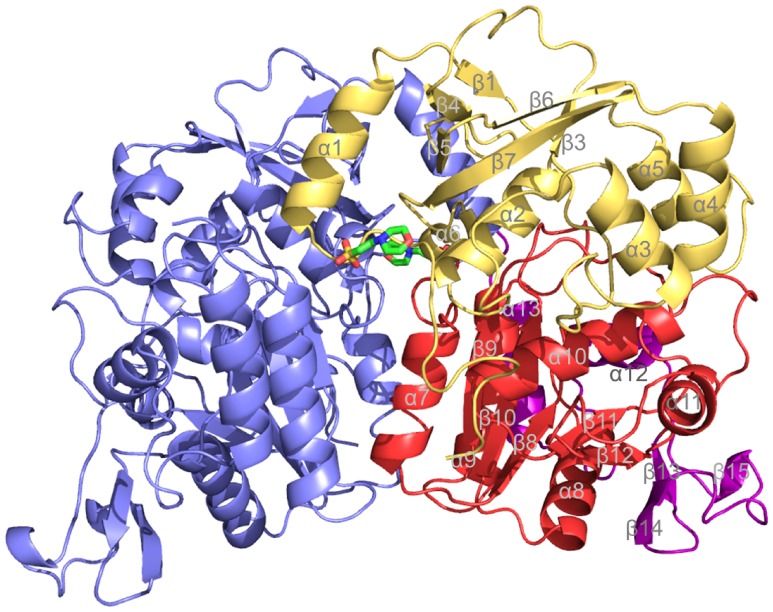
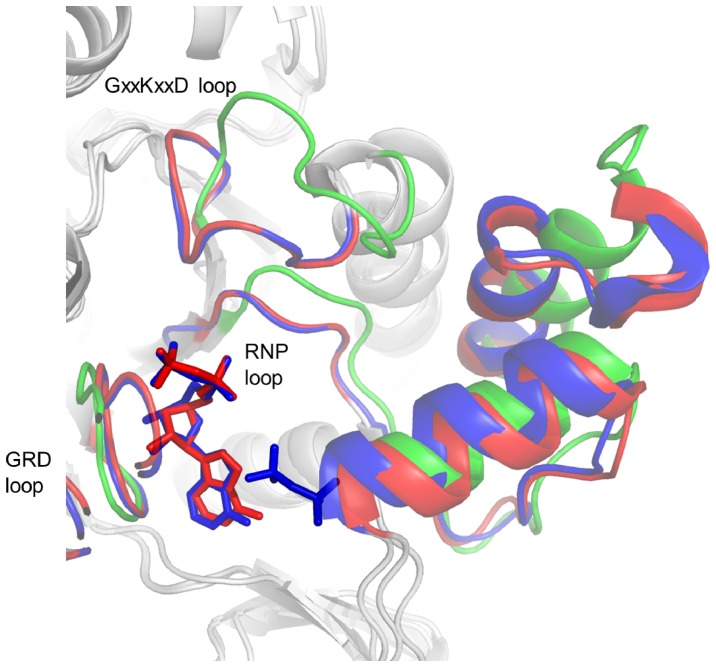
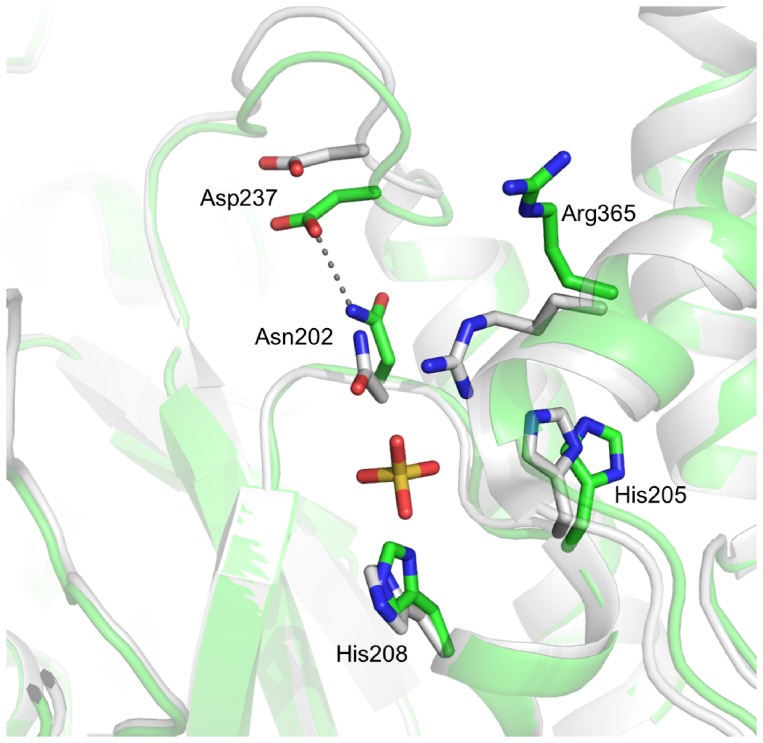
ATP sulfurylase (ATPS) catalyzes a key reaction in the global sulfur cycle by reversibly converting inorganic sulfate (SO4 (2-)) with ATP to adenosine 5'-phosphosulfate (APS) and pyrophosphate (PPi). In this work we report on the sat encoded dissimilatory ATP sulfurylase from the sulfur-oxidizing purple sulfur bacterium Allochromatium vinosum. In this organism, the sat gene is located in one operon and co-transcribed with the aprMBA genes for membrane-bound APS reductase. Like APS reductase, Sat is dispensible for growth on reduced sulfur compounds due to the presence of an alternate, so far unidentified sulfite-oxidizing pathway in A. vinosum. Sulfate assimilation also proceeds independently of Sat by a separate pathway involving a cysDN-encoded assimilatory ATP sulfurylase. We produced the purple bacterial sat-encoded ATP sulfurylase as a recombinant protein in E. coli, determined crucial kinetic parameters and obtained a crystal structure in an open state with a ligand-free active site. By comparison with several known structures of the ATPS-APS complex in the closed state a scenario about substrate-induced conformational changes was worked out. Despite different kinetic properties ATPS involved in sulfur-oxidizing and sulfate-reducing processes are not distinguishable on a structural level presumably due to the interference between functional and evolutionary processes.
三磷酸腺苷硫酸化酶 (ATPS) 通过可逆地将无机硫酸盐 (SO4 (2-)) 与 ATP 转化为腺苷 5'-磷酸硫酸 (APS) 和焦磷酸 (PPi),催化全球硫循环中的关键反应。在这项工作中,我们报告了来自硫氧化紫硫细菌 Allochromatium vinosum 的 sat 编码的异化三磷酸腺苷硫酸化酶。在该生物体中,sat 基因位于一个操纵子中,与膜结合的 APS 还原酶的 aprMBA 基因共转录。与 APS 还原酶一样,由于在 A. vinosum 中存在另一种尚未鉴定的亚硫酸盐氧化途径,因此 Sat 对于生长在还原态硫化合物上是可有可无的。硫酸盐同化也独立于 Sat 通过涉及 cysDN 编码的同化三磷酸腺苷硫酸化酶的单独途径进行。我们在大肠杆菌中产生了紫色细菌 sat 编码的三磷酸腺苷硫酸化酶作为重组蛋白,测定了关键的动力学参数,并获得了一个具有无配体活性位点的开放状态的晶体结构。通过与几种已知的闭合状态下的 ATPS-APS 复合物结构进行比较,我们提出了一个关于底物诱导构象变化的方案。尽管参与硫氧化和硫酸盐还原过程的 ATPS 在结构水平上无法区分,但这可能是由于功能和进化过程之间的干扰。