Watanabe Tomohiro, Kojima Hisaya, Umezawa Kazuhiro, Hori Chiaki, Takasuka Taichi E, Kato Yukako, Fukui Manabu
Institute of Low Temperature Science, Hokkaido University, Sapporo, Japan.
Max Planck Institute for Terrestrial Microbiology, Marburg, Germany.
Front Microbiol. 2019 Feb 25;10:316. doi: 10.3389/fmicb.2019.00316. eCollection 2019.
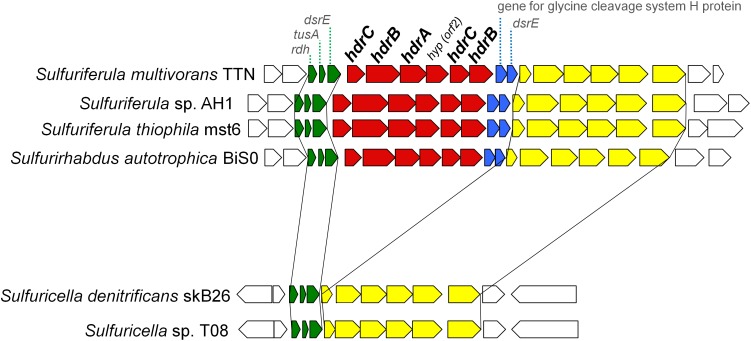
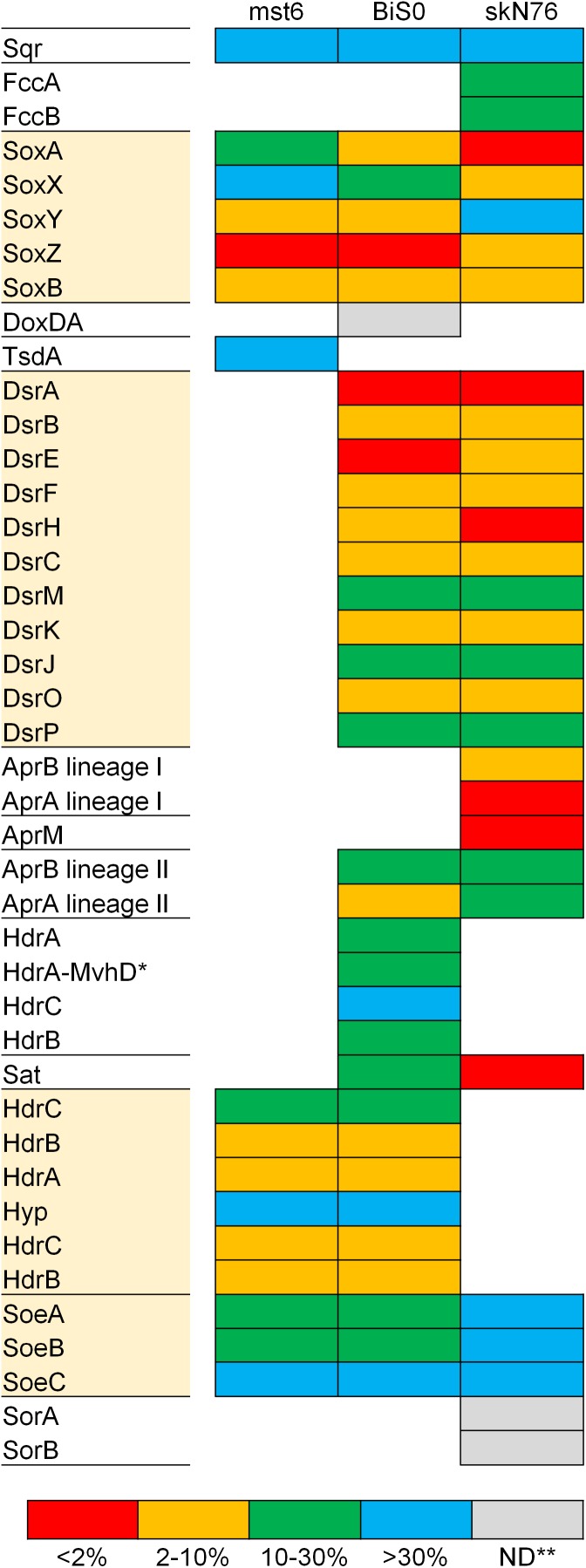
Even in the current era of metagenomics, the interpretation of nucleotide sequence data is primarily dependent on knowledge obtained from a limited number of microbes isolated in pure culture. Thus, it is of fundamental importance to expand the variety of strains available in pure culture, to make reliable connections between physiological characteristics and genomic information. In this study, two sulfur oxidizers that potentially represent two novel species were isolated and characterized. They were subjected to whole-genome sequencing together with 7 neutrophilic and chemolithoautotrophic sulfur-oxidizing bacteria. The genes for sulfur oxidation in the obtained genomes were identified and compared with those of isolated sulfur oxidizers in the classes and . Although the combinations of these genes in the respective genomes are diverse, typical combinations corresponding to three types of core sulfur oxidation pathways were identified. Each pathway involves one of three specific sets of proteins, SoxCD, DsrABEFHCMKJOP, and HdrCBAHypHdrCB. All three core pathways contain the SoxXYZAB proteins, and a cytoplasmic sulfite oxidase encoded by is a conserved component in the core pathways lacking SoxCD. Phylogenetically close organisms share same core sulfur oxidation pathway, but a notable exception was observed in the family ''. In this family, some strains have either core pathway involving DsrABEFHCMKJOP or HdrCBAHypHdrCB, while others have both pathways. A proteomics analysis showed that proteins constituting the core pathways were produced at high levels. While hypothesized function of HdrCBAHypHdrCB is similar to that of Dsr system, both sets of proteins were detected with high relative abundances in the proteome of a strain possessing genes for these proteins. In addition to the genes for sulfur oxidation, those for arsenic metabolism were searched for in the sequenced genomes. As a result, two strains belonging to the families and were observed to harbor genes encoding ArxAB, a type of arsenite oxidase that has been identified in a limited number of bacteria. These findings were made with the newly obtained genomes, including those from 6 genera from which no genome sequence of an isolated organism was previously available. These genomes will serve as valuable references to interpret nucleotide sequences.
即使在当前的宏基因组学时代,核苷酸序列数据的解读主要仍依赖于从有限数量的纯培养分离微生物中获得的知识。因此,扩大纯培养中可用菌株的种类,建立生理特征与基因组信息之间可靠的联系至关重要。在本研究中,分离并鉴定了两种可能代表两个新物种的硫氧化菌。它们与7种嗜中性化能自养硫氧化细菌一起进行了全基因组测序。对获得的基因组中的硫氧化基因进行了鉴定,并与 类和 类中分离的硫氧化菌的基因进行了比较。尽管这些基因在各个基因组中的组合多种多样,但鉴定出了对应于三种核心硫氧化途径的典型组合。每种途径涉及三组特定蛋白质中的一组,即SoxCD、DsrABEFHCMKJOP和HdrCBAHypHdrCB。所有三种核心途径都包含SoxXYZAB蛋白质,并且由 编码的细胞质亚硫酸盐氧化酶是缺乏SoxCD的核心途径中的保守成分。系统发育关系密切的生物体共享相同的核心硫氧化途径,但在“ ”科中观察到一个显著例外。在这个科中,一些菌株具有涉及DsrABEFHCMKJOP或HdrCBAHypHdrCB的核心途径,而另一些菌株则同时具有这两种途径。蛋白质组学分析表明,构成核心途径的蛋白质大量产生。虽然HdrCBAHypHdrCB的假设功能与Dsr系统相似,但在拥有这些蛋白质基因的菌株的蛋白质组中,这两组蛋白质的相对丰度都很高。除了硫氧化基因外,还在测序基因组中搜索了砷代谢基因。结果,观察到属于 和 科的两个菌株含有编码ArxAB的基因,ArxAB是一种在有限数量细菌中已鉴定出的亚砷酸盐氧化酶。这些发现是基于新获得的基因组得出的,包括来自6个属的基因组,此前这些属中没有分离生物体的基因组序列。这些基因组将作为解读核苷酸序列的宝贵参考。