Signal Processing Laboratories (LTS5), Ecole Polytechnique Fédérale de Lausanne, Lausanne, Switzerland.
PLoS One. 2013 Sep 20;8(9):e75061. doi: 10.1371/journal.pone.0075061. eCollection 2013.
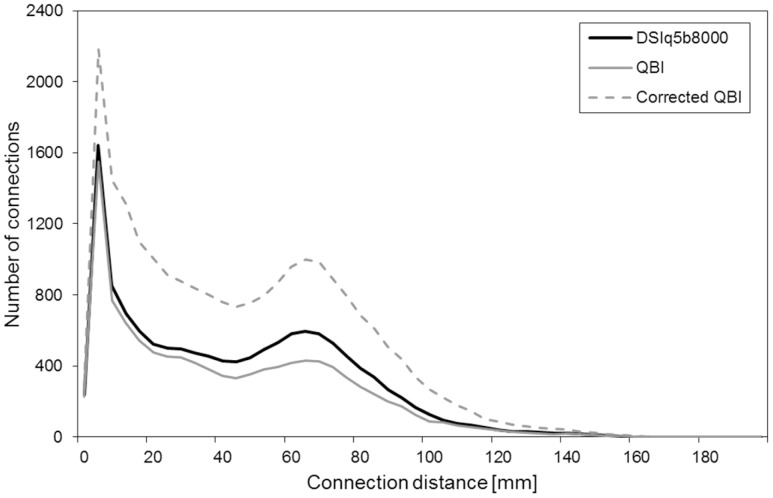
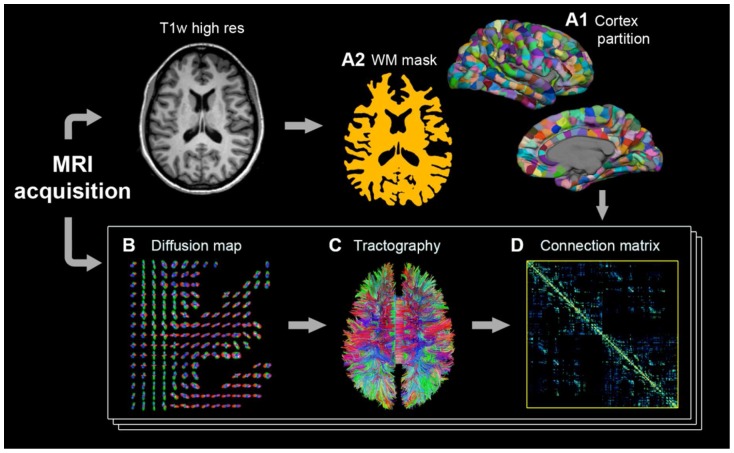
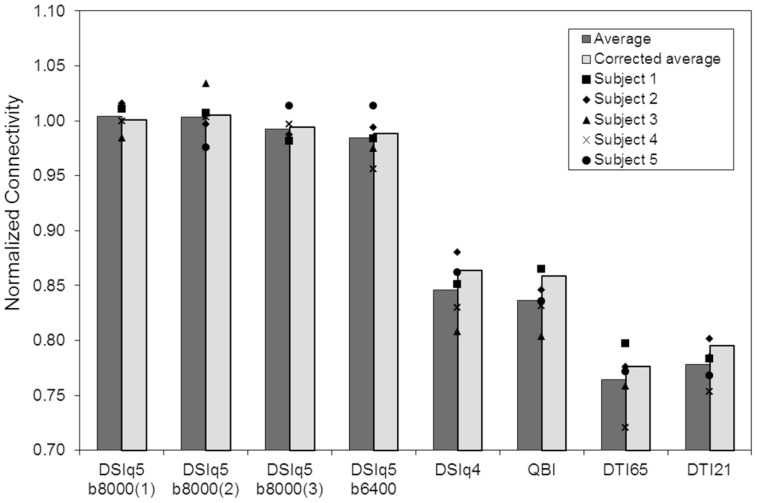
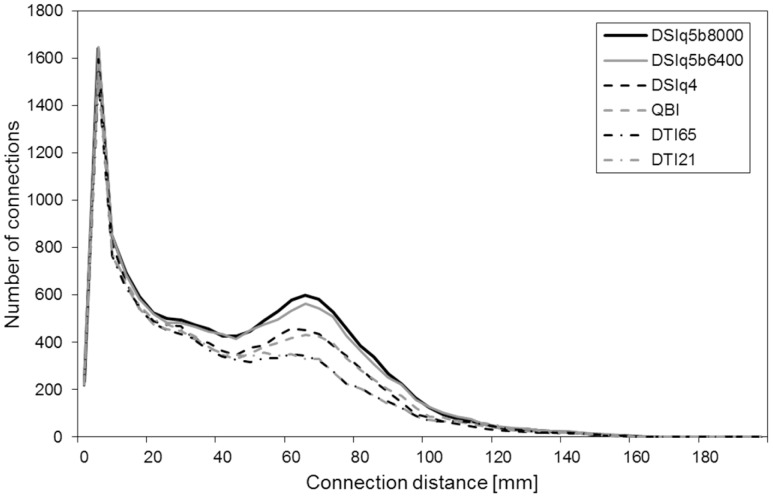
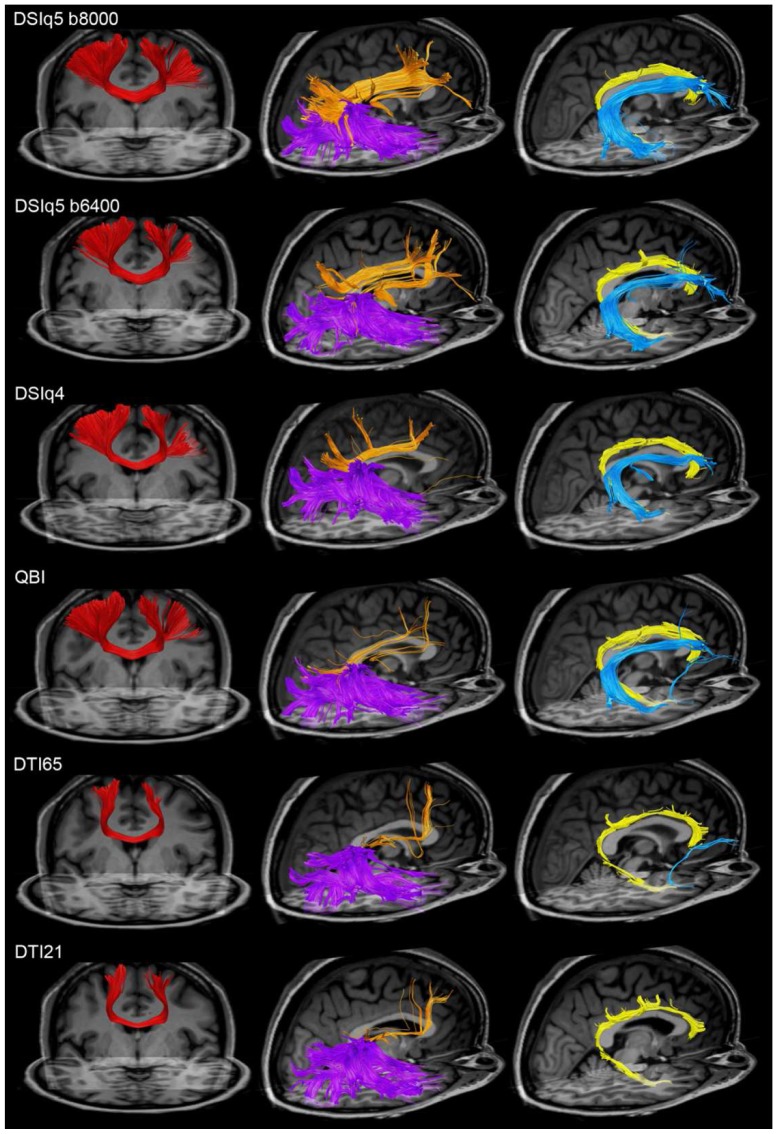
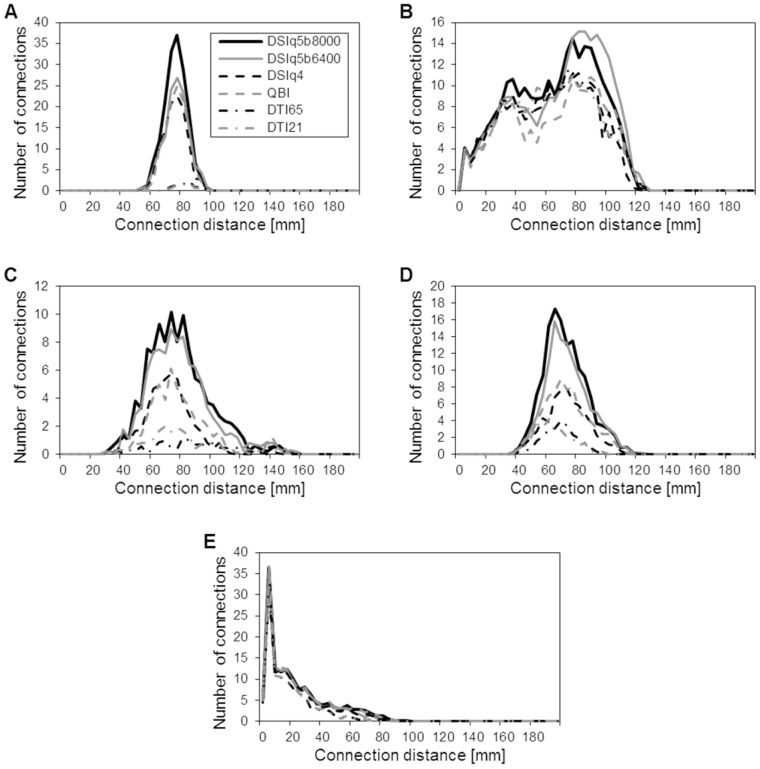
Diffusion MRI has evolved towards an important clinical diagnostic and research tool. Though clinical routine is using mainly diffusion weighted and tensor imaging approaches, Q-ball imaging and diffusion spectrum imaging techniques have become more widely available. They are frequently used in research-oriented investigations in particular those aiming at measuring brain network connectivity. In this work, we aim at assessing the dependency of connectivity measurements on various diffusion encoding schemes in combination with appropriate data modeling. We process and compare the structural connection matrices computed from several diffusion encoding schemes, including diffusion tensor imaging, q-ball imaging and high angular resolution schemes, such as diffusion spectrum imaging with a publically available processing pipeline for data reconstruction, tracking and visualization of diffusion MR imaging. The results indicate that the high angular resolution schemes maximize the number of obtained connections when applying identical processing strategies to the different diffusion schemes. Compared to the conventional diffusion tensor imaging, the added connectivity is mainly found for pathways in the 50-100mm range, corresponding to neighboring association fibers and long-range associative, striatal and commissural fiber pathways. The analysis of the major associative fiber tracts of the brain reveals striking differences between the applied diffusion schemes. More complex data modeling techniques (beyond tensor model) are recommended 1) if the tracts of interest run through large fiber crossings such as the centrum semi-ovale, or 2) if non-dominant fiber populations, e.g. the neighboring association fibers are the subject of investigation. An important finding of the study is that since the ground truth sensitivity and specificity is not known, the comparability between results arising from different strategies in data reconstruction and/or tracking becomes implausible to understand.
扩散 MRI 已发展成为一种重要的临床诊断和研究工具。虽然临床常规主要使用扩散加权和张量成像方法,但 Q 球成像和扩散谱成像技术已经变得更加普及。它们经常用于以测量脑网络连通性为目标的研究型调查中。在这项工作中,我们旨在评估连接测量值对各种扩散编码方案的依赖性,同时结合适当的数据建模。我们处理和比较了从几种扩散编码方案计算得出的结构连接矩阵,包括扩散张量成像、Q 球成像和高角分辨率方案,例如扩散谱成像,我们使用了一个公共的处理管道进行数据重建、跟踪和可视化扩散磁共振成像。结果表明,当对不同的扩散方案应用相同的处理策略时,高角分辨率方案可以最大限度地增加获得的连接数量。与传统的扩散张量成像相比,增加的连通性主要出现在 50-100mm 范围内的路径中,对应于相邻的联合纤维和长程联合、纹状体和连合纤维路径。大脑主要联合纤维束的分析显示,应用的扩散方案之间存在显著差异。建议 1)如果感兴趣的束经过大纤维交叉,如半卵圆中心,或者 2)如果非主导纤维群体,例如相邻的联合纤维是研究的主题,使用更复杂的数据建模技术(超越张量模型)。这项研究的一个重要发现是,由于不知道真实的敏感性和特异性,因此在数据重建和/或跟踪中不同策略产生的结果之间的可比性变得难以理解。