Private practice, Teaneck, NJ.
Am J Orthod Dentofacial Orthop. 2013 Oct;144(4):568-76. doi: 10.1016/j.ajodo.2013.06.016.
Genetic influences on the development of malocclusion include heritable effects on both masticatory muscles and jaw skeletal morphology. Beyond genetic variations, however, the characteristics of muscle and bone are also influenced by epigenetic mechanisms that produce differences in gene expression. We studied 2 enzymes known to change gene expressions through histone modifications, chromatin-modifying histone acetyltransferase KAT6B and deacetylase HDAC4, to determine their associations with musculoskeletal variations in jaw deformation malocclusions.
Samples of masseter muscle were obtained from subjects undergoing orthognathic surgery from 6 malocclusion classes based on skeletal sagittal and vertical dysplasia. The muscles were characterized for fiber type properties by immunohistochemistry, and their total RNA was isolated for gene expression studies by microarray analysis and quantitative real-time polymerase chain reaction.
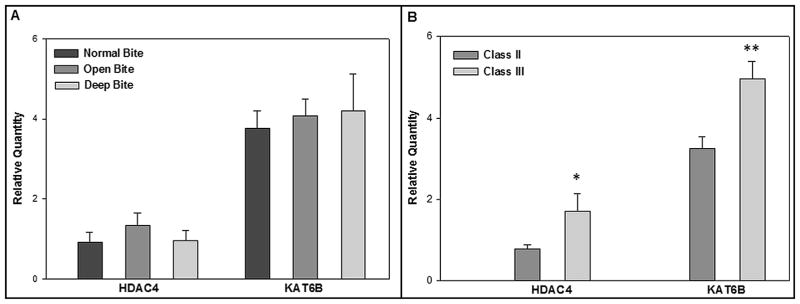
Gene expressions for fast isoforms of myosins and contractile regulatory proteins and for KAT6B and HDAC4 were severalfold greater in masseter muscles from a patient with a deepbite compared with one with an open bite, and genes related to exercise and activity did not differ substantially. In the total population, expressions of HDAC4 (P = 0.03) and KAT6B (P = 0.004) were significantly greater in subjects with sagittal Class III than in Class II malocclusion, whereas HDAC4 tended to correlate negatively with slow myosin type I and positively with fast myosin gene, especially type IIX.
These data support other published reports of epigenetic regulation in the determination of skeletal muscle fiber phenotypes and bone growth. Further investigations are needed to elucidate how this regulatory model might apply to musculoskeletal development and malocclusion.
遗传因素对错颌畸形的发展有影响,包括咀嚼肌和颌骨骨骼形态的遗传影响。然而,除了遗传变异之外,肌肉和骨骼的特征也受到表观遗传机制的影响,这些机制会导致基因表达的差异。我们研究了两种已知通过组蛋白修饰改变基因表达的酶,即组蛋白乙酰转移酶 KAT6B 和去乙酰化酶 HDAC4,以确定它们与颌骨变形错颌畸形的肌肉骨骼变化的相关性。
从 6 种基于骨骼矢状和垂直发育不良的错颌畸形类别的接受正颌手术的患者中获取咀嚼肌样本。通过免疫组织化学对肌肉的纤维类型特性进行了特征描述,并通过微阵列分析和定量实时聚合酶链反应对其总 RNA 进行了基因表达研究。
与开颌患者相比,深覆颌患者的咀嚼肌中肌球蛋白和收缩调节蛋白的快肌同工型以及 KAT6B 和 HDAC4 的基因表达高出数倍,而与运动和活动相关的基因差异不大。在总人群中,HDAC4(P = 0.03)和 KAT6B(P = 0.004)的表达在矢状位 III 类错颌患者中明显高于 II 类错颌患者,而 HDAC4 与慢肌 I 型呈负相关,与快肌基因呈正相关,尤其是 IIX 型。
这些数据支持其他关于表观遗传调控在确定骨骼肌纤维表型和骨骼生长中的作用的已发表报告。需要进一步研究阐明这种调节模型如何适用于肌肉骨骼发育和错颌畸形。