Department of Biostatistics and Computational Biology, Dana-Farber Cancer Institute, Boston, Massachusetts.
Department of Urology, Emory University, Atlanta, Georgia.
J Urol. 2014 Mar;191(3):638-45. doi: 10.1016/j.juro.2013.09.040. Epub 2013 Sep 25.
We expanded the clinical usefulness of EPIC-CP (Expanded Prostate Cancer Index Composite for Clinical Practice) by evaluating its responsiveness to health related quality of life changes, defining the minimally important differences for an individual patient change in each domain and applying it to a sexual outcome prediction model.
In 1,201 subjects from a previously described multicenter longitudinal cohort we modeled the EPIC-CP domain scores of each treatment group before treatment, and at short-term and long-term followup. We considered a posttreatment domain score change from pretreatment of 0.5 SD or greater clinically significant and p ≤ 0.01 statistically significant. We determined the domain minimally important differences using the pooled 0.5 SD of the 2, 6, 12 and 24-month posttreatment changes from pretreatment values. We then recalibrated an EPIC-CP based nomogram model predicting 2-year post-prostatectomy functional erection from that developed using EPIC-26.
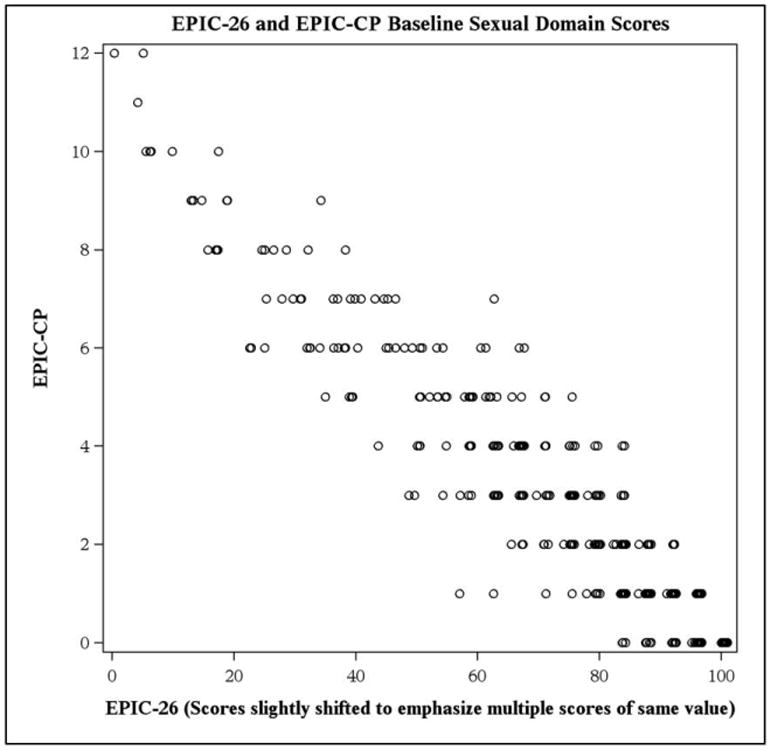
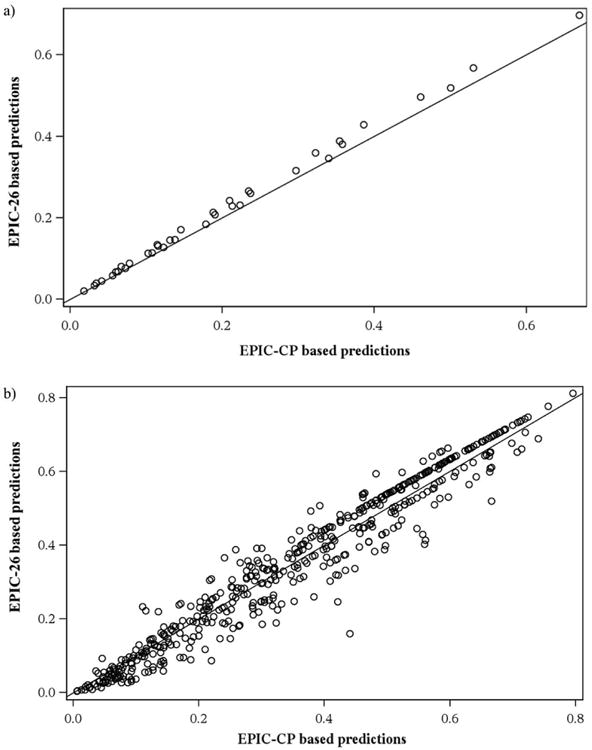
For each health related quality of life domain EPIC-CP was sensitive to similar posttreatment health related quality of life changes with time, as was observed using EPIC-26. The EPIC-CP minimally important differences in changes in the urinary incontinence, urinary irritation/obstruction, bowel, sexual and vitality/hormonal domains were 1.0, 1.3, 1.2, 1.6 and 1.0, respectively. The EPIC-CP based sexual prediction model performed well (AUC 0.76). It showed robust agreement with its EPIC-26 based counterpart with 10% or less predicted probability differences between models in 95% of individuals and a mean ± SD difference of 0.0 ± 0.05 across all individuals.
EPIC-CP is responsive to health related quality of life changes during convalescence and it can be used to predict 2-year post-prostatectomy sexual outcomes. It can facilitate shared medical decision making and patient centered care.
通过评估 EPIC-CP(临床实践扩展前列腺癌指数综合)对健康相关生活质量变化的反应能力,为每个领域的个体患者变化定义最小有意义差异,并将其应用于性功能预测模型,从而扩展其临床实用性。
在之前描述的多中心纵向队列的 1201 名受试者中,我们对每个治疗组在治疗前、短期和长期随访时的 EPIC-CP 域评分进行建模。我们认为治疗后域评分从治疗前变化 0.5 SD 或更大为临床显著,p≤0.01 为统计学显著。我们使用治疗后 2、6、12 和 24 个月与治疗前值相比的 0.5 SD 的总和,确定域最小有意义差异。然后,我们使用 EPIC-26 开发的 EPIC-CP 基于Nomogram 模型来预测前列腺切除术 2 年后的功能性勃起功能,并对其进行重新校准。
对于每个健康相关生活质量领域,EPIC-CP 都与 EPIC-26 观察到的情况一样,对随时间变化的治疗后健康相关生活质量变化敏感。尿失禁、尿刺激/梗阻、肠、性功能和活力/激素领域的 EPIC-CP 最小有意义变化分别为 1.0、1.3、1.2、1.6 和 1.0。基于 EPIC-CP 的性功能预测模型表现良好(AUC 0.76)。它与基于 EPIC-26 的对应模型具有很强的一致性,在 95%的个体中,两个模型的预测概率差异为 10%或更小,在所有个体中,平均差异为 0.0 ± 0.05。
EPIC-CP 对康复期间的健康相关生活质量变化有反应,可用于预测前列腺切除术 2 年后的性功能结果。它可以促进共同的医疗决策和以患者为中心的护理。