Ozaki Toshinori, Nakamura Mizuyo, Shimozato Osamu
Laboratory of DNA Damage Signaling, Chiba Cancer Center Research Institute, Chiba 260-8717, Japan.
Biomolecules. 2015 Oct 23;5(4):2854-76. doi: 10.3390/biom5042854.
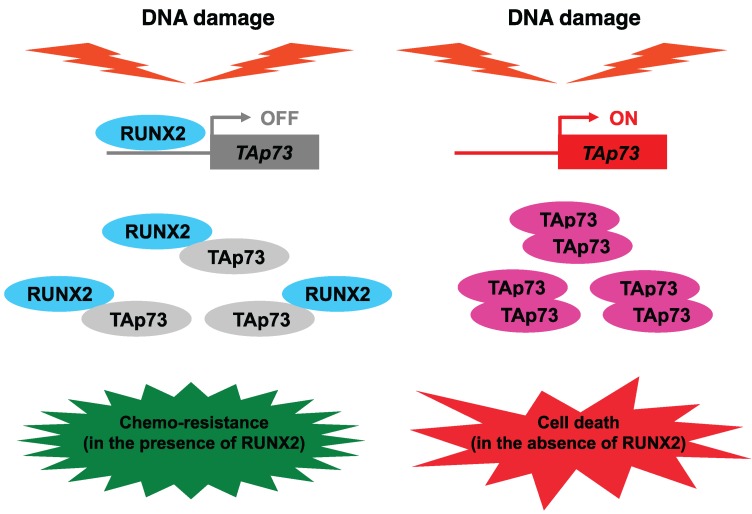
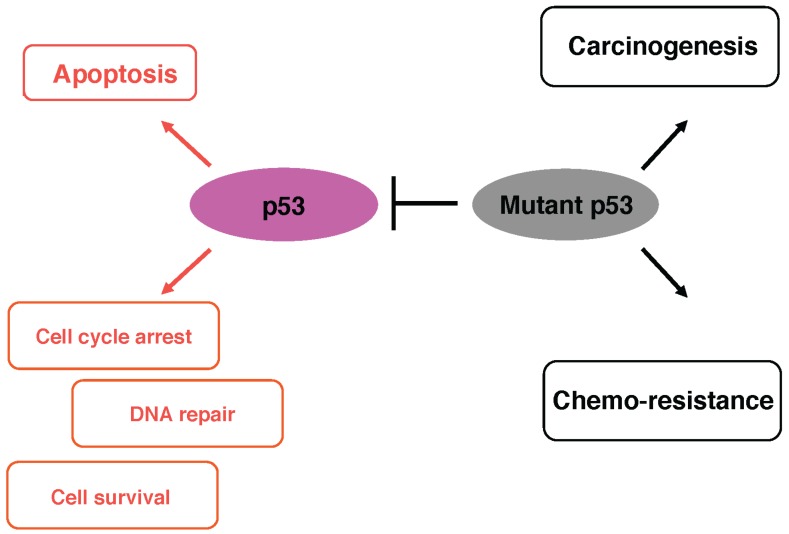
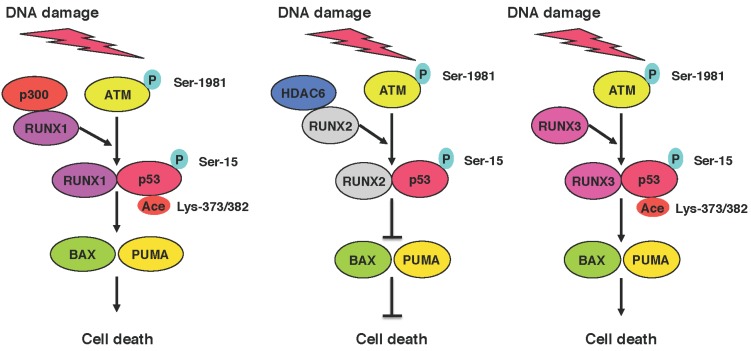
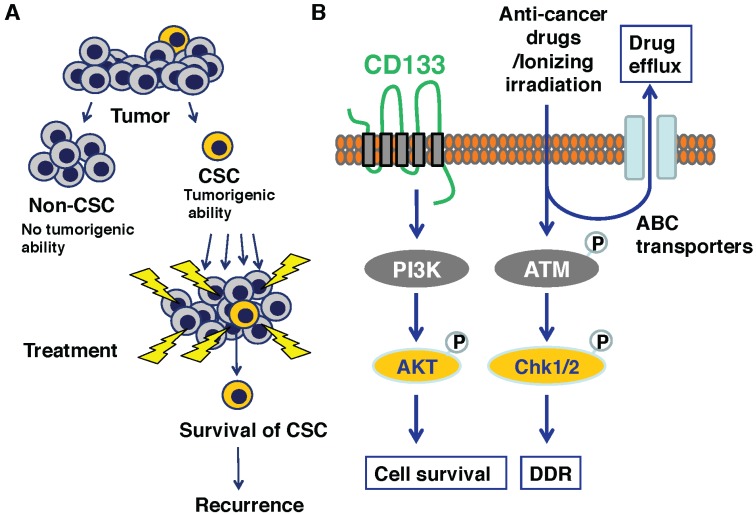
During the lifespan of cells, their genomic DNA is continuously exposed to theendogenous and exogenous DNA insults. Thus, the appropriate cellular response to DNAdamage plays a pivotal role in maintaining genomic integrity and also acts as a molecularbarrier towards DNA legion-mediated carcinogenesis. The tumor suppressor p53 participatesin an integral part of proper regulation of DNA damage response (DDR). p53 is frequentlymutated in a variety of human cancers. Since mutant p53 displays a dominant-negative behavioragainst wild-type p53, cancers expressing mutant p53 sometimes acquire drug-resistantphenotype, suggesting that mutant p53 prohibits the p53-dependent cell death pathwayfollowing DNA damage, and thereby contributing to the acquisition and/or maintenance ofdrug resistance of malignant cancers. Intriguingly, we have recently found that silencing ofpro-oncogenic RUNX2 enhances drug sensitivity of aggressive cancer cells regardless of p53status. Meanwhile, cancer stem cells (CSCs) have stem cell properties such as drug resistance.Therefore, the precise understanding of the biology of CSCs is quite important to overcometheir drug resistance. In this review, we focus on molecular mechanisms behind DDR as wellas the serious drug resistance of malignant cancers and discuss some attractive approachesto improving the outcomes of patients bearing drug-resistant cancers.
在细胞的生命周期中,其基因组DNA不断受到内源性和外源性DNA损伤。因此,细胞对DNA损伤的适当反应在维持基因组完整性方面起着关键作用,并且还作为对抗DNA损伤介导的致癌作用的分子屏障。肿瘤抑制因子p53参与DNA损伤反应(DDR)的适当调节的一个不可或缺的部分。p53在多种人类癌症中经常发生突变。由于突变型p53对野生型p53表现出显性负性作用,表达突变型p53的癌症有时会获得耐药表型,这表明突变型p53在DNA损伤后阻止了p53依赖的细胞死亡途径,从而导致恶性癌症获得和/或维持耐药性。有趣的是,我们最近发现,致癌性RUNX2的沉默增强了侵袭性癌细胞的药物敏感性,而与p53状态无关。同时,癌症干细胞(CSCs)具有诸如耐药性等干细胞特性。因此,准确了解CSCs的生物学特性对于克服其耐药性非常重要。在这篇综述中,我们关注DDR背后的分子机制以及恶性癌症的严重耐药性,并讨论一些有吸引力的方法来改善患有耐药性癌症患者的治疗结果。