Wang Zhiyun, Wang Jianping, Maercker Andreas
Department of Psychology, School of Philosophy, Wuhan University, Wuhan, China.
J Med Internet Res. 2013 Sep 30;15(9):e213. doi: 10.2196/jmir.2690.
Guided self-help interventions for PTSD (post-traumatic stress disorder) are a promising tool for the dissemination of contemporary psychological treatment.
This study investigated the efficacy of the Chinese version of the My Trauma Recovery (CMTR) website.
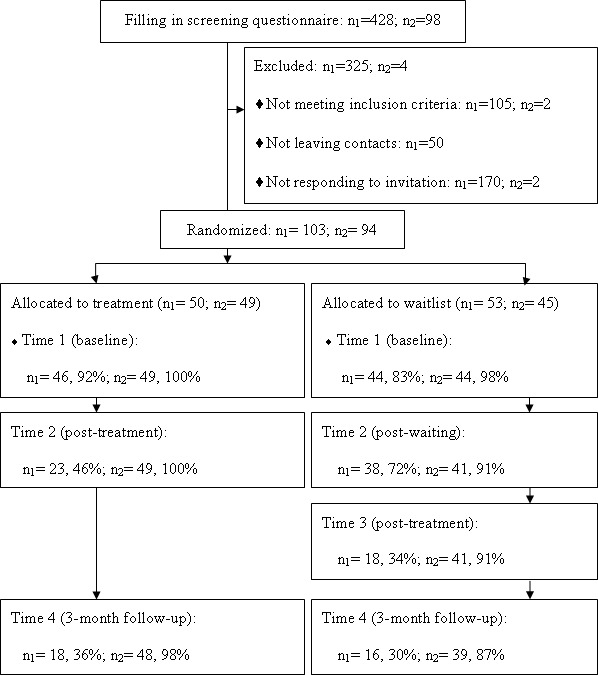
In an urban context, 90 survivors of different trauma types were recruited via Internet advertisements and allocated to a randomized controlled trial (RCT) with a waiting list control condition. In addition, in a rural context, 93 survivors mainly of the 2008 Sichuan earthquake were recruited in-person for a parallel RCT in which the website intervention was conducted in a counseling center and guided by volunteers. Assessment was completed online on a professional Chinese survey website. The primary outcome measure was the Post-traumatic Diagnostic Scale (PDS); secondary outcome measures were Symptom Checklist 90-Depression (SCL-D), Trauma Coping Self-Efficacy Scale (CSE), Post-traumatic Cognitive Changes (PCC), and Social Functioning Impairment (SFI) questionnaires adopted from the My Trauma Recovery website.
For the urban sample, findings indicated a significant group×time interaction in post-traumatic symptom severity (F₁,₈₈=7.65, P=.007). CMTR reduced post-traumatic symptoms significantly with high effect size after one month of treatment (F₁,₄₅=15.13, Cohen's d=0.81, P<.001) and the reduction was sustained over a 3-month follow-up (F₁,₄₅=17.29, Cohen's d=0.87, P<.001). In the rural sample, the group×time interaction was also significant in post-traumatic symptom severity (F₁,₉₁=5.35, P=.02). Post-traumatic symptoms decreased significantly after treatment (F₁,₄₈=43.97, Cohen's d=1.34, P<.001) and during the follow-up period (F₁,₄₈=24.22, Cohen's d=0.99, P<.001). Additional outcome measures (post-traumatic cognitive changes, depression) indicated a range of positive effects, in particular in the urban sample (group×time interactions: F₁,₈₈=5.32-8.37, all Ps<.03), contributing to the positive evidence for self-help interventions. Differences in the effects in the two RCTs are exploratorily explained by sociodemographic, motivational, and setting feature differences between the two samples.
These findings give support for the short-term efficacy of CMTR in the two Chinese populations and contribute to the literature that self-help Web-based programs can be used to provide mental health help for traumatized persons.
Australia New Zealand Clinical Trials Registry (ANZCTR): ACTRN12611000951954; https://www.anzctr.org.au/Trial/Registration/TrialReview.aspx?ACTRN=12611000951954 (Archived by WebCite at http://www.webcitation.org/6G7WyNODk).

创伤后应激障碍(PTSD)的引导式自助干预是传播当代心理治疗的一种有前景的工具。
本研究调查了中文版“我的创伤恢复”(CMTR)网站的疗效。
在城市环境中,通过网络广告招募了90名不同创伤类型的幸存者,并将其分配到一项带有等待列表对照条件的随机对照试验(RCT)中。此外,在农村环境中,主要招募了93名2008年四川地震的幸存者,进行一项平行RCT,其中网站干预在咨询中心进行,并由志愿者指导。评估在一个专业的中文调查网站上在线完成。主要结局指标是创伤后诊断量表(PDS);次要结局指标是从“我的创伤恢复”网站采用的症状自评量表90-抑郁(SCL-D)、创伤应对自我效能量表(CSE)、创伤后认知变化(PCC)和社会功能损害(SFI)问卷。
对于城市样本,结果表明创伤后症状严重程度存在显著的组×时间交互作用(F₁,₈₈ = 7.65,P = 0.007)。治疗1个月后,CMTR显著降低了创伤后症状,效应量较高(F₁,₄₅ = 15.13,Cohen's d = 0.81,P < 0.001),并且在3个月的随访中这种降低得以持续(F₁,₄₅ = 17.29,Cohen's d = 0.87,P < 0.001)。在农村样本中,创伤后症状严重程度的组×时间交互作用也显著(F₁,₉₁ = 5.35,P = 0.02)。治疗后创伤后症状显著降低(F₁,₄₈ = 43.97,Cohen's d = 1.34,P < 0.001),并且在随访期间也降低(F₁,₄₈ = 24.22,Cohen's d = 0.99,P < 0.001)。其他结局指标(创伤后认知变化、抑郁)显示出一系列积极效果,尤其是在城市样本中(组×时间交互作用:F₁,₈₈ = 5.32 - 8.37,所有P < 0.03),为自助干预提供了积极证据。两个RCT中效果的差异通过两个样本在社会人口统计学、动机和环境特征方面的差异进行了探索性解释。
这些发现支持了CMTR在两个中国人群中的短期疗效,并为基于网络的自助项目可用于为受创伤者提供心理健康帮助的文献做出了贡献。
澳大利亚新西兰临床试验注册中心(ANZCTR):ACTRN12611000951954;https://www.anzctr.org.au/Trial/Registration/TrialReview.aspx?ACTRN=12611000951954(由WebCite存档于http://www.webcitation.org/6G7WyNODk)。