Kalaszczynska Ilona, Ruminski Slawomir, Platek Anna E, Bissenik Igor, Zakrzewski Piotr, Noszczyk Maria, Lewandowska-Szumiel Malgorzata
Tissue Engineering Lab, Department of Histology and Embryology, Center for Biostructure Research, Medical University of Warsaw , Warsaw, Poland . ; Department of Biophysics and Human Physiology, Medical University of Warsaw , Warsaw, Poland .
Biores Open Access. 2013 Oct;2(5):356-63. doi: 10.1089/biores.2013.0029.
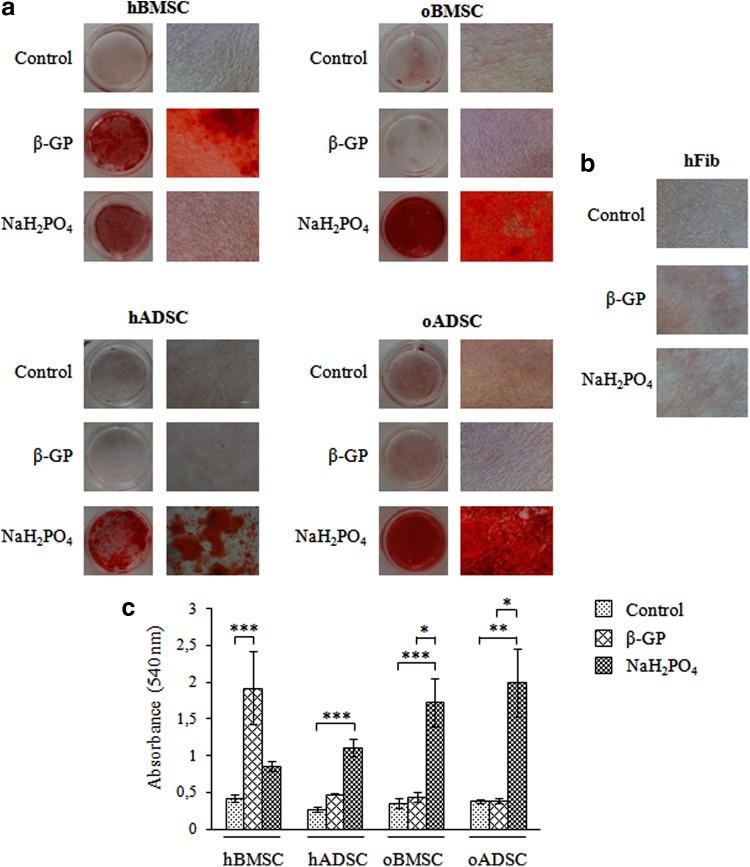
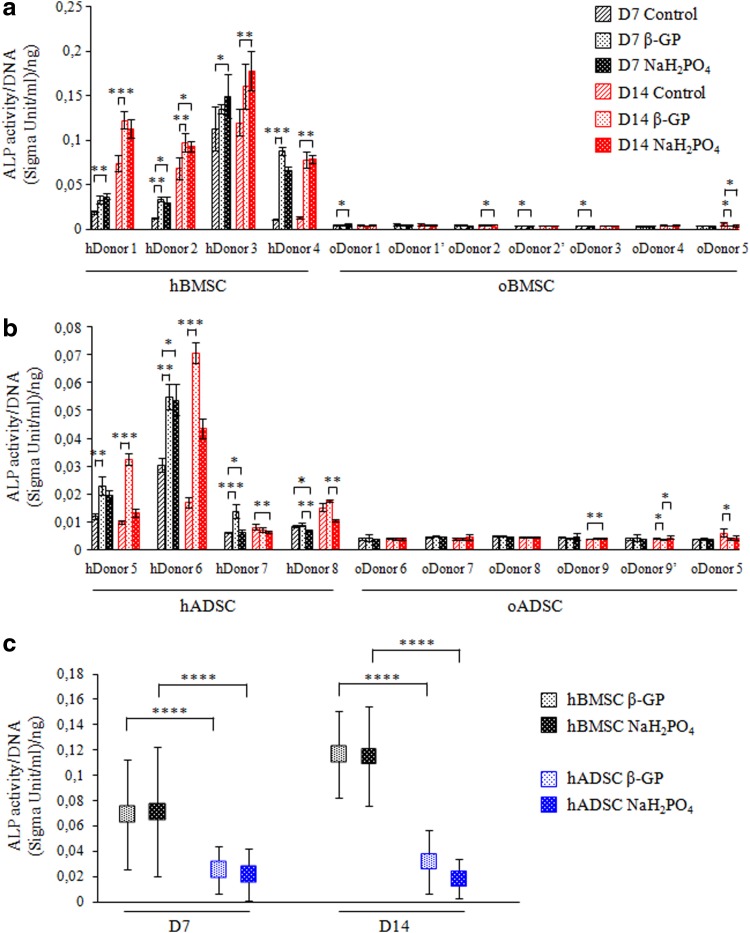
It is expected that use of adult multipotential mesenchymal stem cells (MSCs) for bone tissue engineering (TE) will lead to improvement of TE products. Prior to clinical application, biocompatibility of bone TE products need to be tested in vitro and in vivo. In orthopedic research, sheep are a well-accepted model due to similarities with humans and are assumed to be predictive of human outcomes. In this study we uncover differences between human and ovine bone marrow-derived MSCs (BMSCs) and adipose tissue-derived MSCs (ADSCs) in response to osteogenic media. Osteogenic differentiation of BMSCs and ADSCs was monitored by alkaline phosphatase (ALP) activity and calcium deposition. Mineralization of ovine BMSC was achieved in medium containing NaH2PO4 as a source of phosphate ions (Pi), but not in medium containing β-glycerophosphate (β-GP), which is most often used. In a detailed study we found no induction of ALP activity in ovine BMSCs and ADSCs upon osteogenic stimulation, which makes β-GP an unsuitable source of phosphate ions for ovine cells. Moreover, mineralization of human ADSCs was more efficient in osteogenic medium containing NaH2PO4. These results indicate major differences between ovine and human MSCs and suggest that standard in vitro osteogenic differentiation techniques may not be suitable for all types of cells used in cell-based therapies. Since mineralization is a widely accepted marker of the osteogenic differentiation and maturation of cells in culture, it may lead to potentially misleading results and should be taken into account at the stage of planning and interpreting preclinical observations performed in animal models. We also present a cell culture protocol for ovine ADSCs, which do not express ALP activity and do not mineralize under routine pro-osteogenic conditions in vitro. We plan to apply it in preclinical experiments of bone tissue-engineered products performed in an ovine model.
预计将成人多能间充质干细胞(MSCs)用于骨组织工程(TE)将改善TE产品。在临床应用之前,骨TE产品的生物相容性需要在体外和体内进行测试。在骨科研究中,由于与人类相似,绵羊是一种广泛接受的模型,并被认为可以预测人类结果。在本研究中,我们揭示了人类和绵羊骨髓来源的间充质干细胞(BMSCs)以及脂肪组织来源的间充质干细胞(ADSCs)在响应成骨培养基时的差异。通过碱性磷酸酶(ALP)活性和钙沉积监测BMSCs和ADSCs的成骨分化。绵羊BMSC在含有NaH2PO4作为磷酸根离子(Pi)来源的培养基中实现矿化,但在最常用的含有β-甘油磷酸(β-GP)的培养基中未实现矿化。在一项详细研究中,我们发现成骨刺激后绵羊BMSCs和ADSCs中没有诱导ALP活性,这使得β-GP成为绵羊细胞不适合的磷酸根离子来源。此外,人类ADSCs在含有NaH2PO4的成骨培养基中矿化更有效。这些结果表明绵羊和人类MSCs之间存在主要差异,并表明标准的体外成骨分化技术可能不适用于基于细胞的治疗中使用的所有类型的细胞。由于矿化是培养细胞成骨分化和成熟的广泛接受的标志物,它可能导致潜在的误导性结果,并且在规划和解释在动物模型中进行的临床前观察阶段应予以考虑。我们还提出了一种绵羊ADSCs的细胞培养方案,这些细胞在体外常规促骨生成条件下不表达ALP活性且不矿化。我们计划将其应用于在绵羊模型中进行的骨组织工程产品的临床前实验。