Centre National de la Recherche Scientifique, LMGM-UMR5100, Toulouse, France ; Université de Toulouse, UPS, Laboratoire de Microbiologie et Génétique Moléculaires, Toulouse, France.
PLoS Genet. 2013;9(9):e1003819. doi: 10.1371/journal.pgen.1003819. Epub 2013 Sep 26.
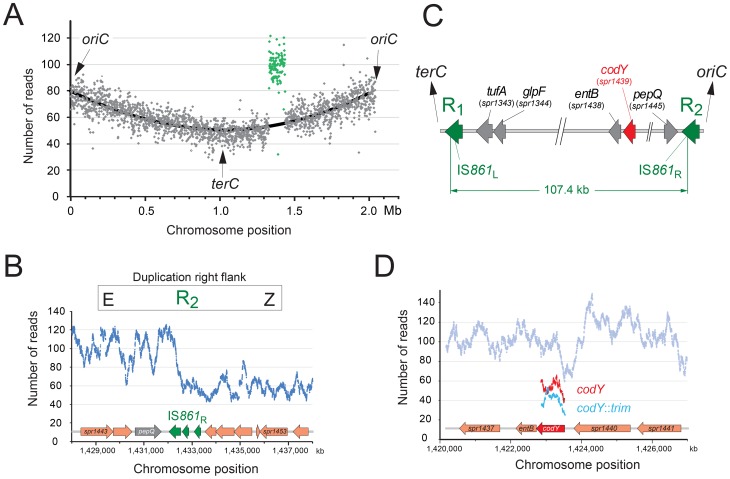
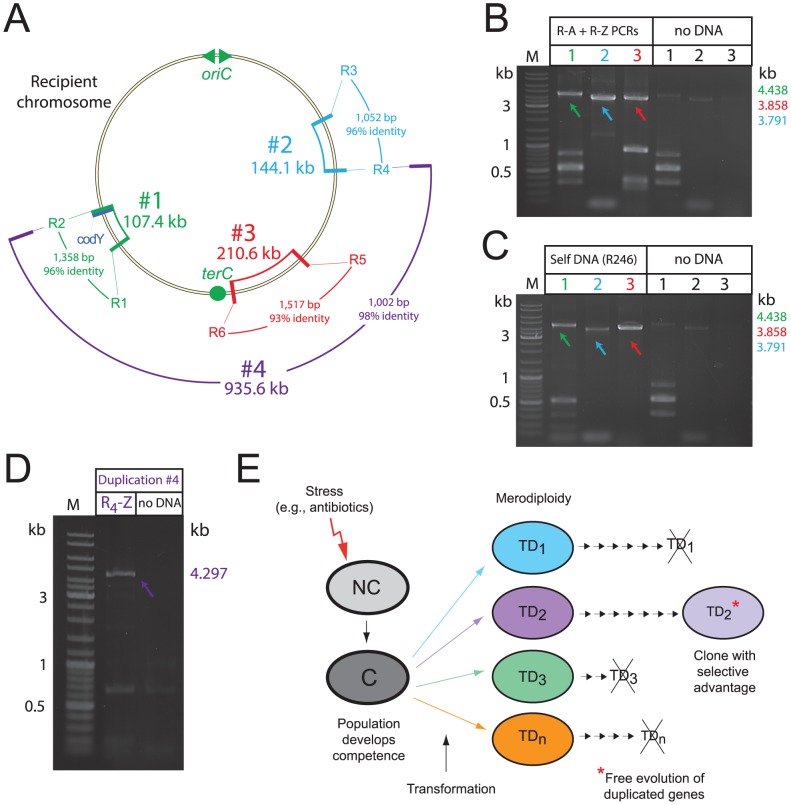
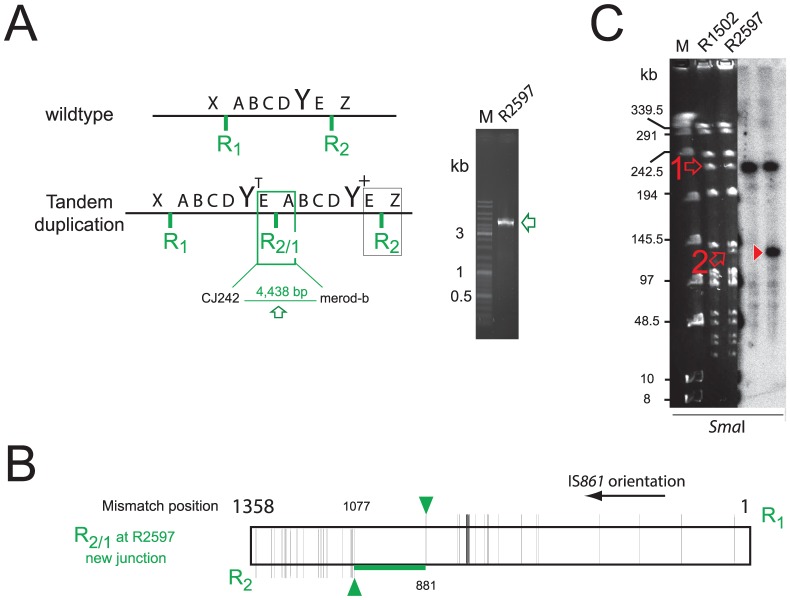
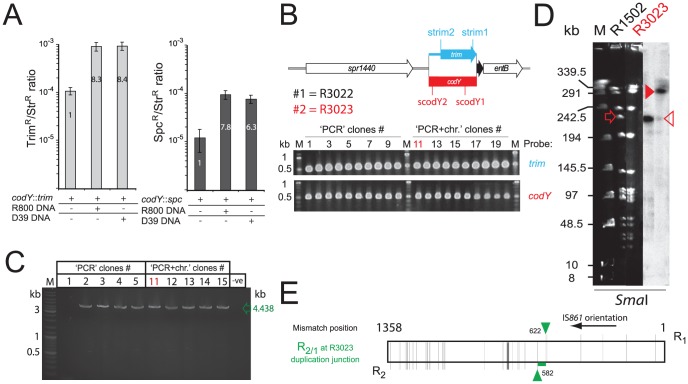
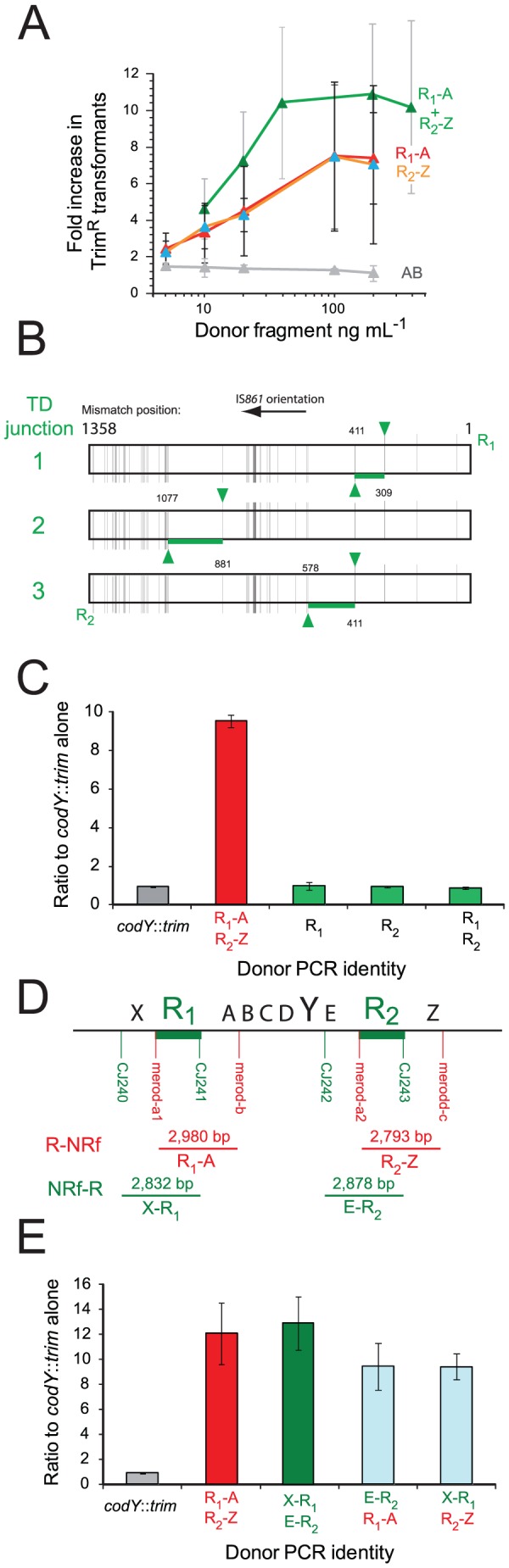
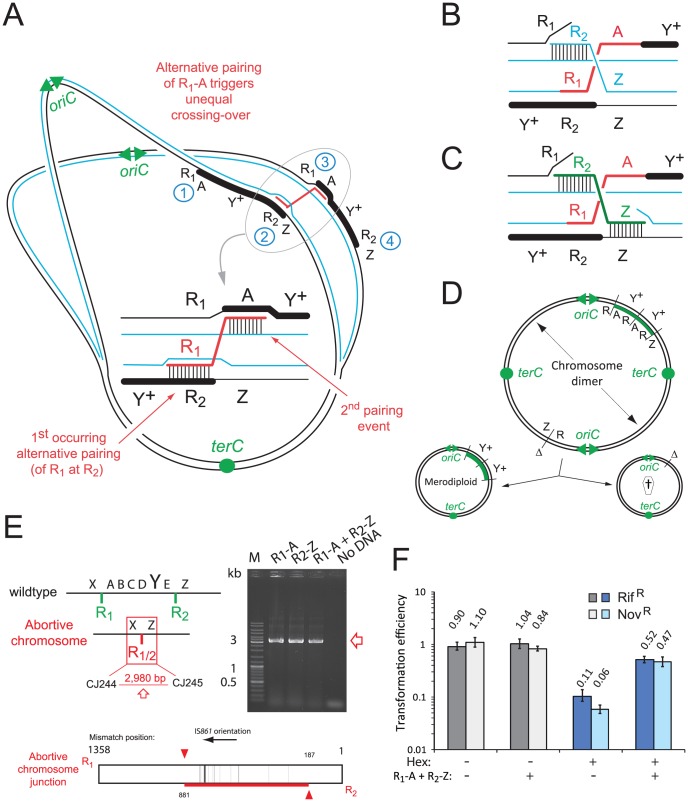
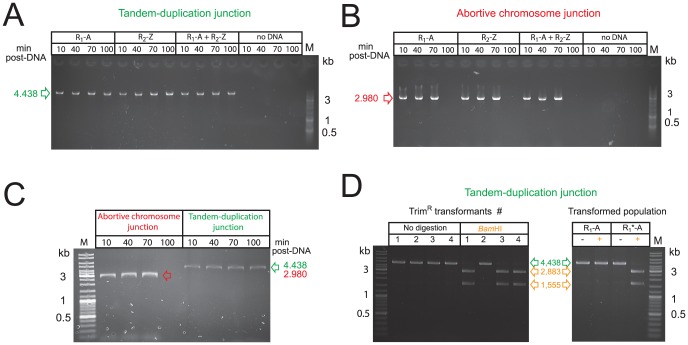
Partial duplication of genetic material is prevalent in eukaryotes and provides potential for evolution of new traits. Prokaryotes, which are generally haploid in nature, can evolve new genes by partial chromosome duplication, known as merodiploidy. Little is known about merodiploid formation during genetic exchange processes, although merodiploids have been serendipitously observed in early studies of bacterial transformation. Natural bacterial transformation involves internalization of exogenous donor DNA and its subsequent integration into the recipient genome by homology. It contributes to the remarkable plasticity of the human pathogen Streptococcus pneumoniae through intra and interspecies genetic exchange. We report that lethal cassette transformation produced merodiploids possessing both intact and cassette-inactivated copies of the essential target gene, bordered by repeats (R) corresponding to incomplete copies of IS861. We show that merodiploidy is transiently stimulated by transformation, and only requires uptake of a ~3-kb DNA fragment partly repeated in the chromosome. We propose and validate a model for merodiploid formation, providing evidence that tandem-duplication (TD) formation involves unequal crossing-over resulting from alternative pairing and interchromatid integration of R. This unequal crossing-over produces a chromosome dimer, resolution of which generates a chromosome with the TD and an abortive chromosome lacking the duplicated region. We document occurrence of TDs ranging from ~100 to ~900 kb in size at various chromosomal locations, including by self-transformation (transformation with recipient chromosomal DNA). We show that self-transformation produces a population containing many different merodiploid cells. Merodiploidy provides opportunities for evolution of new genetic traits via alteration of duplicated genes, unrestricted by functional selective pressure. Transient stimulation of a varied population of merodiploids by transformation, which can be triggered by stresses such as antibiotic treatment in S. pneumoniae, reinforces the plasticity potential of this bacterium and transformable species generally.
遗传物质的部分重复在真核生物中很普遍,为新特征的进化提供了潜力。原核生物在本质上通常是单倍体,它们可以通过部分染色体重复(称为部分二倍体)来进化新基因。尽管在早期的细菌转化研究中偶然观察到了部分二倍体,但对于遗传交换过程中部分二倍体的形成知之甚少。天然细菌转化涉及外源性供体 DNA 的内化及其随后通过同源性整合到受体基因组中。它通过种内和种间遗传交换为人类病原体肺炎链球菌的显著可塑性做出了贡献。我们报告称,致死盒转化产生了部分二倍体,它们具有完整的和带有盒失活的必需靶基因的拷贝,两侧是与 IS861 的不完全拷贝相对应的重复(R)。我们表明,部分二倍体通过转化短暂地受到刺激,并且仅需要摄取部分重复的约 3kb 染色体片段。我们提出并验证了部分二倍体形成的模型,该模型提供了证据表明串联复制(TD)的形成涉及由替代配对和染色体内整合 R 引起的不等交换。这种不等交换产生一个染色体二聚体,其分辨率产生一个具有 TD 和一个缺少重复区域的无功能染色体。我们记录了在各种染色体位置发生的大小从约 100kb 到约 900kb 的 TD,包括通过自我转化(用受体染色体 DNA 进行转化)。我们表明,自我转化产生了一个包含许多不同部分二倍体细胞的群体。部分二倍体为通过改变重复基因来进化新的遗传特征提供了机会,不受功能选择性压力的限制。转化通过抗生素治疗等压力对多样化的部分二倍体群体的短暂刺激,增强了这种细菌和可转化物种的可塑性潜力。