Departament de Farmacologia, de Terapèutica i de Toxicologia, Institut de Neurociències, Universitat Autònoma de Barcelona, Bellaterra, Barcelona, Spain.
PLoS One. 2013 Sep 23;8(9):e74344. doi: 10.1371/journal.pone.0074344. eCollection 2013.
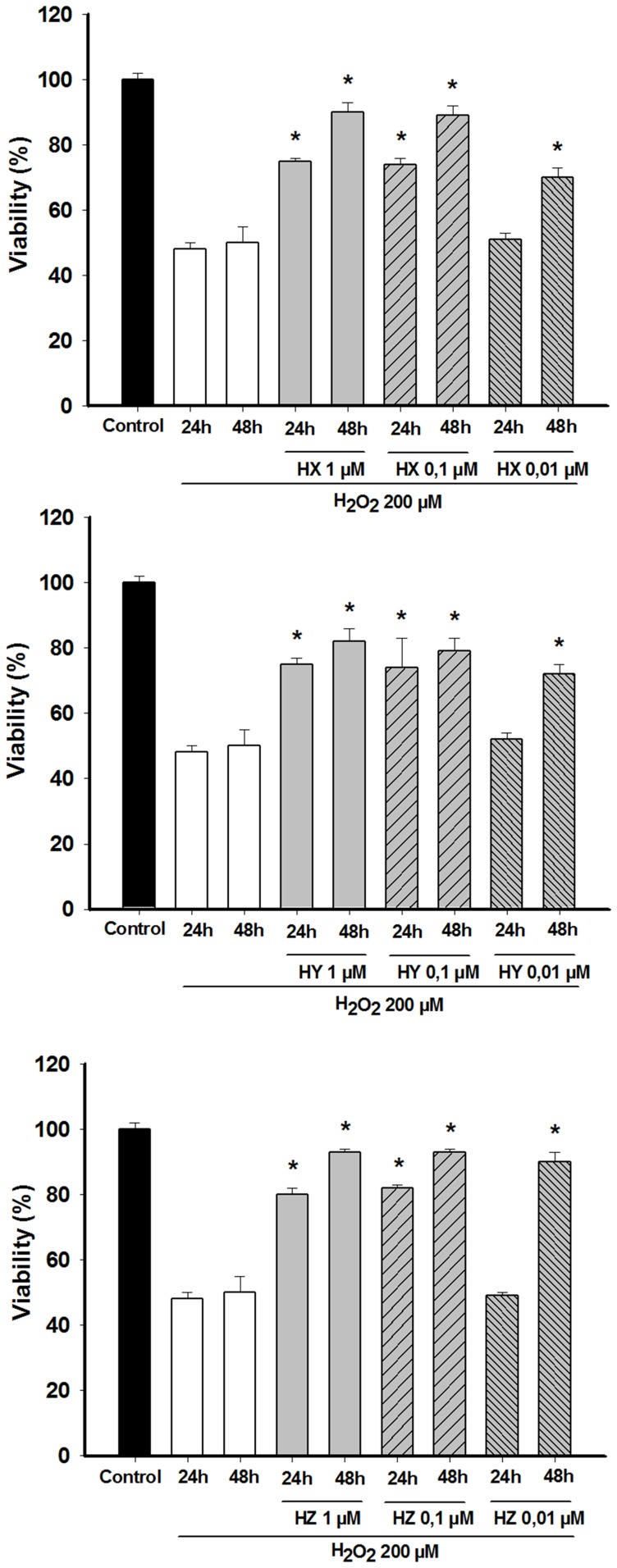
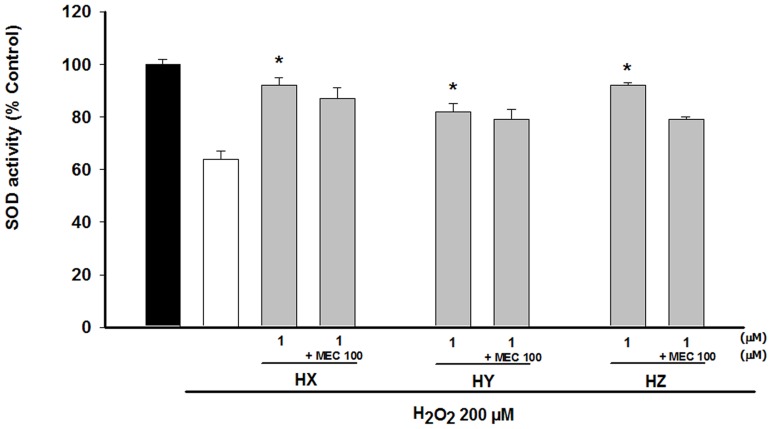
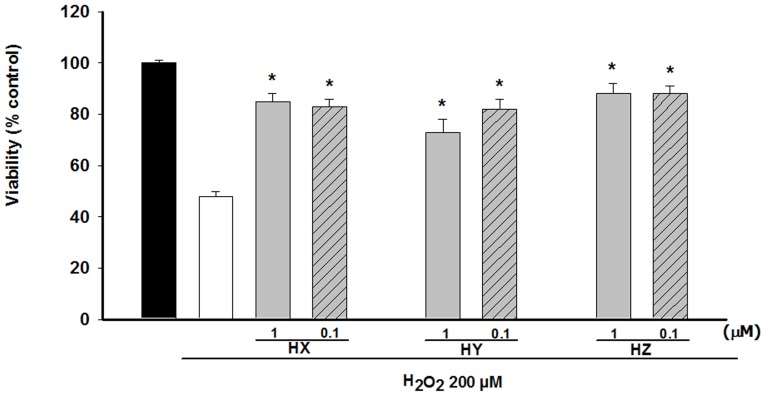
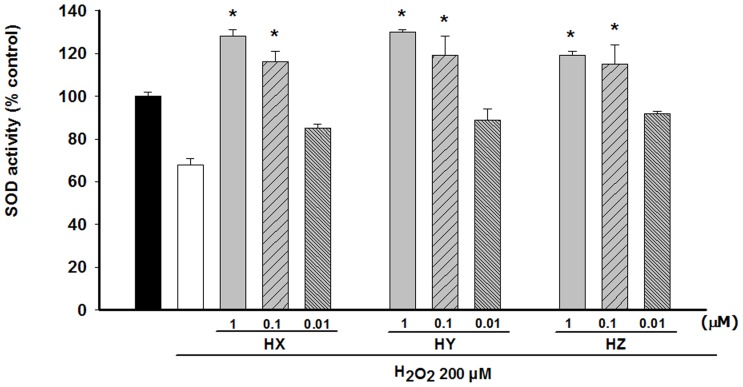
Oxidative stress is implicated in the pathogenesis of neurodegenerative disorders and hydrogen peroxide (H2O2) plays a central role in the stress. Huprines, a group of potent acetylcholinesterase inhibitors (AChEIs), have shown a broad cholinergic pharmacological profile. Recently, it has been observed that huprine X (HX) improves cognition in non transgenic middle aged mice and shows a neuroprotective activity (increased synaptophysin expression) in 3xTg-AD mice. Consequently, in the present experiments the potential neuroprotective effect of huprines (HX, HY, HZ) has been analyzed in two different in vitro conditions: undifferentiated and NGF-differentiated PC12 cells. Cells were subjected to oxidative insult (H2O2, 200 µM) and the protective effects of HX, HY and HZ (0.01 µM-1 µM) were analyzed after a pre-incubation period of 24 and 48 hours. All huprines showed protective effects in both undifferentiated and NGF-differentiated cells, however only in differentiated cells the effect was dependent on cholinergic receptors as atropine (muscarinic antagonist, 0.1 µM) and mecamylamine (nicotinic antagonist, 100 µM) reverted the neuroprotection action of huprines. The decrease in SOD activity observed after oxidative insult was overcome in the presence of huprines and this effect was not mediated by muscarinic or nicotinic receptors. In conclusion, huprines displayed neuroprotective properties as previously observed in in vivo studies. In addition, these effects were mediated by cholinergic receptors only in differentiated cells. However, a non-cholinergic mechanism, probably through an increase in SOD activity, seems to be also involved in the neuroprotective effects of huprines.
氧化应激与神经退行性疾病的发病机制有关,而过氧化氢 (H2O2) 在应激中起着核心作用。苦参碱是一组强效乙酰胆碱酯酶抑制剂 (AChEIs),具有广泛的胆碱能药理学特性。最近,人们观察到苦参碱 X (HX) 可改善非转基因中年小鼠的认知功能,并在 3xTg-AD 小鼠中表现出神经保护活性(增加突触素表达)。因此,在本实验中,苦参碱(HX、HY、HZ)的潜在神经保护作用在两种不同的体外条件下进行了分析:未分化和 NGF 分化的 PC12 细胞。细胞受到氧化应激(H2O2,200µM)的影响,在 24 小时和 48 小时的预孵育期后,分析 HX、HY 和 HZ(0.01µM-1µM)的保护作用。所有苦参碱在未分化和 NGF 分化的细胞中均显示出保护作用,但仅在分化的细胞中,这种作用依赖于胆碱能受体,因为阿托品(毒蕈碱拮抗剂,0.1µM)和美加明(烟碱拮抗剂,100µM)可逆转苦参碱的神经保护作用。氧化应激后观察到的 SOD 活性下降在苦参碱存在的情况下得到克服,而这种作用不受毒蕈碱或烟碱受体的介导。总之,苦参碱表现出与以前在体内研究中观察到的神经保护特性。此外,这些作用仅在分化的细胞中通过胆碱能受体介导。然而,一种非胆碱能机制,可能通过增加 SOD 活性,也可能参与苦参碱的神经保护作用。