Department of Computer Science, Technion-IIT, Haifa, Israel.
PLoS One. 2013 Sep 26;8(9):e75370. doi: 10.1371/journal.pone.0075370. eCollection 2013.
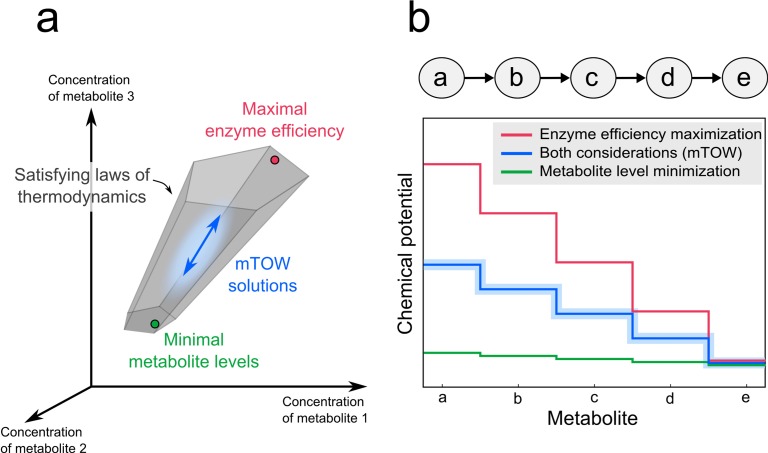
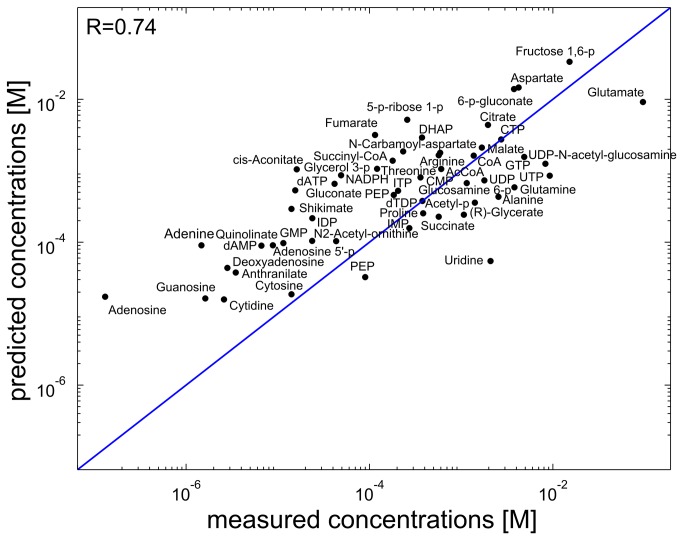
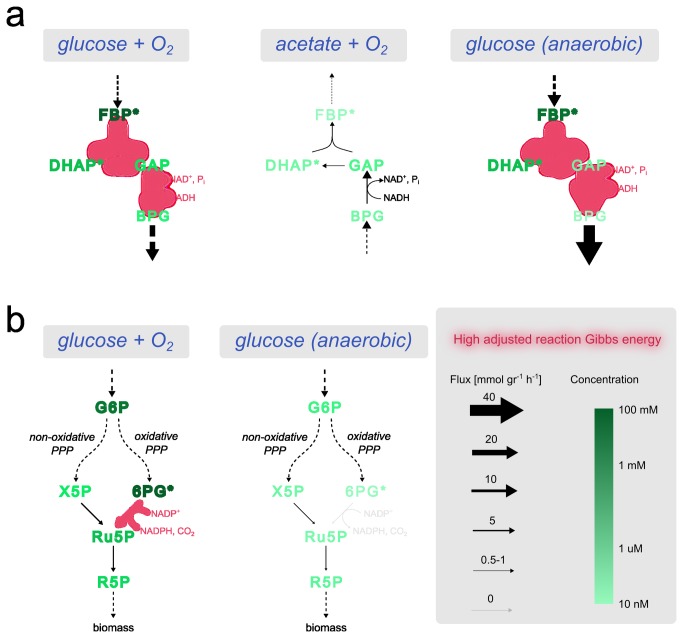
Steady-state metabolite concentrations in a microorganism typically span several orders of magnitude. The underlying principles governing these concentrations remain poorly understood. Here, we hypothesize that observed variation can be explained in terms of a compromise between factors that favor minimizing metabolite pool sizes (e.g. limited solvent capacity) and the need to effectively utilize existing enzymes. The latter requires adequate thermodynamic driving force in metabolic reactions so that forward flux substantially exceeds reverse flux. To test this hypothesis, we developed a method, metabolic tug-of-war (mTOW), which computes steady-state metabolite concentrations in microorganisms on a genome-scale. mTOW is shown to explain up to 55% of the observed variation in measured metabolite concentrations in E. coli and C. acetobutylicum across various growth media. Our approach, based strictly on first thermodynamic principles, is the first method that successfully predicts high-throughput metabolite concentration data in bacteria across conditions.
在微生物中,稳态代谢物浓度通常跨越几个数量级。然而,这些浓度背后的控制原理仍未被很好地理解。在这里,我们假设可以根据有利于最小化代谢物池大小的因素(例如有限的溶剂容量)和有效利用现有酶的需要之间的折衷来解释观察到的变化。后者需要在代谢反应中有足够的热力学驱动力,以使正向通量大大超过反向通量。为了验证这一假设,我们开发了一种方法,即代谢拔河(mTOW),该方法可以在基因组范围内计算微生物中的稳态代谢物浓度。结果表明,mTOW 可以解释 55%的大肠杆菌和丙酮丁醇梭菌在各种生长培养基中的测量代谢物浓度的观察到的变化。我们的方法严格基于第一热力学原理,是第一个成功预测细菌在不同条件下高通量代谢物浓度数据的方法。