Department of Pathology, Rabin Medical Center, Petah Tikva, Israel ; Sackler School of Medicine, Tel Aviv University, Tel Aviv, Israel.
PLoS One. 2013 Sep 25;8(9):e75547. doi: 10.1371/journal.pone.0075547. eCollection 2013.
Obesity is associated with glomerular hyperfiltration, increased proximal tubular sodium reabsorption, glomerular enlargement and renal hypertrophy. A single experimental study reported an increased glomerular urinary space in obese dogs. Whether proximal tubular volume is increased in obese subjects and whether their glomerular and tubular urinary spaces are enlarged is unknown.
To determine whether proximal tubules and glomerular and tubular urinary space are enlarged in obese subjects with proteinuria and glomerular hyperfiltration.
Kidney biopsies from 11 non-diabetic obese with proteinuria and 14 non-diabetic lean patients with a creatinine clearance above 50 ml/min and with mild or no interstitial fibrosis were retrospectively analyzed using morphometric methods. The cross-sectional area of the proximal tubular epithelium and lumen, the volume of the glomerular tuft and of Bowman's space and the nuclei number per tubular profile were estimated.
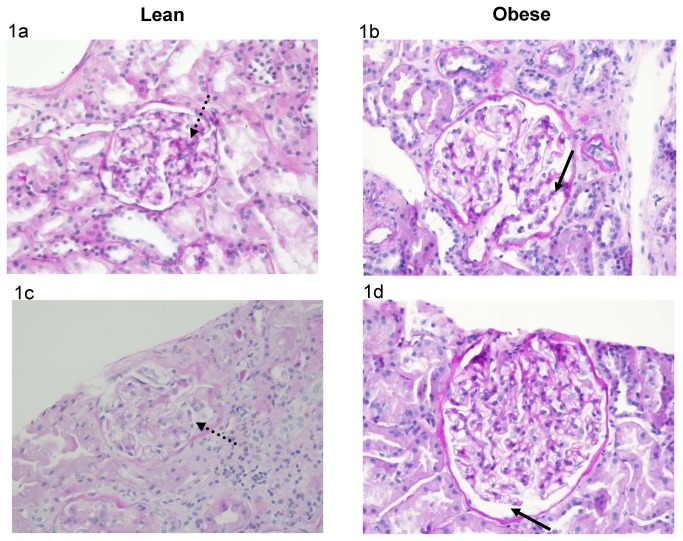
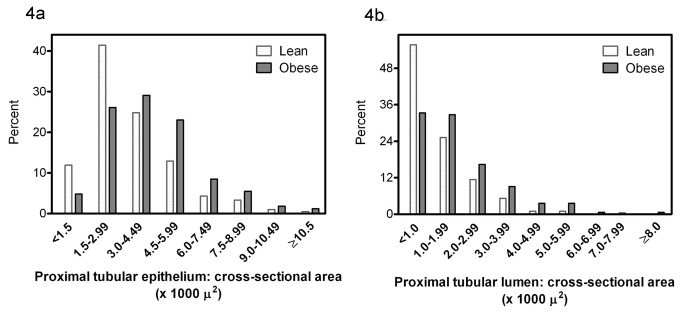
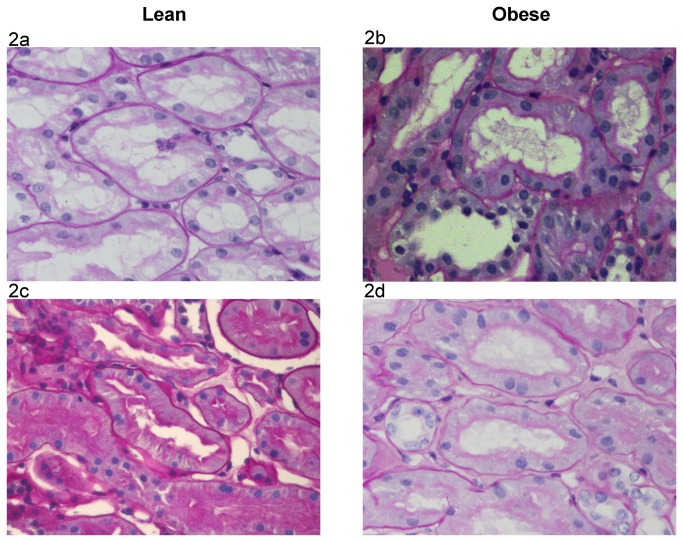
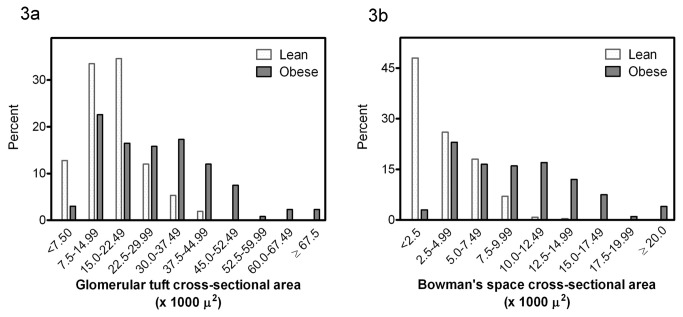
Creatinine clearance was higher in the obese than in the lean group (P=0.03). Proteinuria was similarly increased in both groups. Compared to the lean group, the obese group displayed a 104% higher glomerular tuft volume (P=0.001), a 94% higher Bowman's space volume (P=0.003), a 33% higher cross-sectional area of the proximal tubular epithelium (P=0.02) and a 54% higher cross-sectional area of the proximal tubular lumen (P=0.01). The nuclei number per proximal tubular profile was similar in both groups, suggesting that the increase in tubular volume is due to hypertrophy and not to hyperplasia.
Obesity-related glomerular hyperfiltration is associated with proximal tubular epithelial hypertrophy and increased glomerular and tubular urinary space volume in subjects with proteinuria. The expanded glomerular and urinary space is probably a direct consequence of glomerular hyperfiltration. These effects may be involved in the pathogenesis of obesity-related renal disease.
肥胖与肾小球高滤过、近端肾小管钠重吸收增加、肾小球增大和肾肥大有关。一项单因素实验研究报道肥胖犬的肾小球尿空间增加。肥胖患者的近端肾小管体积是否增加以及他们的肾小球和肾小管尿空间是否增大尚不清楚。
确定蛋白尿和肾小球高滤过的肥胖患者中近端小管和肾小球及小管尿空间是否增大。
回顾性分析 11 例非糖尿病肥胖伴蛋白尿和 14 例非糖尿病瘦伴肌酐清除率>50ml/min 且间质纤维化轻度或无的患者的肾活检,采用形态计量学方法。估计近端肾小管上皮和管腔的横截面积、肾小球毛簇和鲍曼氏空间的体积以及每个肾小管轮廓的核数。
肥胖组的肌酐清除率高于瘦组(P=0.03)。两组蛋白尿均明显增加。与瘦组相比,肥胖组肾小球毛簇体积增加 104%(P=0.001),鲍曼氏空间体积增加 94%(P=0.003),近端肾小管上皮横截面积增加 33%(P=0.02),近端肾小管腔横截面积增加 54%(P=0.01)。两组的近端肾小管核数相似,提示肾小管体积的增加是由于肥大而不是增生。
肥胖相关的肾小球高滤过与蛋白尿患者的近端肾小管上皮细胞肥大以及肾小球和小管尿空间体积增加有关。扩张的肾小球和尿空间可能是肾小球高滤过的直接后果。这些影响可能参与肥胖相关肾脏疾病的发病机制。