Max Planck Institute for Plant Breeding Research, Carl-von-Linné-Weg 10, 50829, Cologne, Germany.
BMC Bioinformatics. 2013 Oct 4;14:292. doi: 10.1186/1471-2105-14-292.
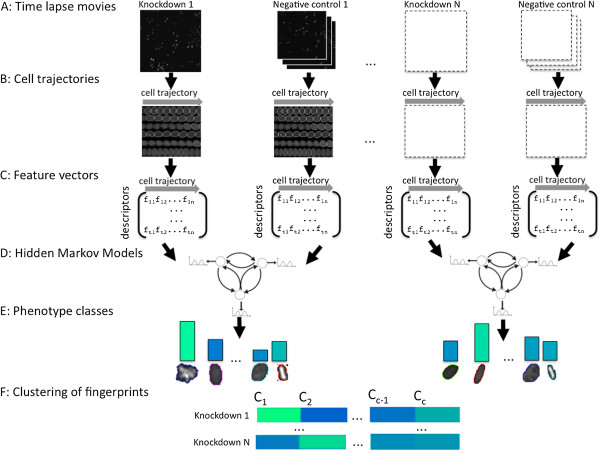
Gene perturbation experiments in combination with fluorescence time-lapse cell imaging are a powerful tool in reverse genetics. High content applications require tools for the automated processing of the large amounts of data. These tools include in general several image processing steps, the extraction of morphological descriptors, and the grouping of cells into phenotype classes according to their descriptors. This phenotyping can be applied in a supervised or an unsupervised manner. Unsupervised methods are suitable for the discovery of formerly unknown phenotypes, which are expected to occur in high-throughput RNAi time-lapse screens.
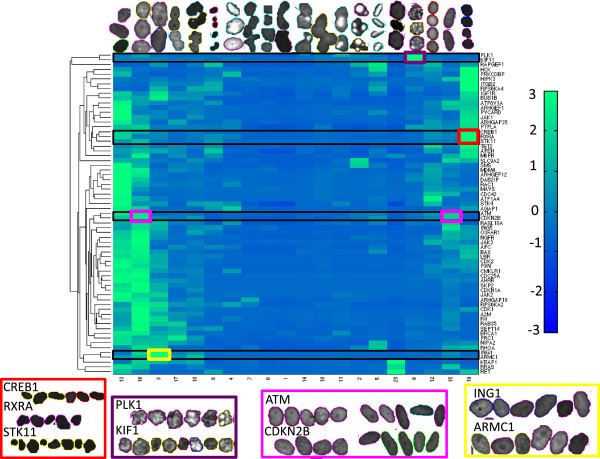
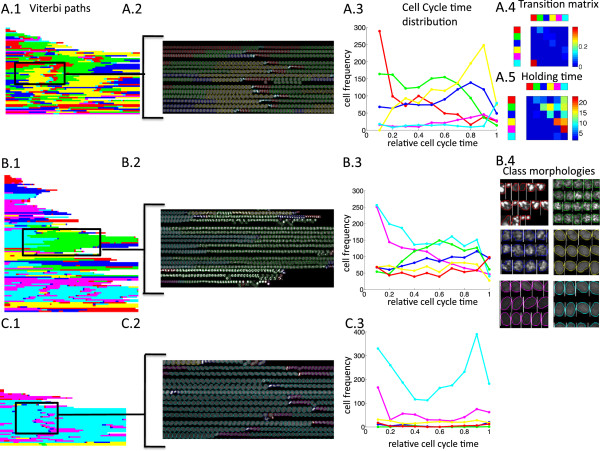
We developed an unsupervised phenotyping approach based on Hidden Markov Models (HMMs) with multivariate Gaussian emissions for the detection of knockdown-specific phenotypes in RNAi time-lapse movies. The automated detection of abnormal cell morphologies allows us to assign a phenotypic fingerprint to each gene knockdown. By applying our method to the Mitocheck database, we show that a phenotypic fingerprint is indicative of a gene's function.
Our fully unsupervised HMM-based phenotyping is able to automatically identify cell morphologies that are specific for a certain knockdown. Beyond the identification of genes whose knockdown affects cell morphology, phenotypic fingerprints can be used to find modules of functionally related genes.
基因干扰实验与荧光延时细胞成像相结合,是反向遗传学的有力工具。高通量应用需要工具来自动处理大量数据。这些工具通常包括几个图像处理步骤、形态描述符的提取,以及根据描述符将细胞分组为表型类。这种表型分析可以采用有监督或无监督的方式。无监督方法适用于发现以前未知的表型,这些表型预计会在高通量 RNAi 延时筛选中出现。
我们开发了一种基于隐马尔可夫模型(HMMs)的无监督表型分析方法,该方法具有多元高斯发射,用于检测 RNAi 延时电影中特定于基因敲低的表型。自动检测异常细胞形态使我们能够为每个基因敲低分配一个表型指纹。通过将我们的方法应用于 Mitocheck 数据库,我们表明表型指纹是基因功能的指示。
我们完全无监督的基于 HMM 的表型分析能够自动识别特定于特定敲低的细胞形态。除了识别敲低影响细胞形态的基因之外,表型指纹还可用于寻找功能相关基因的模块。