Science + Technology in Learning Whitley Bay, UK.
Front Hum Neurosci. 2013 Sep 25;7:589. doi: 10.3389/fnhum.2013.00589. eCollection 2013.
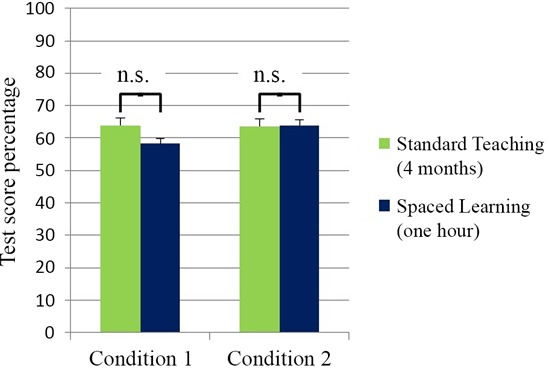
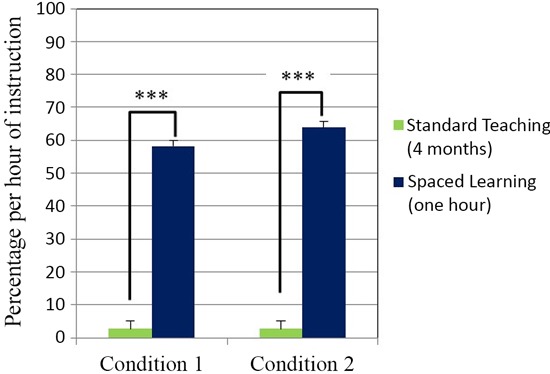
Memory systems select from environmental stimuli those to encode permanently. Repeated stimuli separated by timed spaces without stimuli can initiate Long-Term Potentiation (LTP) and long-term memory (LTM) encoding. These processes occur in time scales of minutes, and have been demonstrated in many species. This study reports on using a specific timed pattern of three repeated stimuli separated by 10 min spaces drawn from both behavioral and laboratory studies of LTP and LTM encoding. A technique was developed based on this pattern to test whether encoding complex information into LTM in students was possible using the pattern within a very short time scale. In an educational context, stimuli were periods of highly compressed instruction, and spaces were created through 10 min distractor activities. Spaced Learning in this form was used as the only means of instruction for a national curriculum Biology course, and led to very rapid LTM encoding as measured by the high-stakes test for the course. Remarkably, learning at a greatly increased speed and in a pattern that included deliberate distraction produced significantly higher scores than random answers (p < 0.00001) and scores were not significantly different for experimental groups (one hour spaced learning) and control groups (four months teaching). Thus learning per hour of instruction, as measured by the test, was significantly higher for the spaced learning groups (p < 0.00001). In a third condition, spaced learning was used to replace the end of course review for one of two examinations. Results showed significantly higher outcomes for the course using spaced learning (p < 0.0005). The implications of these findings and further areas for research are briefly considered.
记忆系统从环境刺激中选择要永久编码的信息。通过时间间隔没有刺激的重复刺激可以引发长时程增强(LTP)和长期记忆(LTM)编码。这些过程发生在几分钟的时间尺度内,并在许多物种中得到了证明。本研究报告了使用一种特定的定时模式,从 LTP 和 LTM 编码的行为和实验室研究中重复三次刺激,间隔 10 分钟。基于这种模式开发了一种技术,以测试是否可以在非常短的时间尺度内使用该模式将复杂信息编码到学生的 LTM 中。在教育环境中,刺激是高度压缩的教学期,而间隔期是通过 10 分钟的分散活动创造的。这种形式的间隔学习被用作国家生物课程唯一的教学手段,并且通过该课程的高风险测试,非常迅速地进行了 LTM 编码。值得注意的是,以大大提高的速度学习,并且包括故意分心的模式,产生的分数明显高于随机答案(p <0.00001),并且实验组(间隔一小时学习)和对照组(四个月教学)的分数没有显着差异。因此,如测试所示,每小时的教学,间隔学习组的学习速度明显更快(p <0.00001)。在第三个条件下,间隔学习用于取代两门考试之一的课程结束复习。结果表明,使用间隔学习的课程成绩明显更高(p <0.0005)。简要考虑了这些发现的含义和进一步的研究领域。