Department of Neurology, University Hospital "12 de Octubre", Madrid, Spain; Department of Medicine, Faculty of Medicine, Complutense University, Madrid, Spain; Centro de Investigación Biomédica en Red sobre Enfermedades Neurodegenerativas, Madrid, Spain.
J Psychiatr Res. 2013 Dec;47(12):1998-2003. doi: 10.1016/j.jpsychires.2013.09.007. Epub 2013 Sep 20.
It is not clear whether cognitive decline progresses more quickly in long sleepers than in short sleepers or than in participants with usual sleep duration. We assessed cognitive decline as a function of self-reported sleep duration in a prospective population-based cohort (NEDICES).
Participants were evaluated at baseline and 3 years later. Baseline demographic variables were recorded and participants indicated their daily sleep usual duration as the sum of nighttime sleep and daytime napping. The average daily total usual sleep duration was grouped into three categories: ≤ 5 h (short sleepers), 6-8 h (reference category), and ≥ 9 h (long sleepers). At baseline and at follow-up, a 37-item version of the Mini-Mental State Examination (37-MMSE) was administered.
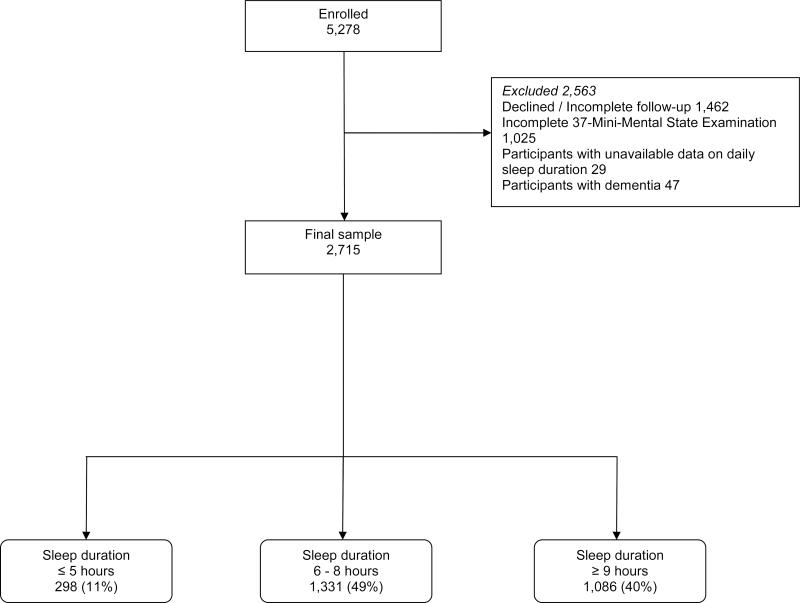
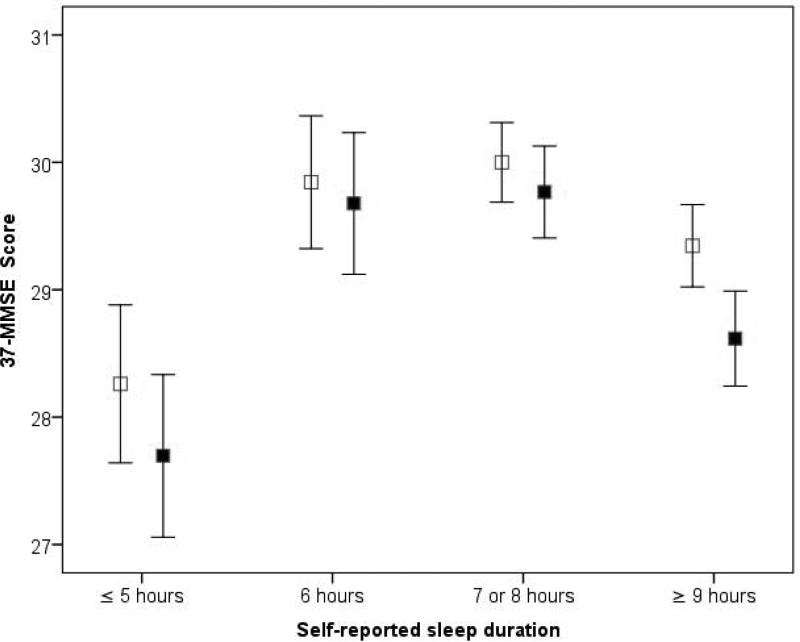
The final sample, 2715 participants (72.9 ± 6.1 years), comprised 298 (11%) short sleepers, 1086 (40%) long sleepers, and 1331 (49%) in the reference group (6-8 h). During the three year follow-up period, the 37-MMSE declined by 0.5 ± 4.0 points in short sleepers, 0.6 ± 4.3 points in long sleepers, and 0.2 ± 3.8 points in the reference group (p = 0.08). The difference between short sleepers and the reference group was not significant (p = 0.142); however, the difference between long sleepers and the reference group was significant (p = 0.040). In analyses adjusted for baseline age and other potential confounders, this difference remained robust.
In this study, cognitive test scores among long sleepers declined more rapidly than observed in a reference group. Additional studies are needed to confirm these results.
目前尚不清楚长睡眠者的认知衰退速度是否快于短睡眠者,或者是否快于睡眠时间正常的参与者。我们在一项前瞻性基于人群的队列研究(NEDICES)中,根据自我报告的睡眠时间评估认知衰退情况。
参与者在基线和 3 年后进行评估。记录基线人口统计学变量,并让参与者指出他们每天的睡眠通常持续时间,即夜间睡眠时间和白天小睡时间的总和。平均每日总通常睡眠时间分为三组:≤5 小时(短睡眠者)、6-8 小时(参考组)和≥9 小时(长睡眠者)。在基线和随访时,进行 37 项简易精神状态检查(37-MMSE)。
最终样本包括 2715 名参与者(72.9±6.1 岁),其中 298 名(11%)为短睡眠者,1086 名(40%)为长睡眠者,1331 名(49%)为参考组(6-8 小时)。在 3 年的随访期间,短睡眠者的 37-MMSE 下降了 0.5±4.0 分,长睡眠者下降了 0.6±4.3 分,参考组下降了 0.2±3.8 分(p=0.08)。短睡眠者与参考组之间的差异无统计学意义(p=0.142);然而,长睡眠者与参考组之间的差异有统计学意义(p=0.040)。在调整基线年龄和其他潜在混杂因素后,这一差异仍然稳健。
在这项研究中,长睡眠者的认知测试分数下降速度快于参考组。需要进一步研究来证实这些结果。