Department of Epidemiology and Statistics, School of Public Health and Management at Ningxia Medical University, Yinchuan, China.
Department of Epidemiology and Statistics at School of Public Health of Guangdong Medical University, Dongguan, China.
PLoS One. 2021 May 27;16(5):e0252208. doi: 10.1371/journal.pone.0252208. eCollection 2021.
Studies have found that social capital (SC) is associated with the risk of cognitive decline; however, the mechanism explaining how SC leads to cognitive decline is unclear. The current study examines the mediation effect of sleep duration on the relationship between SC and cognitive decline in Chinese older adults.
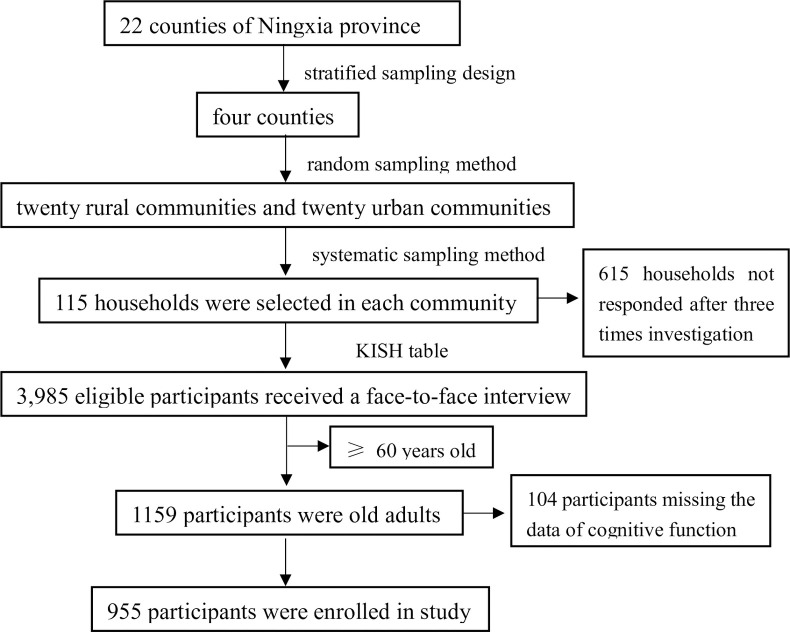
A cross-sectional study of 955 community-dwelling aged 60 or over was conducted. The mini-mental state examination (MMSE), self-report sleep duration questionnaire, and social capital scales were administered during the face-to-face survey. The Bootstrap methods PROCESS program is employed to test the mediation model.
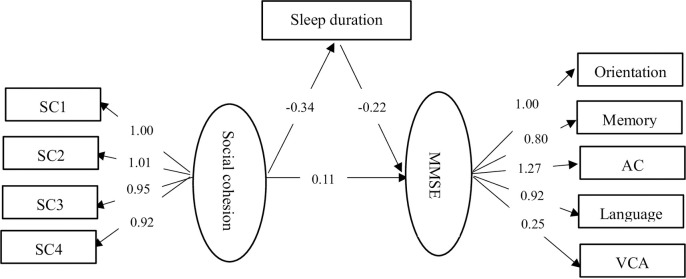
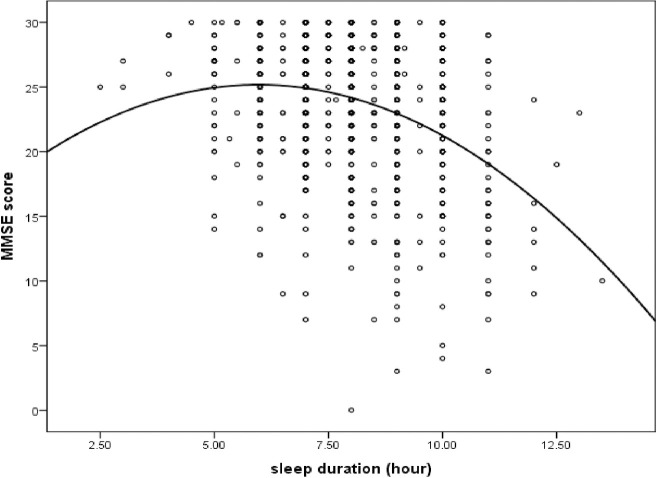
After controlling for covariates, both social cohesion and social interaction were positively correlated with the MMSE score (p<0.001), and social cohesion was negatively correlated with sleep duration (p = 0.009); On the contrary, sleep duration was negatively correlated with MMSE score (p<0.001). Linear regression analysis showed social cohesion was positively associated with the MMSE score (β = 0.16, p = 0.005), while sleep duration was associated with an increased risk of cognitive decline (β = -0.72, p<0.001). Sleep duration has mediated the relationship between social cohesion and cognitive decline (explaining 21.7% of the total variance).
Social capital negatively associated with the risk of cognitive decline in this Chinese population, and sleep duration may partly explain this relationship. It may be a suggestive clue to identify those at a higher risk of progressing to cognitive impairment. Further prospective study in need to confirm this finding due to the cross-sectional design.
研究发现社会资本(SC)与认知能力下降的风险有关;然而,解释 SC 如何导致认知能力下降的机制尚不清楚。本研究考察了睡眠时长在 SC 与中国老年人认知能力下降之间的关系中的中介效应。
对 955 名居住在社区的 60 岁及以上老年人进行了横断面研究。在面对面调查中进行了简易精神状态检查(MMSE)、自我报告的睡眠时长问卷和社会资本量表。采用 Bootstrap 方法 PROCESS 程序检验中介模型。
在控制了协变量后,社会凝聚力和社会互动均与 MMSE 评分呈正相关(p<0.001),社会凝聚力与睡眠时长呈负相关(p = 0.009);相反,睡眠时长与 MMSE 评分呈负相关(p<0.001)。线性回归分析表明社会凝聚力与 MMSE 评分呈正相关(β = 0.16,p = 0.005),而睡眠时长与认知能力下降的风险增加相关(β = -0.72,p<0.001)。睡眠时长中介了社会凝聚力与认知能力下降之间的关系(解释了总方差的 21.7%)。
在该中国人群中,社会资本与认知能力下降的风险呈负相关,而睡眠时长可能部分解释了这种关系。这可能是识别那些认知障碍风险较高的人的一个提示线索。由于横断面设计,需要进一步的前瞻性研究来证实这一发现。