Department of Entomology and Nematology, University of Florida, Vero Beach, Florida, United States of America.
PLoS One. 2013 Sep 30;8(9):e74582. doi: 10.1371/journal.pone.0074582. eCollection 2013.
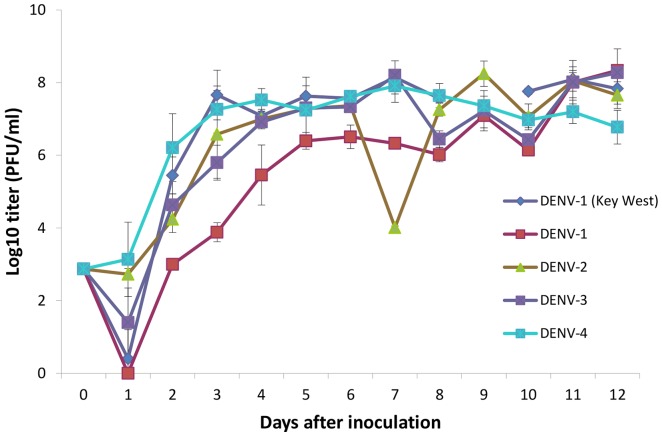
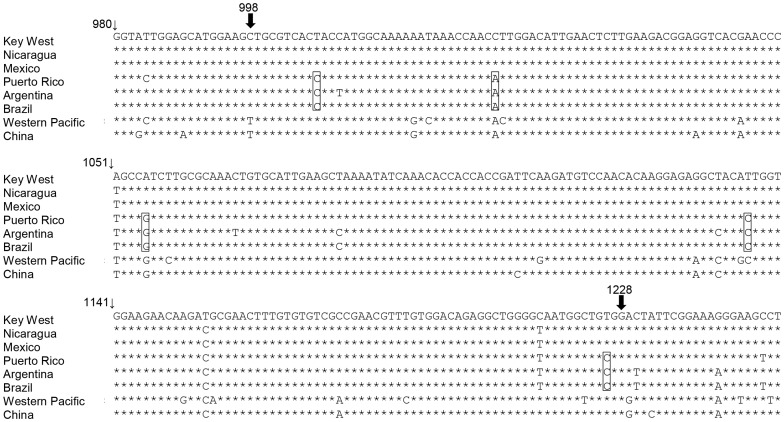
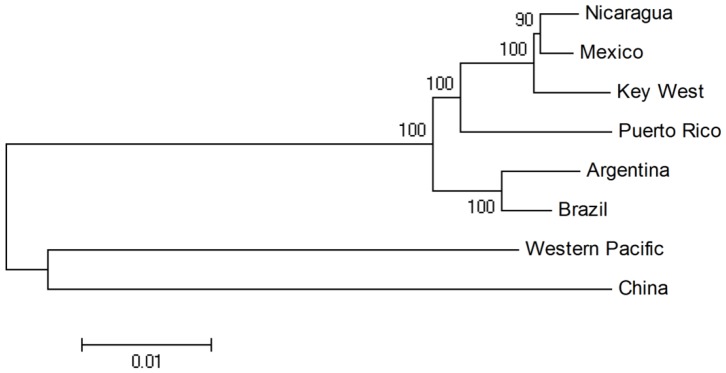
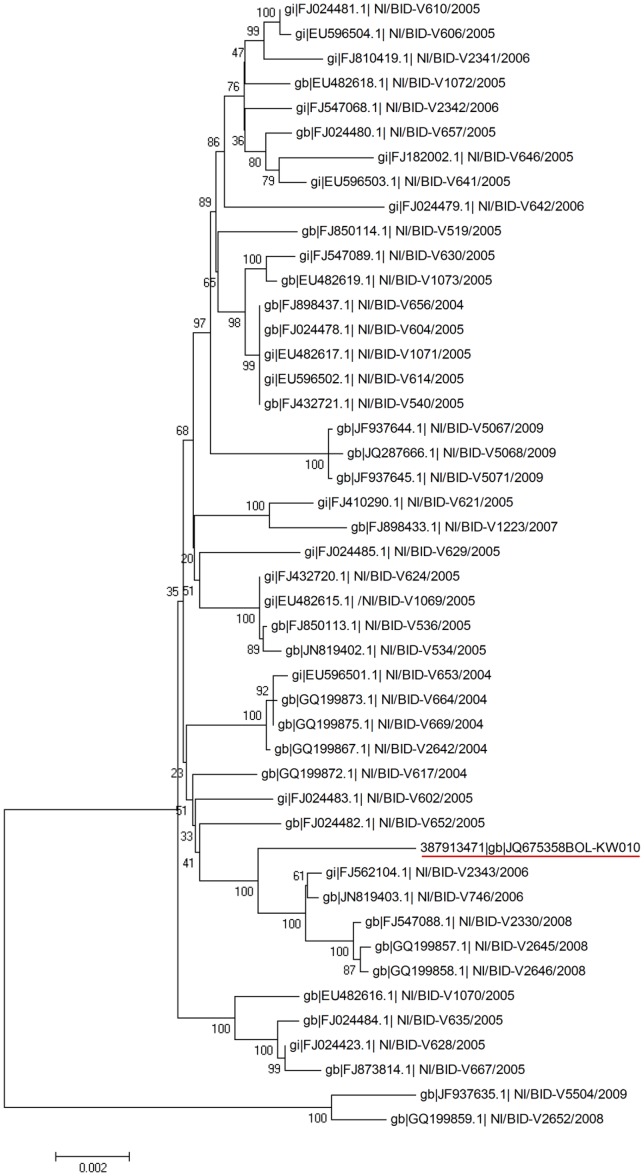
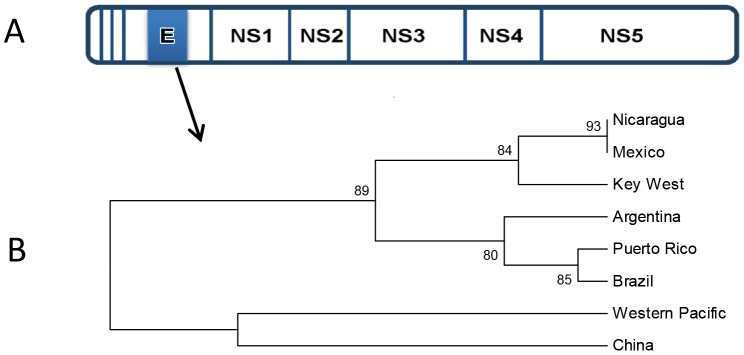
Dengue virus (DENV) is transmitted to humans through the bite of mosquitoes. In November 2010, a dengue outbreak was reported in Monroe County in southern Florida (FL), including greater than 20 confirmed human cases. The virus collected from the human cases was verified as DENV serotype 1 (DENV-1) and one isolate was provided for sequence analysis. RNA was extracted from the DENV-1 isolate and was used in reverse transcription polymerase chain reaction (RT-PCR) to amplify PCR fragments to sequence. Nucleic acid primers were designed to generate overlapping PCR fragments that covered the entire genome. The DENV-1 isolate found in Key West (KW), FL was sequenced for whole genome characterization. Sequence assembly, Genbank searches, and recombination analyses were performed to verify the identity of the genome sequences and to determine percent similarity to known DENV-1 sequences. We show that the KW DENV-1 strain is 99% identical to Nicaraguan and Mexican DENV-1 strains. Phylogenetic and recombination analyses suggest that the DENV-1 isolated in KW originated from Nicaragua (NI) and the KW strain may circulate in KW. Also, recombination analysis results detected recombination events in the KW strain compared to DENV-1 strains from Puerto Rico. We evaluate the relative growth of KW strain of DENV-1 compared to other dengue viruses to determine whether the underlying genetics of the strain is associated with a replicative advantage, an important consideration since local transmission of DENV may result because domestic tourism can spread DENVs.
登革热病毒(DENV)通过蚊子叮咬传播给人类。2010 年 11 月,佛罗里达州(FL)南部的门罗县报告了一起登革热疫情,包括 20 多例确诊的人类病例。从这些人类病例中采集的病毒被证实为血清型 1(DENV-1),并提供了一个分离株进行序列分析。从 DENV-1 分离株中提取 RNA,用于逆转录聚合酶链反应(RT-PCR)扩增 PCR 片段进行测序。设计了核酸引物来产生覆盖整个基因组的重叠 PCR 片段。对佛罗里达州基韦斯特(KW)的 DENV-1 分离株进行了全基因组测序,以进行特征描述。进行了序列组装、Genbank 搜索和重组分析,以验证基因组序列的身份,并确定与已知 DENV-1 序列的相似百分比。我们表明,KW 的 DENV-1 株与尼加拉瓜和墨西哥的 DENV-1 株完全相同。系统发育和重组分析表明,KW 分离的 DENV-1 源自尼加拉瓜(NI),并且 KW 株可能在 KW 循环。此外,与来自波多黎各的 DENV-1 株相比,重组分析结果检测到 KW 株中的重组事件。我们评估 KW 株的 DENV-1 与其他登革热病毒的相对生长情况,以确定该株的潜在遗传是否与复制优势有关,这是一个重要的考虑因素,因为国内旅游可能会传播 DENVs,从而导致当地的 DENV 传播。