Department of Science & Education, Shanghai Municipal Center for Disease Control & Prevention, Shanghai, China.
PLoS One. 2013 Sep 30;8(9):e75926. doi: 10.1371/journal.pone.0075926. eCollection 2013.
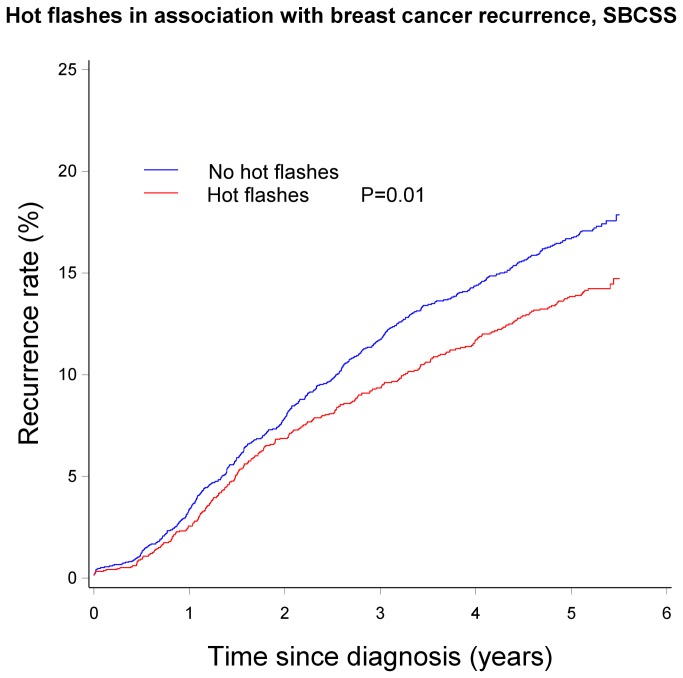
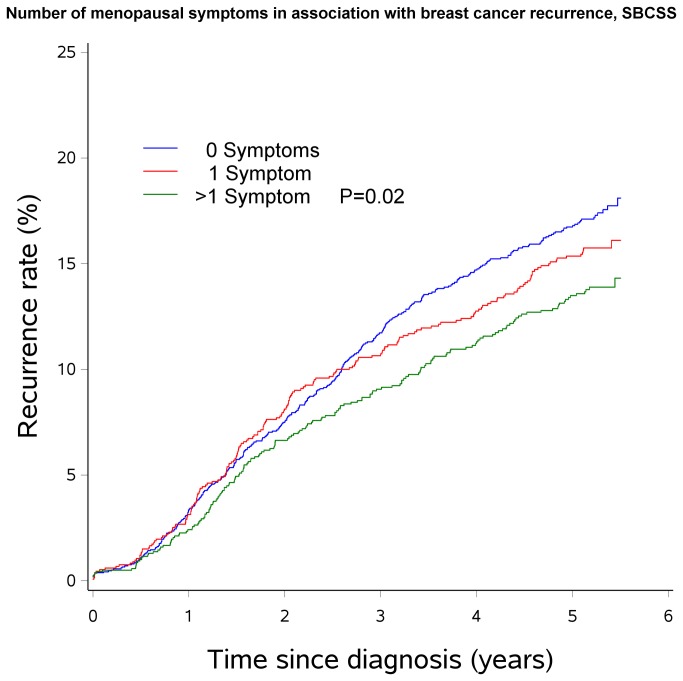
Menopausal symptoms have been suggested to be an indicator of better prognosis among patients treated for breast cancer, because women who experience these symptoms usually have a lower level of estrogen. We tested this hypothesis in a population-based, prospective cohort study involving 4,842 women with stage 0 to III primary breast cancer who were enrolled in the Shanghai Breast Cancer Survival Study between March 2002 and April 2006, were aged 20 to 75 years, and were recruited 6 months post-diagnosis. They were followed-up by in-person surveys and record linkages with the vital statistics registry. Cox regression analysis was used to evaluate the association of menopausal symptoms at baseline with breast cancer recurrence. Approximately 56% of patients experienced at least one menopausal symptom, including hot flashes, night sweats, and/or vaginal dryness at baseline. During a median follow-up period of 5.3 years, 720 women had a recurrence. Experiencing hot flashes or having ≥2 menopausal symptoms was associated with lower risk of recurrence among premenopausal women (hazard ratio [HR]=0.77, 95% confidence interval [CI]: 0.62-0.96 for hot flashes; 0.73, 0.56-0.96 for ≥2 menopausal symptoms). Lower recurrence risk in relation to hot flashes was also observed among women who were not overweight/obese (HR=0.78, 95% CI: 0.64-0.99), those with relatively low waist-to-hip ratio (WHR) (HR=0.77, 95% CI: 0.61-0.97), and those who used tamoxifen (HR=0.75, 95% CI: 0.58-0.98). Consistently experiencing multiple menopausal symptoms was associated with lower recurrence risk among women with low WHR or who used tamoxifen. This large, population-based cohort study of women with breast cancer confirms that experiencing menopausal symptoms is an indicator of favorable breast cancer prognosis.
绝经期症状被认为是接受乳腺癌治疗的患者预后较好的指标,因为出现这些症状的女性通常雌激素水平较低。我们在一项基于人群的前瞻性队列研究中检验了这一假设,该研究纳入了 2002 年 3 月至 2006 年 4 月期间参加上海乳腺癌生存研究的 4842 名 0 期至 3 期原发性乳腺癌女性患者,年龄在 20 至 75 岁之间,在诊断后 6 个月招募。通过个人调查和与生命统计登记处的记录链接进行随访。Cox 回归分析用于评估基线时的绝经期症状与乳腺癌复发的关系。大约 56%的患者在基线时经历了至少一种绝经期症状,包括热潮红、盗汗和/或阴道干燥。在中位随访 5.3 年期间,720 名患者复发。在绝经前女性中,经历热潮红或有≥2 种绝经期症状与复发风险降低相关(风险比 [HR]=0.77,95%置信区间 [CI]:0.62-0.96 为热潮红;0.73,0.56-0.96 为≥2 种绝经期症状)。在非超重/肥胖(HR=0.78,95% CI:0.64-0.99)、相对低腰围-臀围比(WHR)(HR=0.77,95% CI:0.61-0.97)和使用他莫昔芬的女性(HR=0.75,95% CI:0.58-0.98)中,与热潮红相关的复发风险降低也有观察到。持续经历多种绝经期症状与 WHR 较低或使用他莫昔芬的女性复发风险降低相关。这项针对乳腺癌女性的大型基于人群的队列研究证实,经历绝经期症状是乳腺癌预后良好的指标。