Lee Wha Jin, Yoon Cindy W, Kim Sung-Woo, Jeong Hye Jin, Seo Seongho, Na Duk L, Noh Young, Seong Joon-Kyung
School of Biomedical Engineering, Korea University, Seoul, South Korea.
Department of Neurology, School of Medicine, Inha University, Incheon, South Korea.
Front Neurosci. 2021 Feb 16;15:606600. doi: 10.3389/fnins.2021.606600. eCollection 2021.
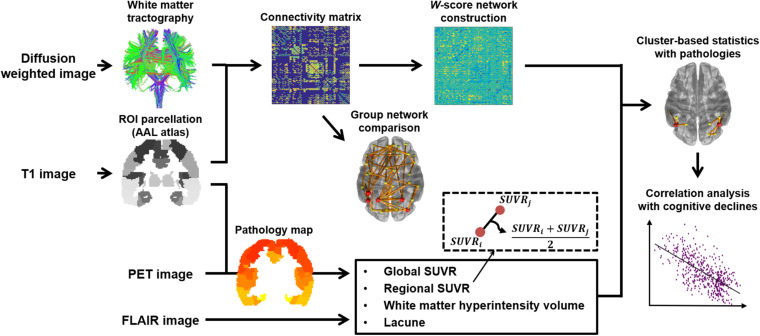
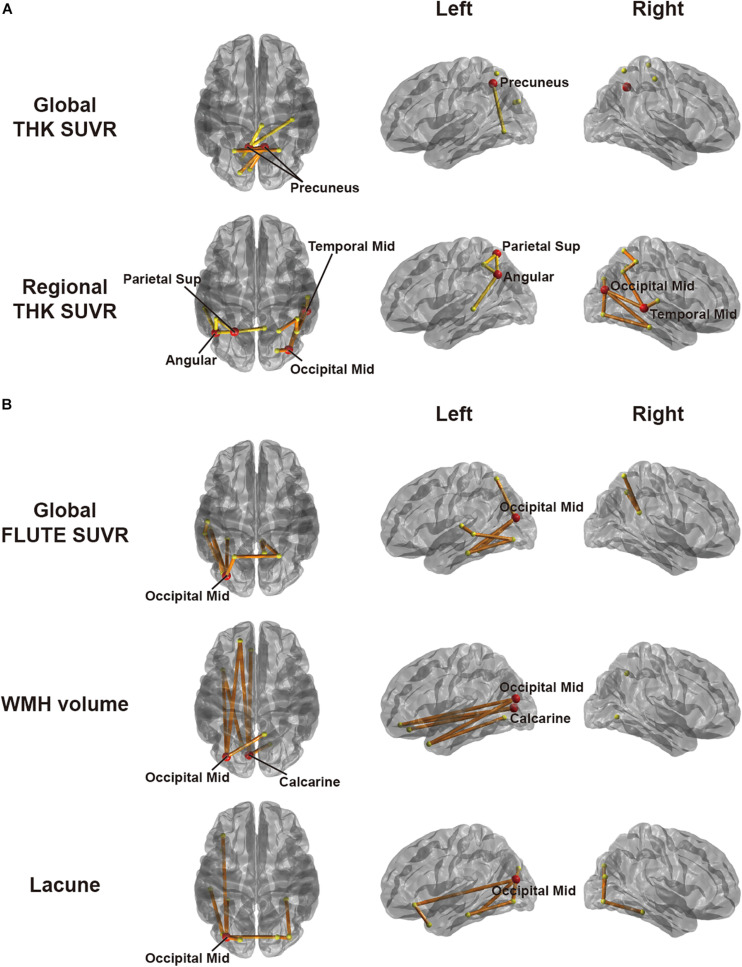
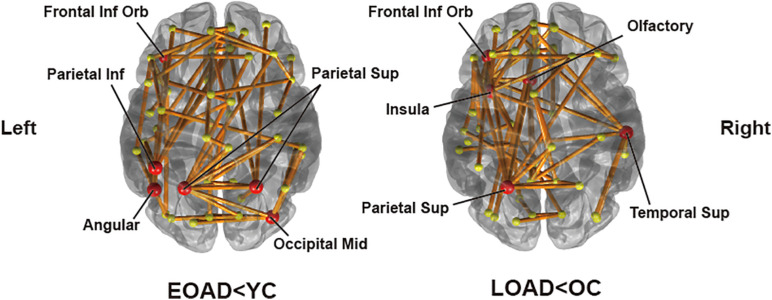
Early- and late-onset Alzheimer's disease (AD) patients often exhibit distinct features. We sought to compare overall white matter connectivity and evaluate the pathological factors (amyloid, tau, and vascular pathologies) that affect the disruption of connectivity in these two groups. A total of 50 early- and 38 late-onset AD patients, as well as age-matched cognitively normal participants, were enrolled and underwent diffusion-weighted magnetic resonance imaging to construct fractional anisotropy-weighted white matter connectivity maps. [F]-THK5351 PET, [F]-Flutemetamol PET, and magnetic resonance imaging were used for the evaluation of tau and related astrogliosis, amyloid, and small vessel disease markers (lacunes and white matter hyperintensities). Cluster-based statistics was performed for connectivity comparisons and correlation analysis between connectivity disruption and the pathological markers. Both patient groups exhibited significantly disrupted connectivity compared to their control counterparts with distinct patterns. Only THK retention was related to connectivity disruption in early-onset AD patients, and this disruption showed correlations with most cognitive scores, while late-onset AD patients had disrupted connectivity correlated with amyloid deposition, white matter hyperintensities, and lacunes in which only a few cognitive scores showed associations. These findings suggest that the pathogenesis of connectivity disruption and its effects on cognition are distinct between EOAD and LOAD.
早发型和晚发型阿尔茨海默病(AD)患者通常表现出不同的特征。我们试图比较整体白质连通性,并评估影响这两组连通性破坏的病理因素(淀粉样蛋白、tau蛋白和血管病变)。共招募了50例早发型和38例晚发型AD患者以及年龄匹配的认知正常参与者,他们接受了扩散加权磁共振成像,以构建分数各向异性加权白质连通性图谱。使用[F]-THK5351 PET、[F]-氟替美莫PET和磁共振成像来评估tau蛋白及相关星形胶质细胞增生、淀粉样蛋白和小血管疾病标志物(腔隙和白质高信号)。进行基于聚类的统计分析,以比较连通性,并分析连通性破坏与病理标志物之间的相关性。与对照组相比,两组患者均表现出明显的连通性破坏,且模式不同。在早发型AD患者中,只有THK保留与连通性破坏有关,且这种破坏与大多数认知评分相关,而晚发型AD患者的连通性破坏与淀粉样蛋白沉积、白质高信号和腔隙相关,其中只有少数认知评分显示出关联。这些发现表明,早发型AD和晚发型AD在连通性破坏的发病机制及其对认知的影响方面存在差异。