Kebede Bekana, Abate Tatek, Mekonnen Desalew
Department of Health Services Management, Institute of Public Health, University of Gondar, Ethiopia.
Pan Afr Med J. 2013 Jun 9;15:50. doi: 10.11604/pamj.2013.15.50.2328. eCollection 2013.
HIV is still an enormous global burden and it is also causing loss of huge health care workers (HCWs) on the already limited human resource capacity in health care services in Sub-Saharan Africa. Variety of methods of accelerating HIV testing is required to increase the rate of HIV testing and expand treatment services. Therefore, this study was aimed to find out the prevalence, feasibility and options of HIV self-testing practices in Ethiopia.
A cross-sectional study design triangulated with qualitative method was conducted from February to May, 2012. The data was collected using a semi-structured pretested questionnaire and in-depth interview, at government and private health centers or clinics and hospitals. During the data collection all the available healthcare workers (HCWs) which encompass the internship students including: Medical, Health Officer, Nurses, Midwives and Laboratory students, and health professionals working in the selected health institutions were involved.
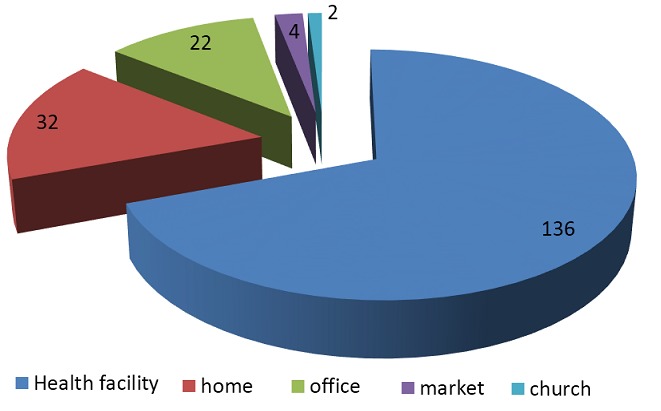
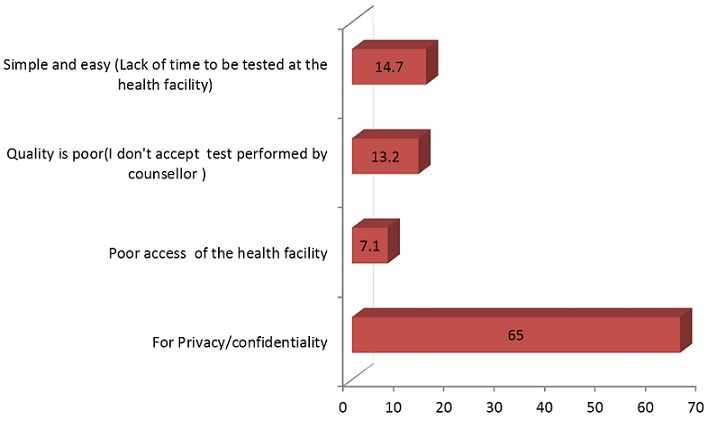
A total of 307 HCWs were included in the analysis and we found that 288(94.4%) of them were ever tested for HIV, of which majority 203 (70.5%) were tested by themselves though 244(80%) of the HCWs had motivation or interest to be tested by themselves. Generally, of the ever tested only 85(29.5%) were tested by the help of health care providers/counselors other than self. Regarding the place where the HCWs had the test, majority 136 (69.4%) tested by themselves at the health facility and the rest were tested at their home, office, market and church. The main reason stated for self-testing was the need for confidentiality for the test result, which was mentioned by 205(82%). Moreover, 35(14.0%) claims lack of time to access the ordinary counseling and testing services.
This study depicts high rate of HIV self-testing practice among HCWs. This shows that HIV self-testing can be considered as one pillar to increase the HIV-testing services and a means for the HIV prevention and control policy, through increasing HIV testing uptake and awareness of HIV status. However, the implementation may require the role of different stakeholders and decision makers with further study to extend the options.
艾滋病毒仍然是一个巨大的全球负担,并且它还导致撒哈拉以南非洲地区本来就有限的卫生保健服务人力资源中大量医护人员的流失。需要采用多种加速艾滋病毒检测的方法来提高艾滋病毒检测率并扩大治疗服务。因此,本研究旨在了解埃塞俄比亚艾滋病毒自我检测行为的流行情况、可行性及选择。
2012年2月至5月采用横断面研究设计并结合定性方法。通过使用半结构化的预测试问卷以及在政府和私立卫生中心、诊所及医院进行深入访谈来收集数据。在数据收集期间,所有可用的医护人员,包括实习学生,如医学专业学生、卫生官员、护士、助产士和实验室学生,以及在选定卫生机构工作的卫生专业人员都参与其中。
共有307名医护人员纳入分析,我们发现其中288人(94.4%)曾接受过艾滋病毒检测,其中大多数203人(70.5%)是自行检测,尽管244名(80%)医护人员有自行检测的动机或意愿。总体而言,在所有接受过检测的人中,只有85人(29.5%)是在医护人员/咨询师的帮助下而非自行检测的。关于医护人员进行检测的地点,大多数136人(69.4%)在医疗机构自行检测,其余的在其家中、办公室、市场和教堂检测。自行检测的主要原因是检测结果需要保密,205人(82%)提到了这一点。此外,35人(14.0%)称没有时间去接受常规的咨询和检测服务。
本研究表明医护人员中艾滋病毒自我检测行为的比例很高。这表明艾滋病毒自我检测可被视为提高艾滋病毒检测服务的一个支柱以及艾滋病毒预防和控制政策的一种手段,通过提高艾滋病毒检测率和对艾滋病毒感染状况的知晓率来实现。然而,实施可能需要不同利益相关者和决策者发挥作用,并有待进一步研究以扩展选择。