Sladky Ronald, Höflich Anna, Küblböck Martin, Kraus Christoph, Baldinger Pia, Moser Ewald, Lanzenberger Rupert, Windischberger Christian
MR Centre of Excellence, Medical University of Vienna, 1090 Vienna, Austria Centre for Medical Physics and Biomedical Engineering.
Department of Psychiatry and Psychotherapy, Medical University of Vienna, 1090 Vienna, Austria.
Cereb Cortex. 2015 Apr;25(4):895-903. doi: 10.1093/cercor/bht279. Epub 2013 Oct 9.
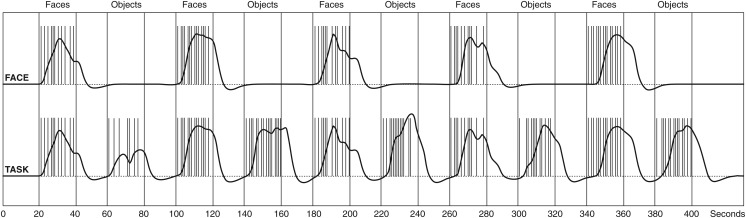
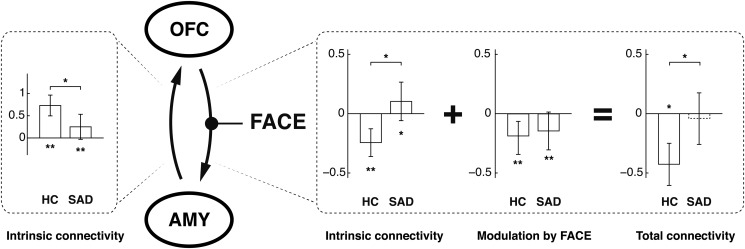
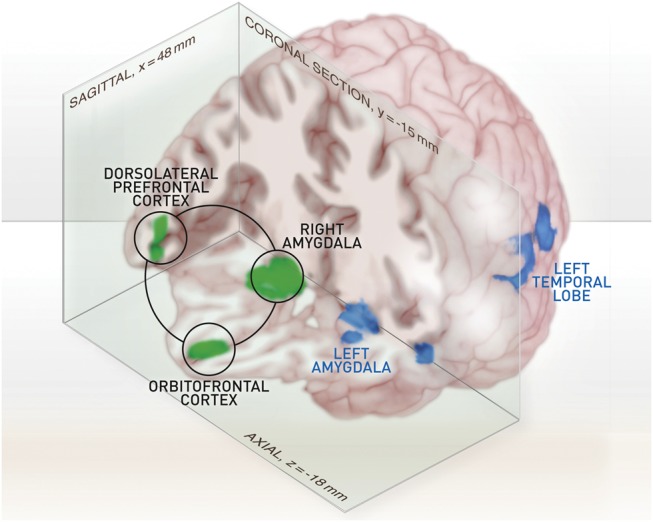
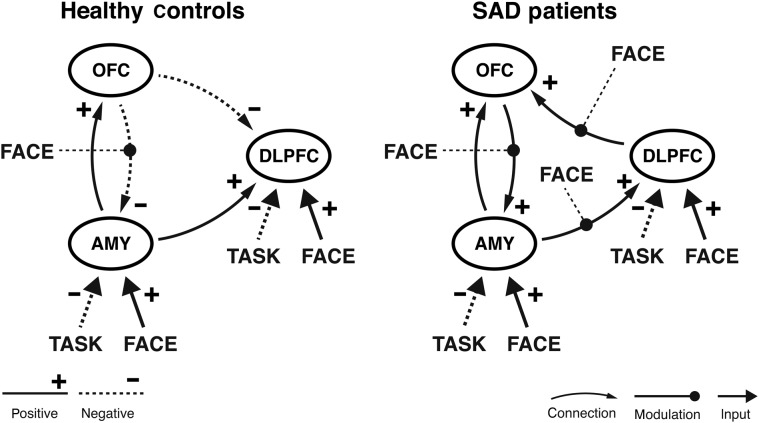
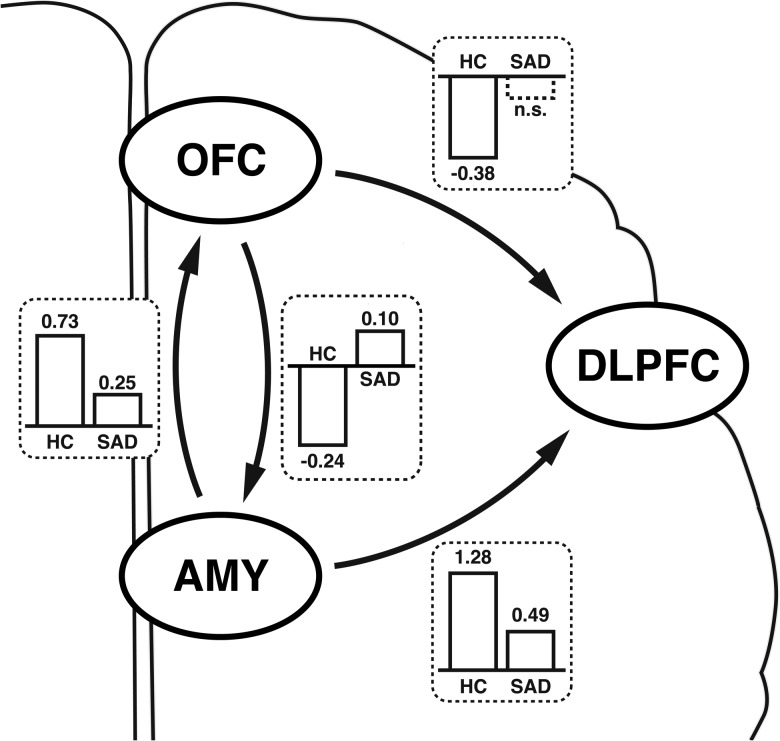
Social anxiety disorder (SAD) is characterized by over-reactivity of fear-related circuits in social or performance situations and associated with marked social impairment. We used dynamic causal modeling (DCM), a method to evaluate effective connectivity, to test our hypothesis that SAD patients would exhibit dysfunctions in the amygdala-prefrontal emotion regulation network. Thirteen unmedicated SAD patients and 13 matched healthy controls performed a series of facial emotion and object discrimination tasks while undergoing fMRI. The emotion-processing network was identified by a task-related contrast and motivated the selection of the right amygdala, OFC, and DLPFC for DCM analysis. Bayesian model averaging for DCM revealed abnormal connectivity between the OFC and the amygdala in SAD patients. In healthy controls, this network represents a negative feedback loop. In patients, however, positive connectivity from OFC to amygdala was observed, indicating an excitatory connection. As we did not observe a group difference of the modulatory influence of the FACE condition on the OFC to amygdala connection, we assume a context-independent reduction of prefrontal control over amygdalar activation in SAD patients. Using DCM, it was possible to highlight not only the neuronal dysfunction of isolated brain regions, but also the dysbalance of a distributed functional network.
社交焦虑障碍(SAD)的特征是在社交或表现情境中与恐惧相关的神经回路反应过度,并伴有明显的社交功能损害。我们使用动态因果模型(DCM)(一种评估有效连接性的方法)来检验我们的假设,即社交焦虑障碍患者在杏仁核-前额叶情绪调节网络中会出现功能障碍。13名未接受药物治疗的社交焦虑障碍患者和13名匹配的健康对照在进行功能磁共振成像(fMRI)时执行了一系列面部情绪和物体辨别任务。通过与任务相关的对比确定了情绪处理网络,并促使我们选择右侧杏仁核、眶额皮质(OFC)和背外侧前额叶皮质(DLPFC)进行DCM分析。DCM的贝叶斯模型平均法显示,社交焦虑障碍患者的眶额皮质和杏仁核之间存在异常连接。在健康对照中,该网络代表一个负反馈回路。然而,在患者中,观察到从眶额皮质到杏仁核的正连接,表明存在兴奋性连接。由于我们未观察到面部条件对眶额皮质到杏仁核连接的调节影响存在组间差异,我们推测社交焦虑障碍患者中前额叶对杏仁核激活的控制在与情境无关的情况下降低。使用DCM,不仅可以突出孤立脑区的神经元功能障碍,还可以突出分布式功能网络的失衡。