Scognamiglio Paola, Chiaradia Giacomina, De Carli Gabriella, Giuliani Massimo, Mastroianni Claudio Maria, Aviani Barbacci Stefano, Buonomini Anna Rita, Grisetti Susanna, Sampaolesi Alessandro, Corpolongo Angela, Orchi Nicoletta, Puro Vincenzo, Ippolito Giuseppe, Girardi Enrico
National Institute for Infectious Diseases "L, Spallanzani" (IRCCS), Via Portuense 292, Rome 00149, Italy.
BMC Infect Dis. 2013 Oct 10;13:473. doi: 10.1186/1471-2334-13-473.
The aim of our work was to evaluate the potential impact of the European policy of testing for HIV all individuals presenting with an indicator disease, to prevent late diagnosis of HIV. We report on a retrospective analysis among individuals diagnosed with HIV to assess whether a history of certain diseases prior to HIV diagnosis was associated with the chance of presenting late for care, and to estimate the proportion of individuals presenting late who could have been diagnosed earlier if tested when the indicator disease was diagnosed.
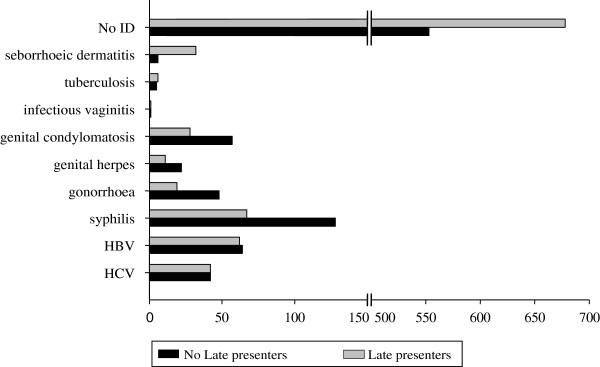
We studied a large cohort of individuals newly diagnosed with HIV infection in 13 counselling and testing sites in the Lazio Region, Italy (01/01/2004-30/04/2009). Considered indicator diseases were: viral hepatitis infection (HBV/HCV), sexually transmitted infections, seborrhoeic dermatitis and tuberculosis. Logistic regression analysis was performed to estimate association of occurrence of at least one indicator disease with late HIV diagnosis.
In our analysis, the prevalence of late HIV diagnosis was 51.3% (890/1735). Individuals reporting at least one indicator disease before HIV diagnosis (29% of the study population) had a lower risk of late diagnosis (OR = 0.7; 95%CI: 0.5-0.8) compared to those who did not report a previous indicator disease. 52/890 (5.8%) late presenters were probably already infected at the time the indicator disease was diagnosed, a median of 22.6 months before HIV diagnosis.
Our data suggest that testing for HIV following diagnosis of an indicator disease significantly decreases the probability of late HIV diagnosis. Moreover, for 5.5% of late HIV presenters, diagnosis could have been anticipated if they had been tested when an HIV indicator disease was diagnosed.However, this strategy for enhancing early HIV diagnosis needs to be complemented by client-centred interventions that aim to increase awareness in people who do not perceive themselves as being at risk for HIV.
我们工作的目的是评估欧洲对所有出现指标性疾病的个体进行HIV检测的政策对于预防HIV晚期诊断的潜在影响。我们报告了一项针对HIV确诊个体的回顾性分析,以评估HIV诊断前某些疾病史是否与延迟就医的可能性相关,并估计如果在指标性疾病诊断时进行检测,那些延迟就诊的个体中本可更早被诊断出HIV的比例。
我们研究了意大利拉齐奥地区13个咨询与检测点(2004年1月1日至2009年4月30日)新确诊HIV感染的一大群个体。所考虑的指标性疾病包括:病毒性肝炎感染(HBV/HCV)、性传播感染、脂溢性皮炎和结核病。进行逻辑回归分析以估计至少一种指标性疾病的发生与HIV晚期诊断之间的关联。
在我们的分析中,HIV晚期诊断的患病率为51.3%(890/1735)。与未报告先前指标性疾病的个体相比,在HIV诊断前报告至少一种指标性疾病的个体(占研究人群的29%)晚期诊断风险较低(OR = 0.7;95%CI:0.5 - 0.8)。890名延迟就诊者中有52名(5.8%)在指标性疾病诊断时可能已感染HIV,这发生在HIV诊断前中位数22.6个月。
我们的数据表明,在指标性疾病诊断后进行HIV检测可显著降低HIV晚期诊断的概率。此外,对于5.5%的HIV延迟就诊者,如果在HIV指标性疾病诊断时进行检测,本可更早做出诊断。然而,这种加强HIV早期诊断的策略需要辅以以客户为中心的干预措施,旨在提高那些未意识到自己有HIV感染风险的人群的认识。