
禁食状态下,人类女性血浆中内脂素浓度与脂肪摄入量相关。
Fasting plasma adropin concentrations correlate with fat consumption in human females.
作者信息
St-Onge Marie-Pierre, Shechter Ari, Shlisky Julie, Tam Charmaine S, Gao Su, Ravussin Eric, Butler Andrew A
机构信息
New York Obesity Nutrition Research Center, St. Luke's/Roosevelt Hospital and College of Physicians and Surgeons, Columbia University, New York, 10025, USA.
出版信息
Obesity (Silver Spring). 2014 Apr;22(4):1056-63. doi: 10.1002/oby.20631. Epub 2013 Oct 17.
OBJECTIVE
This study investigated whether plasma adropin concentrations are influenced by sleep restriction and correlate with dietary preferences.
METHODS
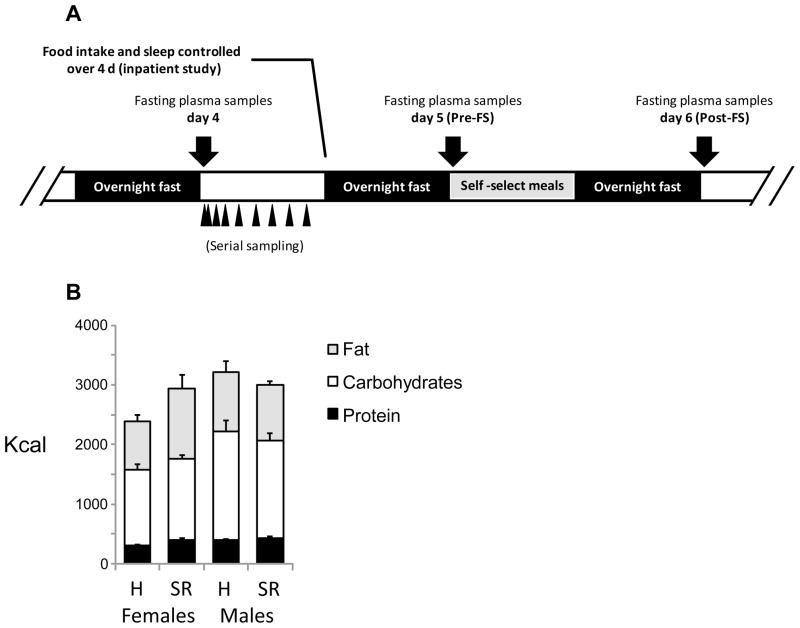
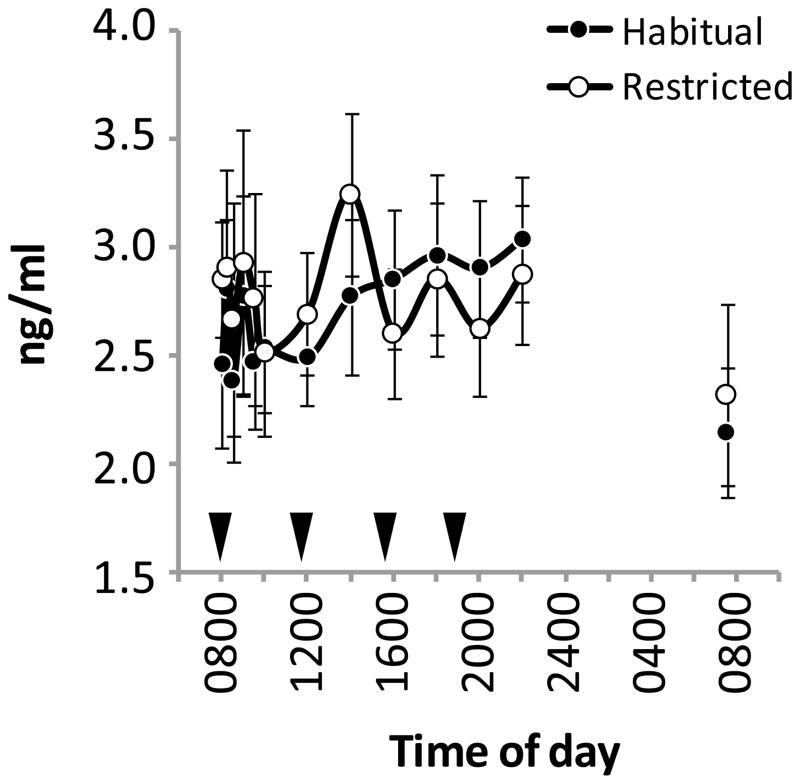
Plasma adropin concentrations were measured by ELISA using samples from a study that investigated feeding behavior in sleep deprived lean (body mass index 22-26 kg/m(2) ) men and women aged 30-45 y. Sleep (habitual or restricted to 4h/night) and diet were controlled during a 4-day inpatient period. On day 5, food was self-selected (FS). Adropin was measured on day 4 in samples collected throughout the day, and then after an overnight fast at 0730 on days 5 (Pre-FS) and 6 (Post-FS).
RESULTS
Plasma adropin concentrations were not affected by sleep restriction. However, circulating adropin concentrations correlated with food selection preferences in women, irrespective of sleep status. Pre-FS adropin correlated positively with fat intake (total fat, r = 0.867, P < 0.05; saturated fat, r = 0.959, P < 0.01) and negatively with carbohydrate intake (r = -0.894, P < 0.05) as a percent total energy. Post-FS adropin correlated with total (r = 0.797, P < 0.05) and saturated fat intake (r = 0.945, P < 0.01), and negative with total carbohydrate intake (r = -0.929, P < 0.01). Pre-FS adropin also correlated with fat intake in kcal adjusted for body size (total fat, r = 0.852, P < 0.05; saturated fat, r = 0.927, P < 0.01).
CONCLUSIONS
Plasma adropin concentrations correlate with fat consumption in women.
目的
本研究调查了血浆中内脂素浓度是否受睡眠限制影响,以及是否与饮食偏好相关。
方法
采用酶联免疫吸附测定法(ELISA)测量血浆内脂素浓度,样本来自一项研究,该研究调查了30至45岁体重正常(体重指数22 - 26kg/m²)的睡眠剥夺男女的进食行为。在为期4天的住院期间,对睡眠(习惯睡眠或限制为每晚4小时)和饮食进行控制。在第5天,食物为自选(FS)。在第4天,对全天采集的样本测量内脂素,然后在第5天(FS前)和第6天(FS后)07:30空腹过夜后再次测量。
结果
血浆内脂素浓度不受睡眠限制的影响。然而,无论睡眠状态如何,女性循环内脂素浓度与食物选择偏好相关。FS前内脂素与脂肪摄入量呈正相关(总脂肪,r = 0.867,P < 0.05;饱和脂肪,r = 0.959,P < 0.01),与碳水化合物摄入量占总能量的百分比呈负相关(r = -0.894,P < 0.05)。FS后内脂素与总脂肪(r = 0.797,P < 0.05)和饱和脂肪摄入量(r = 0.945,P < 0.01)呈正相关,与总碳水化合物摄入量呈负相关(r = -0.929,P < 0.01)。FS前内脂素还与根据体型调整后的千卡脂肪摄入量相关(总脂肪,r = 0.852,P < 0.05;饱和脂肪,r = 0.927,P < 0.01)。
结论
女性血浆内脂素浓度与脂肪消耗相关。



 Zotero 插件