Kim Yoon-Seong, Joh Tong H
Burnett School of Biomedical Sciences, College of Medicine, University of Central Florida, Orlando, FL, 32827.
Biomol Ther (Seoul). 2012 Mar;20(2):133-43. doi: 10.4062/biomolther.2012.20.2.133.
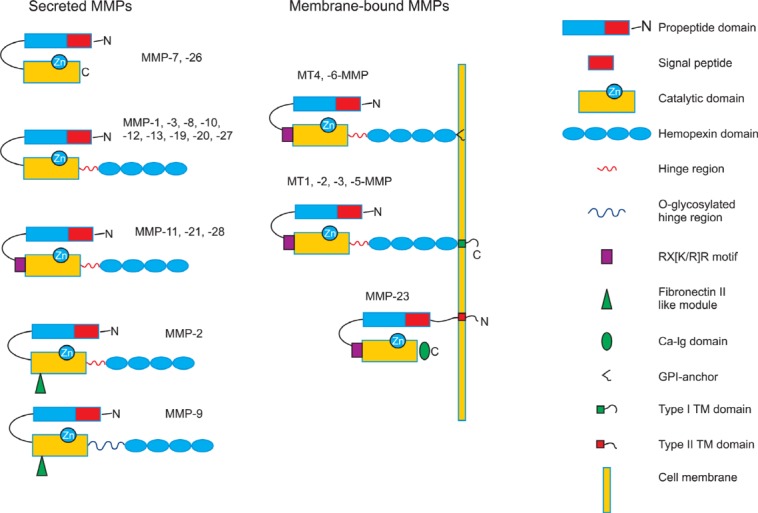
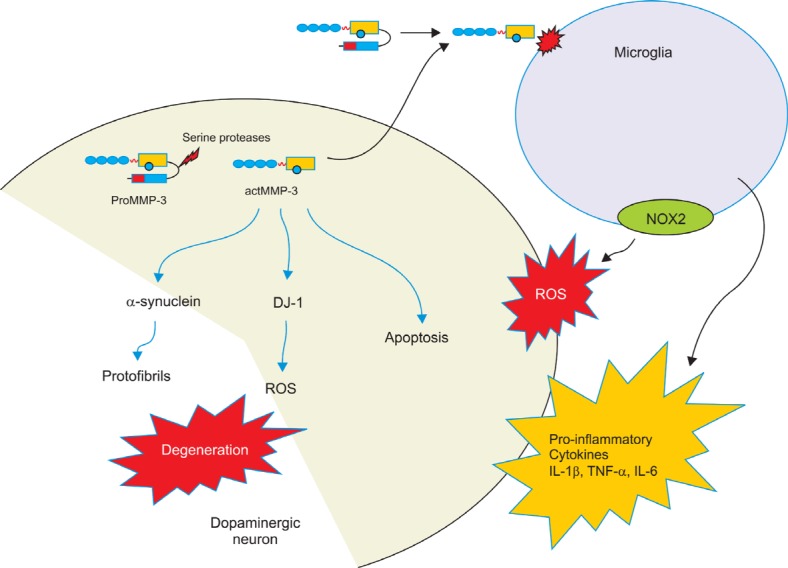
Matrix metalloproteinases (MMPs) are a subfamily of zinc-dependent proteases that are responsible for degradation and remodeling of extracellular matrix proteins. The activity of MMPs is tightly regulated at several levels including cleavage of prodomain, allosteric activation, compartmentalization and complex formation with tissue inhibitor of metalloproteinases (TIMPs). In the central nervous system (CNS), MMPs play a wide variety of roles ranging from brain development, synaptic plasticity and repair after injury to the pathogenesis of various brain disorders. Following general discussion on the domain structure and the regulation of activity of MMPs, we emphasize their implication in various brain disorder conditions such as Alzheimer's disease, multiple sclerosis, ischemia/reperfusion and Parkinson's disease. We further highlight accumulating evidence that MMPs might be the culprit in Parkinson's disease (PD). Among them, MMP-3 appears to be involved in a range of pathogenesis processes in PD including neuroinflammation, apoptosis and degradation of α-synuclein and DJ-1. MMP inhibitors could represent potential novel therapeutic strategies for treatments of neurodegenerative diseases.
基质金属蛋白酶(MMPs)是锌依赖性蛋白酶的一个亚家族,负责细胞外基质蛋白的降解和重塑。MMPs的活性在多个水平上受到严格调控,包括前结构域的切割、变构激活、区室化以及与金属蛋白酶组织抑制剂(TIMPs)形成复合物。在中枢神经系统(CNS)中,MMPs发挥着广泛的作用,从大脑发育、突触可塑性和损伤后的修复到各种脑部疾病的发病机制。在对MMPs的结构域结构和活性调节进行一般性讨论之后,我们强调它们在各种脑部疾病状况中的作用,如阿尔茨海默病、多发性硬化症、缺血/再灌注和帕金森病。我们进一步强调越来越多的证据表明MMPs可能是帕金森病(PD)的罪魁祸首。其中,MMP-3似乎参与了PD的一系列发病过程,包括神经炎症、细胞凋亡以及α-突触核蛋白和DJ-1的降解。MMP抑制剂可能代表了治疗神经退行性疾病的潜在新治疗策略。