Lambertsen L M, Ingels H, Schønheyder H C, Hoffmann S
National Neisseria and Streptococcus Reference (NSR), Statens Serum Institut, Copenhagen, Denmark.
Clin Microbiol Infect. 2014 Apr;20(4):O216-23. doi: 10.1111/1469-0691.12378. Epub 2013 Oct 29.
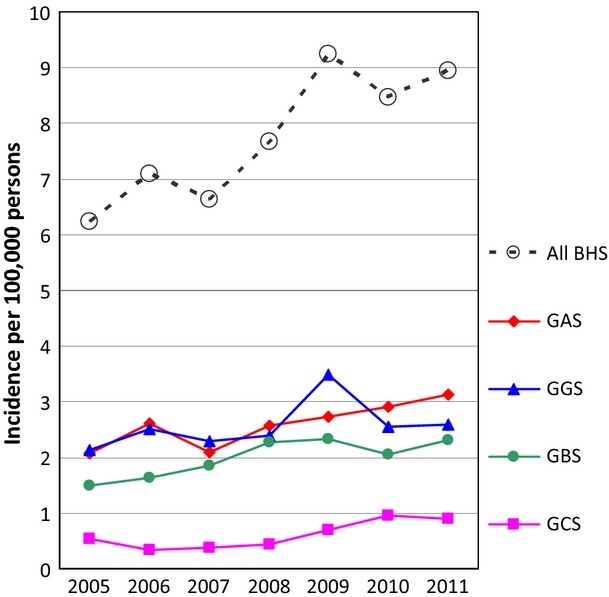
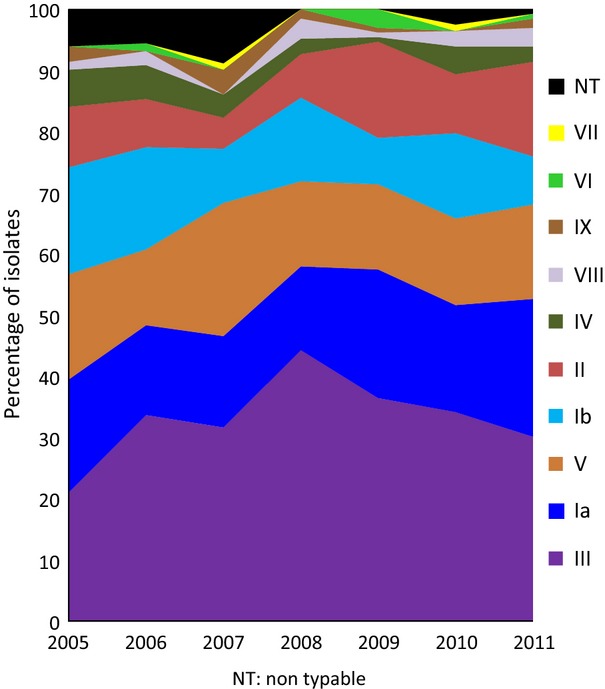
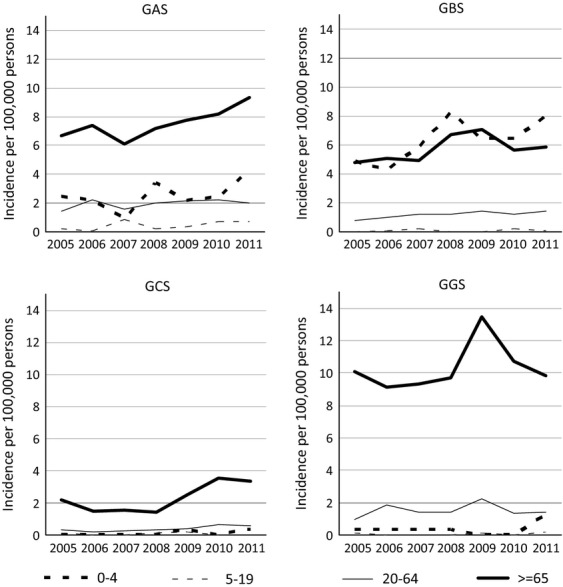
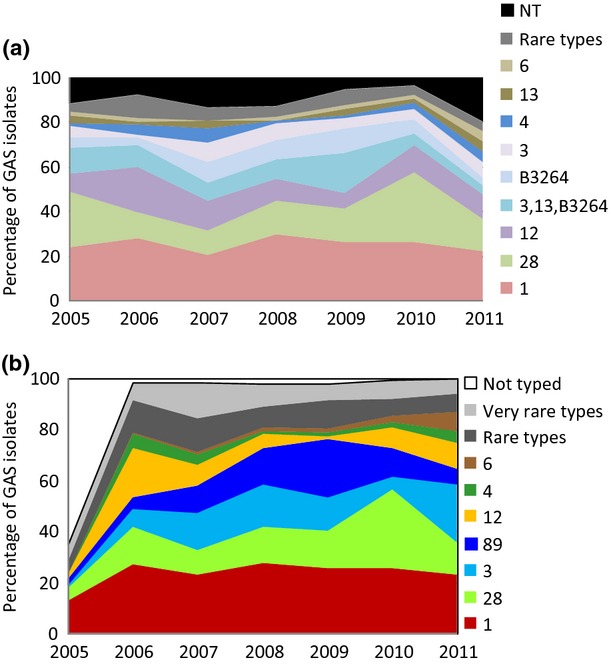
The aim of this work was to describe national surveillance of invasive beta-haemolytic streptococci (BHS) in Denmark and to report overall trends and major findings by groups and types of BHS causing laboratory-confirmed disease from 2005 to 2011. A total of 3063 BHS isolates were received from 2872 patients. Based on confirmed cases the overall annual incidence increased from 6.2 to 8.9 per 100 000 persons between 2005 and 2011. In 2011 the incidences of group A, B, C and G streptococci were 3.1, 2.3, 0.9 and 2.6 per 100 000 persons, respectively. An increase was observed for all groups of BHS, but in particular for group G in men above 65 years of age. Among group A streptococci (GAS), five T-types (1, 28,12, 3,13,B3264 and B3264) represented 71% and five emm-types (1, 28, 3, 89 and 12) 76% of all isolates. Among group B streptococci (GBS) four types (III, Ia, V, Ib) represented 79% of the isolates. Potential coverage for future vaccines against GAS and GBS disease was 76% compared with the 26-valent GAS vaccine and 89% based on GBS serotypes Ia, Ib, II, III and V. The number of reported cases of invasive BHS disease increased in Denmark from 2005 to 2011. Nationwide laboratory-based surveillance of BHS is required to monitor epidemiological changes, explore potential outbreaks and determine potential vaccine coverage.
这项工作的目的是描述丹麦对侵袭性β溶血性链球菌(BHS)的国家监测情况,并报告2005年至2011年期间导致实验室确诊疾病的BHS各群组和类型的总体趋势及主要发现。共从2872名患者中获得了3063株BHS分离株。基于确诊病例,2005年至2011年期间总体年发病率从每10万人6.2例增至8.9例。2011年,A、B、C和G组链球菌的发病率分别为每10万人3.1例、2.3例、0.9例和2.6例。所有BHS群组的发病率均有所上升,尤其是65岁以上男性中的G组链球菌。在A组链球菌(GAS)中,5种T型(1、28、12、3、13、B3264和B3264)占所有分离株的71%,5种emm型(1、28、3、89和12)占76%。在B组链球菌(GBS)中,4种类型(III、Ia、V、Ib)占分离株的79%。与26价GAS疫苗相比,未来针对GAS和GBS疾病疫苗的潜在覆盖率为76%,基于GBS血清型Ia、Ib、II、III和V的覆盖率为89%。2005年至2011年期间,丹麦侵袭性BHS疾病的报告病例数有所增加。需要在全国范围内基于实验室对BHS进行监测,以监测流行病学变化、探索潜在疫情并确定潜在疫苗覆盖率。