
基于分层多传感器的日常生活活动分类:使用基准数据集与最先进算法的比较。
Hierarchical, multi-sensor based classification of daily life activities: comparison with state-of-the-art algorithms using a benchmark dataset.
机构信息
Digital Sports Group, Pattern Recognition Lab, Department of Computer Science, Friedrich-Alexander-University Erlangen-Nuremberg, Germany.
出版信息
PLoS One. 2013 Oct 9;8(10):e75196. doi: 10.1371/journal.pone.0075196. eCollection 2013.
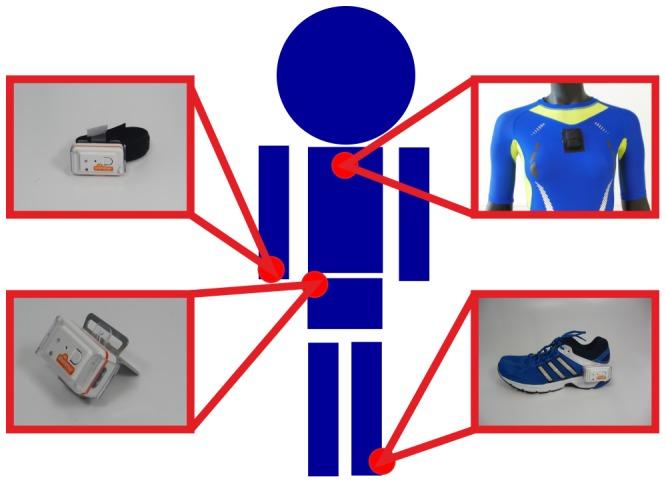
Insufficient physical activity is the 4th leading risk factor for mortality. Methods for assessing the individual daily life activity (DLA) are of major interest in order to monitor the current health status and to provide feedback about the individual quality of life. The conventional assessment of DLAs with self-reports induces problems like reliability, validity, and sensitivity. The assessment of DLAs with small and light-weight wearable sensors (e.g. inertial measurement units) provides a reliable and objective method. State-of-the-art human physical activity classification systems differ in e.g. the number and kind of sensors, the performed activities, and the sampling rate. Hence, it is difficult to compare newly proposed classification algorithms to existing approaches in literature and no commonly used dataset exists. We generated a publicly available benchmark dataset for the classification of DLAs. Inertial data were recorded with four sensor nodes, each consisting of a triaxial accelerometer and a triaxial gyroscope, placed on wrist, hip, chest, and ankle. Further, we developed a novel, hierarchical, multi-sensor based classification system for the distinction of a large set of DLAs. Our hierarchical classification system reached an overall mean classification rate of 89.6% and was diligently compared to existing state-of-the-art algorithms using our benchmark dataset. For future research, the dataset can be used in the evaluation process of new classification algorithms and could speed up the process of getting the best performing and most appropriate DLA classification system.
身体活动不足是导致死亡的第四大风险因素。为了监测当前的健康状况并提供关于个人生活质量的反馈,评估个体日常活动(DLA)的方法引起了人们的极大兴趣。使用自我报告来评估 DLA 会引起可靠性、有效性和敏感性等问题。使用小型轻便的可穿戴传感器(例如惯性测量单元)来评估 DLA 提供了一种可靠和客观的方法。最先进的人体活动分类系统在传感器的数量和种类、进行的活动和采样率等方面存在差异。因此,很难将新提出的分类算法与文献中的现有方法进行比较,也没有通用的数据集。我们生成了一个用于 DLA 分类的公共可用基准数据集。惯性数据使用四个传感器节点记录,每个节点由一个三轴加速度计和一个三轴陀螺仪组成,分别放置在手腕、臀部、胸部和脚踝上。此外,我们开发了一种新颖的、基于分层和多传感器的分类系统,用于区分大量的 DLA。我们的分层分类系统总体平均分类率达到 89.6%,并使用我们的基准数据集对现有的最先进算法进行了仔细比较。对于未来的研究,该数据集可用于评估新分类算法的过程,并加速获得最佳性能和最合适的 DLA 分类系统的过程。



 Zotero 插件