Stein Markus, Ruggiero Paolo, Rappuoli Rino, Bagnoli Fabio
Albany College of Pharmacy and Health Sciences , Albany, NY , USA.
Front Immunol. 2013 Oct 15;4:328. doi: 10.3389/fimmu.2013.00328.
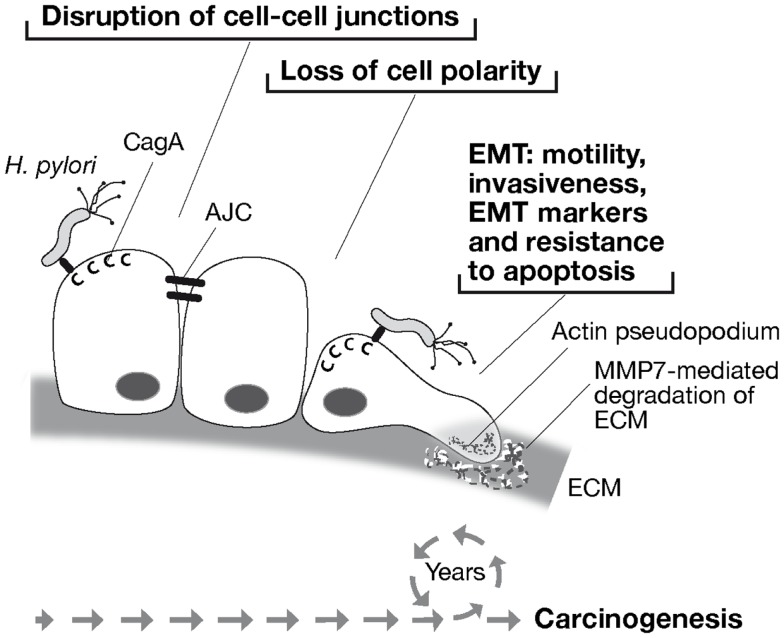
Helicobacter pylori colonizes the gastric mucosa of more than 50% of the human population, causing chronic inflammation, which however is largely asymptomatic. Nevertheless, H. pylori-infected subjects can develop chronic gastritis, peptic ulcer, gastric mucosa-associated lymphoid tissue lymphoma, and gastric cancer. Chronic exposure to the pathogen and its ability to induce epithelial to mesenchymal transition (EMT) through the injection of cytotoxin-associated gene A into gastric epithelial cells may be key triggers of carcinogenesis. By deregulating cell-cell and cell-matrix interactions as well as DNA methylation, histone modifications, expression of micro RNAs, and resistance to apoptosis, EMT can actively contribute to early stages of the cancer formation. Host response to the infection significantly contributes to disease development and the concomitance of particular genotypes of both pathogen and host may turn into the most severe outcomes. T regulatory cells (Treg) have been recently demonstrated to play an important role in H. pylori-related disease development and at the same time the Treg-induced tolerance has been proposed as a possible mechanism that leads to less severe disease. Efficacy of antibiotic therapies of H. pylori infection has significantly dropped. Unfortunately, no vaccine against H. pylori is currently licensed, and protective immunity mechanisms against H. pylori are only partially understood. In spite of promising results obtained in animal models of infection with a number of vaccine candidates, few clinical trials have been conducted so far and with no satisfactory outcomes. However, prophylactic vaccination may be the only means to efficiently prevent H. pylori-associated cancers.
幽门螺杆菌定植于超过50%的人类胃黏膜中,引发慢性炎症,但在很大程度上并无症状。然而,幽门螺杆菌感染的个体可能会发展为慢性胃炎、消化性溃疡、胃黏膜相关淋巴组织淋巴瘤和胃癌。长期接触该病原体及其通过将细胞毒素相关基因A注入胃上皮细胞诱导上皮-间质转化(EMT)的能力可能是致癌的关键触发因素。通过解除细胞间和细胞与基质相互作用以及DNA甲基化、组蛋白修饰、微小RNA表达和对细胞凋亡的抗性的调控,EMT可积极促成癌症形成的早期阶段。宿主对感染的反应对疾病发展有显著影响,病原体和宿主特定基因型的同时存在可能导致最严重的后果。最近已证明调节性T细胞(Treg)在幽门螺杆菌相关疾病发展中起重要作用,同时Treg诱导的耐受性被认为是导致病情较轻的一种可能机制。幽门螺杆菌感染的抗生素治疗效果已显著下降。不幸的是,目前尚无针对幽门螺杆菌的疫苗获得许可,针对幽门螺杆菌的保护性免疫机制也仅得到部分了解。尽管在多种候选疫苗感染动物模型中取得了有前景的结果,但迄今为止仅进行了很少的临床试验且结果并不理想。然而,预防性疫苗接种可能是有效预防幽门螺杆菌相关癌症的唯一手段。