UR2NF - Neuropsychology and Functional Neuroimaging Research Unit at CRCN - Center for Research in Cognition and Neurosciences, Université Libre de Bruxelles Brussels, Belgium ; UNI - ULB Neurosciences Institute, Université Libre de Bruxelles Brussels, Belgium.
Front Psychol. 2013 Oct 16;4:750. doi: 10.3389/fpsyg.2013.00750. eCollection 2013.
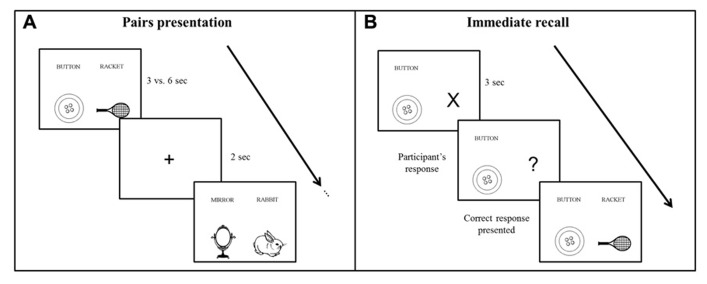
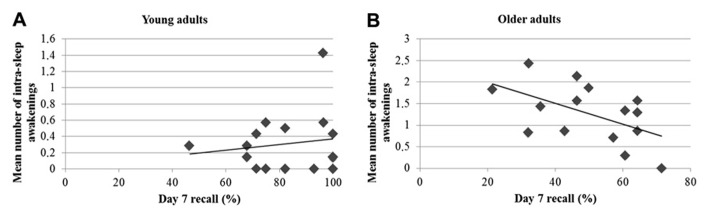
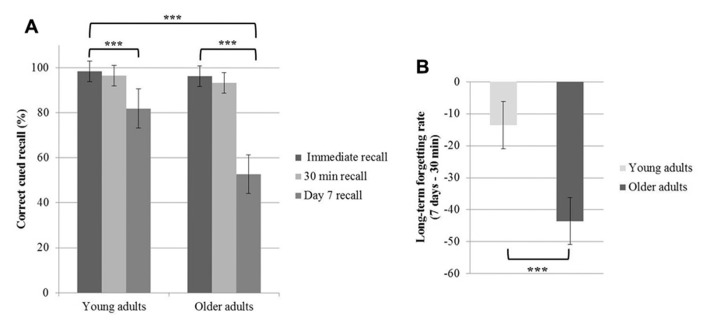
The architecture of sleep and the functional neuroanatomical networks subtending memory consolidation processes are both modified with aging, possibly leading to accelerated forgetting in long-term memory. We investigated associative learning and declarative memory consolidation processes in 16 young (18-30 years) and 16 older (65-75 years) healthy adults. Performance was tested using a cued recall procedure at the end of learning (immediate recall), and 30 min and 7 days later. A delayed recognition test was also administered on day 7. Daily sleep diaries were completed during the entire experiment. Results revealed a similar percentage of correct responses at immediate and 30-min recall in young and older participants. However, recall was significantly decreased 7 days later, with an increased forgetting in older participants. Additionally, intra-sleep awakenings were more frequent in older participants than young adults during the seven nights, and were negatively correlated with delayed recall performance on day 7 in the older group. Altogether, our results suggest a decline in verbal declarative memory consolidation processes with aging, eventually leading to accelerated long-term forgetting indicating that increased sleep fragmentation due to more frequent intra-sleep awakenings in older participants contribute to the reported age-related decline in long-term memory retrieval. Our results highlight the sensitivity of long-term forgetting measures to evidence consolidation deficits in healthy aging.
睡眠的结构以及支持记忆巩固过程的功能神经解剖学网络都随着年龄的增长而发生变化,这可能导致长期记忆中的遗忘加速。我们研究了 16 名年轻(18-30 岁)和 16 名年长(65-75 岁)健康成年人的联想学习和陈述性记忆巩固过程。在学习结束时(即时回忆)、30 分钟后和 7 天后使用提示回忆程序进行了测试。在第 7 天还进行了延迟识别测试。在整个实验过程中,参与者每天都填写睡眠日记。结果显示,年轻和年长参与者在即时和 30 分钟回忆时的正确反应百分比相似。然而,7 天后的回忆明显下降,年长参与者的遗忘增加。此外,在七晚的时间里,年长参与者比年轻成年人更容易在睡眠中醒来,并且在年长组中,这种睡眠中醒来的次数与第 7 天的延迟回忆表现呈负相关。总之,我们的结果表明,随着年龄的增长,言语陈述性记忆巩固过程会下降,最终导致长期遗忘加速,这表明由于年长参与者睡眠中醒来更频繁而导致的睡眠碎片化增加,可能导致了报告中的与年龄相关的长期记忆检索下降。我们的研究结果突出了长期遗忘测量对健康衰老中记忆巩固缺陷的敏感性。