Sreenivasan Vidhyapriya, Aslakson Emily, Kornaus Andrew, Thibos Larry N
*BS(Opt), PhD, FAAO †BA ‡BS §MS, PhD, FAAO School of Optometry, Indiana University, Bloomington, Indiana.
Optom Vis Sci. 2013 Nov;90(11):1292-303. doi: 10.1097/OPX.0000000000000068.
Reduced retinal image contrast produced by accommodative lag is implicated with myopia development. Here, we measure accommodative error and retinal image quality from wavefront aberrations in myopes and emmetropes when they perform visually demanding and naturalistic tasks.
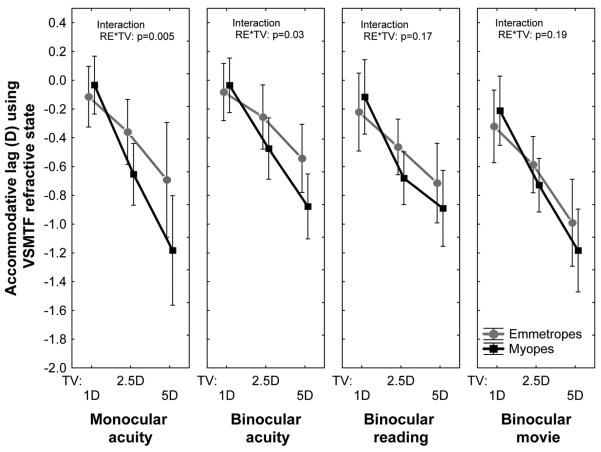
Wavefront aberrations were measured in 10 emmetropic and 11 myopic adults at three distances (100, 40, and 20 cm) while performing four tasks (monocular acuity, binocular acuity, reading, and movie watching). For the acuity tasks, measurements of wavefront error were obtained near the end point of the acuity experiment. Refractive state was defined as the target vergence that optimizes image quality using a visual contrast metric (VSMTF) computed from wavefront errors.
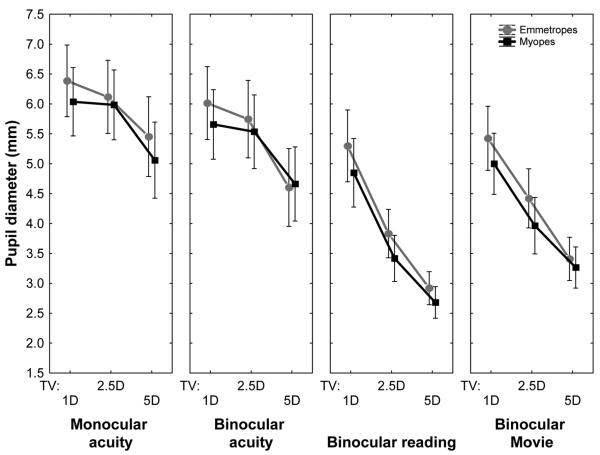
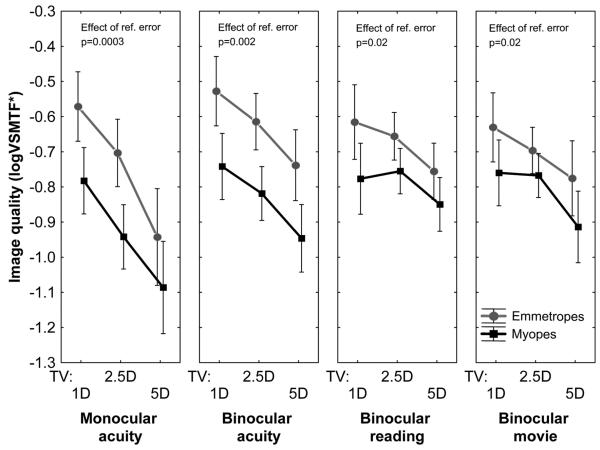
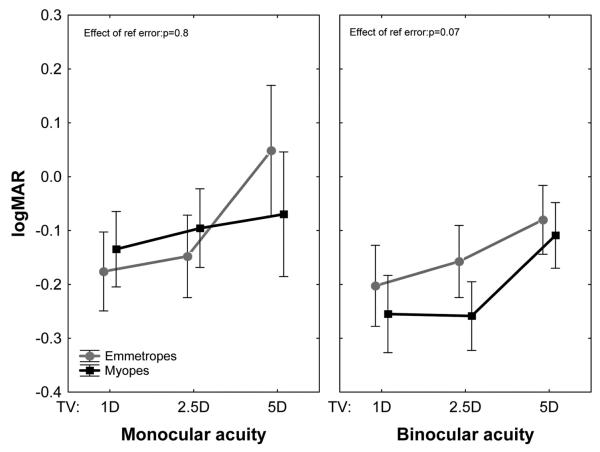
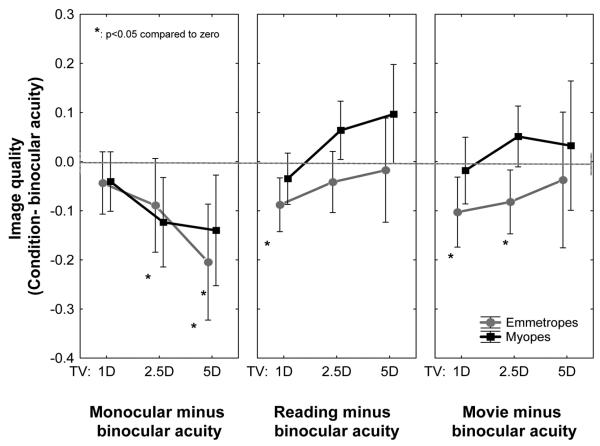
Accommodation was most accurate (and image quality best) during binocular acuity whereas accommodation was least accurate (and image quality worst) while watching a movie. When viewing distance was reduced, accommodative lag increased and image quality (as quantified by VSMTF) declined for all tasks in both refractive groups. For any given viewing distance, computed image quality was consistently worse in myopes than in emmetropes, more so for the acuity than for reading/movie watching. Although myopes showed greater lags and worse image quality for the acuity experiments compared to emmetropes, acuity was not measurably worse in myopes compared to emmetropes.
Retinal image quality present when performing a visually demanding task (e.g., during clinical examination) is likely to be greater than for less demanding tasks (e.g., reading/movie watching). Although reductions in image quality lead to reductions in acuity, the image quality metric VSMTF is not necessarily an absolute indicator of visual performance because myopes achieved slightly better acuity than emmetropes despite showing greater lags and worse image quality. Reduced visual contrast in myopes compared to emmetropes is consistent with theories of myopia progression that point to image contrast as an inhibitory signal for ocular growth.
调节滞后产生的视网膜图像对比度降低与近视发展有关。在此,我们测量近视者和正视者在执行视觉要求较高的自然任务时,由波前像差得出的调节误差和视网膜图像质量。
对10名正视和11名近视成年人在三个距离(100、40和20厘米)执行四项任务(单眼视力、双眼视力、阅读和观看电影)时的波前像差进行测量。对于视力任务,在视力实验终点附近获取波前误差测量值。屈光状态定义为使用根据波前误差计算的视觉对比度指标(VSMTF)优化图像质量的目标聚散度。
在双眼视力检查期间,调节最准确(图像质量最佳),而观看电影时调节最不准确(图像质量最差)。当观看距离减小时,两个屈光组中所有任务的调节滞后均增加,图像质量(由VSMTF量化)下降。对于任何给定的观看距离,近视者计算出的图像质量始终比正视者差,视力任务比阅读/观看电影时更差。尽管与正视者相比,近视者在视力实验中表现出更大的滞后和更差的图像质量,但近视者的视力与正视者相比并无明显差异。
执行视觉要求较高的任务(如临床检查期间)时的视网膜图像质量可能高于要求较低的任务(如阅读/观看电影)。尽管图像质量下降会导致视力下降,但图像质量指标VSMTF不一定是视觉表现的绝对指标,因为尽管近视者表现出更大的滞后和更差的图像质量,但他们的视力略好于正视者。与正视者相比,近视者视觉对比度降低与近视进展理论一致,该理论指出图像对比度是眼部生长的抑制信号。