Department of Microbiology and Immunology, Albert Einstein College of Medicine 1300 Morris Park Avenue, Bronx, New York, 10461.
Cancer Med. 2013 Aug;2(4):571-82. doi: 10.1002/cam4.94. Epub 2013 Jul 2.
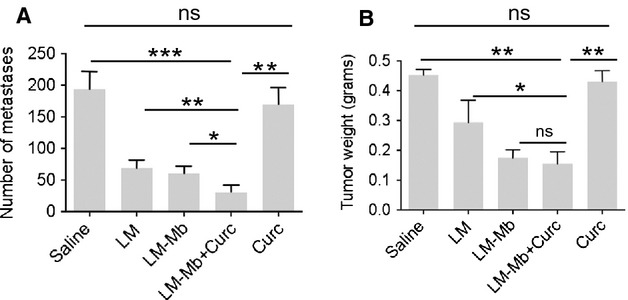
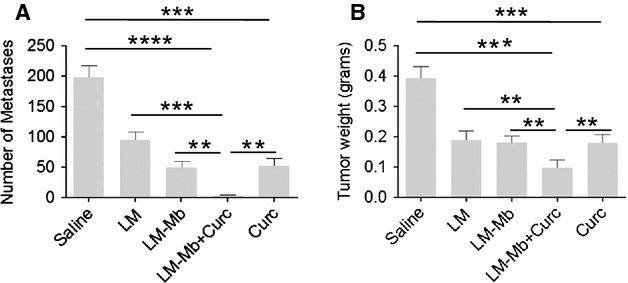
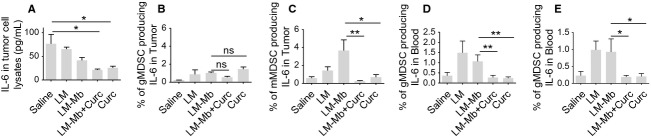
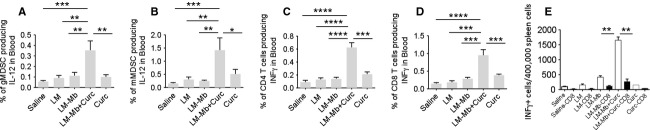
Success of cancer vaccination is strongly hampered by immune suppression in the tumor microenvironment (TME). Interleukin (IL)-6 is particularly and highly produced by triple-negative breast cancer (TNBC) cells, and has been considered as an important contributor to immune suppression in the TME. Therefore, we hypothesized that IL-6 reduction may improve efficacy of vaccination against TNBC cancer through improved T-cell responses. To prove this hypothesis, we investigated the effect of curcumin, an inhibitor of IL-6 production, on vaccination of a highly attenuated Listeria monocytogenes (Listeria(at)), encoding tumor-associated antigens (TAA) Mage-b in a TNBC model 4T1. Two therapeutic vaccination strategies with Listeria(at)-Mage-b and curcumin were tested. The first immunization strategy involved all Listeria(at)-Mage-b vaccinations and curcumin after tumor development. As curcumin has been consumed all over the world, the second immunization strategy involved curcumin before and all therapeutic vaccinations with Listeria(at)-Mage-b after tumor development. Here, we demonstrate that curcumin significantly improves therapeutic efficacy of Listeria(at)-Mage-b with both immunization strategies particularly against metastases in a TNBC model (4T1). The combination therapy was slightly but significantly more effective against the metastases when curcumin was administered before compared to after tumor development. With curcumin before tumor development in the combination therapy, the production of IL-6 was significantly decreased and IL-12 increased by myeloid-derived suppressor cells (MDSC), in correlation with improved CD4 and CD8 T-cell responses in blood. Our study suggests that curcumin improves the efficacy of Listeria(at)-Mage-b vaccine against metastases in TNBC model 4T1 through reversal of tumor-induced immune suppression.
癌症疫苗的成功受到肿瘤微环境(TME)中免疫抑制的严重阻碍。白细胞介素(IL)-6 特别且高度由三阴性乳腺癌(TNBC)细胞产生,并且被认为是 TME 中免疫抑制的重要贡献者。因此,我们假设通过改善 T 细胞反应,IL-6 减少可能会提高针对 TNBC 癌症的疫苗接种效果。为了证明这一假设,我们研究了姜黄素(IL-6 产生的抑制剂)对在 TNBC 模型 4T1 中编码肿瘤相关抗原(TAA)Mage-b 的高度衰减李斯特菌(Listeria(at))疫苗接种的影响。我们测试了两种用李斯特菌(Listeria(at)-Mage-b 和姜黄素治疗的疫苗接种策略。第一种免疫策略涉及所有李斯特菌(Listeria(at)-Mage-b)疫苗接种和肿瘤发展后的姜黄素。由于姜黄素已在全球范围内使用,第二种免疫策略涉及肿瘤发展前的姜黄素和所有李斯特菌(Listeria(at)-Mage-b 治疗性疫苗接种。在这里,我们证明姜黄素可显著改善李斯特菌(Listeria(at)-Mage-b 的治疗效果,两种免疫策略均特别针对 TNBC 模型(4T1)中的转移。与肿瘤发展后相比,当在肿瘤发展前用姜黄素治疗时,组合疗法对转移的效果略有但显著提高。在组合疗法中,在肿瘤发展前用姜黄素治疗时,髓样来源的抑制细胞(MDSC)中 IL-6 的产生显著减少,IL-12 增加,与血液中 CD4 和 CD8 T 细胞反应的改善相关。我们的研究表明,姜黄素通过逆转肿瘤诱导的免疫抑制,提高李斯特菌(Listeria(at)-Mage-b 疫苗对 TNBC 模型 4T1 转移的疗效。